
Why Oil Powders Fail: It’s Not the Oil — It’s the Carrier System
When an oil powder performs poorly, the first instinct is often to blame the oil itself.
The oxidation level may be questioned. The oil load may be blamed. The active content may come under scrutiny.
But in many cases, the real problem is not the oil.
It is the carrier system.
A well-designed oil powder depends on much more than simply combining oil with a dry ingredient. The carrier has a major influence on powder structure, handling, dispersibility, stability, and ultimately how the powder performs in the customer’s finished product.
The carrier is not just a filler
In a properly engineered oil powder, the carrier performs several critical functions.
It helps convert the oil into a stable dry form.
It influences how freely the powder flows.
It affects how the powder behaves in water.
It contributes to how well the oil is distributed throughout the powder matrix.
It can also influence how the finished powder responds to humidity, storage, blending, compression, and downstream processing.
This means two powders made from the same oil can behave very differently if the carrier systems are different.
That is why oil percentage alone does not tell the whole story.
Different carriers create different performance characteristics
There is no single carrier that is ideal for every application.
Some formulations may require a neutral carrier with good flow characteristics.
Others may need a carrier that supports clean-label positioning.
Some applications may prioritize dispersibility.
Others may place greater importance on powder density, mouthfeel, processing behavior, or compatibility with other ingredients.
Common carrier options in oil powders can include:
- Maltodextrin
- Tapioca dextrin
- Gum arabic
- Modified starches
- Tapioca fiber
- Mineral-based carrier systems
Each has different physical and functional characteristics.
The correct choice depends on the oil, the desired oil loading, the finished application, and the performance requirements of the customer.
Why a carrier system can cause a powder to fail
A poorly matched carrier system can create problems even when the oil itself is perfectly acceptable.
The powder may become sticky.
It may cake during storage.
It may have poor flowability.
It may disperse unevenly.
It may produce an undesirable texture in the finished product.
It may separate or behave inconsistently during manufacturing.
In some cases, the carrier system may also limit how much oil can practically be incorporated before the powder begins losing its desirable physical characteristics.
This is why the question should not simply be:
“What percentage of oil is in the powder?”
A better question is:
“How was the carrier system designed for the intended application?”
Clean-label considerations are becoming more important
Carrier choice is also increasingly connected to label strategy.
Many brands today want fewer unfamiliar ingredients and are looking for cleaner, simpler ingredient declarations.
For that reason, ingredients such as tapioca-based carriers or fibers can be attractive in certain applications.
But clean-label positioning should never be considered in isolation.
The carrier still has to perform.
A carrier that looks good on the label but creates poor powder handling, weak dispersibility, or stability problems is not a good formulation choice.
The best system is the one that balances label expectations with technical performance.
Application comes first
Before selecting a carrier, the manufacturer should understand how the customer intends to use the powder.
Is it going into a capsule?
A tablet?
A chew?
A dry drink mix?
A protein powder?
A pet supplement?
A functional food?
A beverage system?
The same oil powder may need very different physical characteristics depending on the final application.
This is why application information matters so much during product development.
A carrier system should be selected to support the performance requirements of the final product, not simply to produce a powder that looks acceptable on a specification sheet.
The specification does not tell the whole story
Two oil powders can show the same oil content on paper and still perform very differently.
One may flow easily through production equipment.
The other may bridge or cake.
One may disperse well.
The other may float, clump, or separate.
One may remain physically stable during storage.
The other may change significantly over time.
The difference may not be the oil at all.
It may be the carrier system.
The right question to ask
When evaluating an oil powder, do not stop at:
“How much oil is in it?”
Ask:
“Was the carrier system designed for my application?”
That question often tells you far more about how the powder will actually perform.
At NPRI-O2P, we work with different carrier systems depending on the oil and the customer’s intended application, because oil powders should be developed around performance — not simply around a number on a specification sheet.
Learn more about oil-to-powder technology and formulation considerations at o2pus.com.
Need Help With Your Formulation?
Whether you’re developing a new oil powder, improving product stability, or solving formulation challenges, our technical team is ready to help. Contact us for formulation guidance, product recommendations, or sample requests.
Recommended Technical Articles
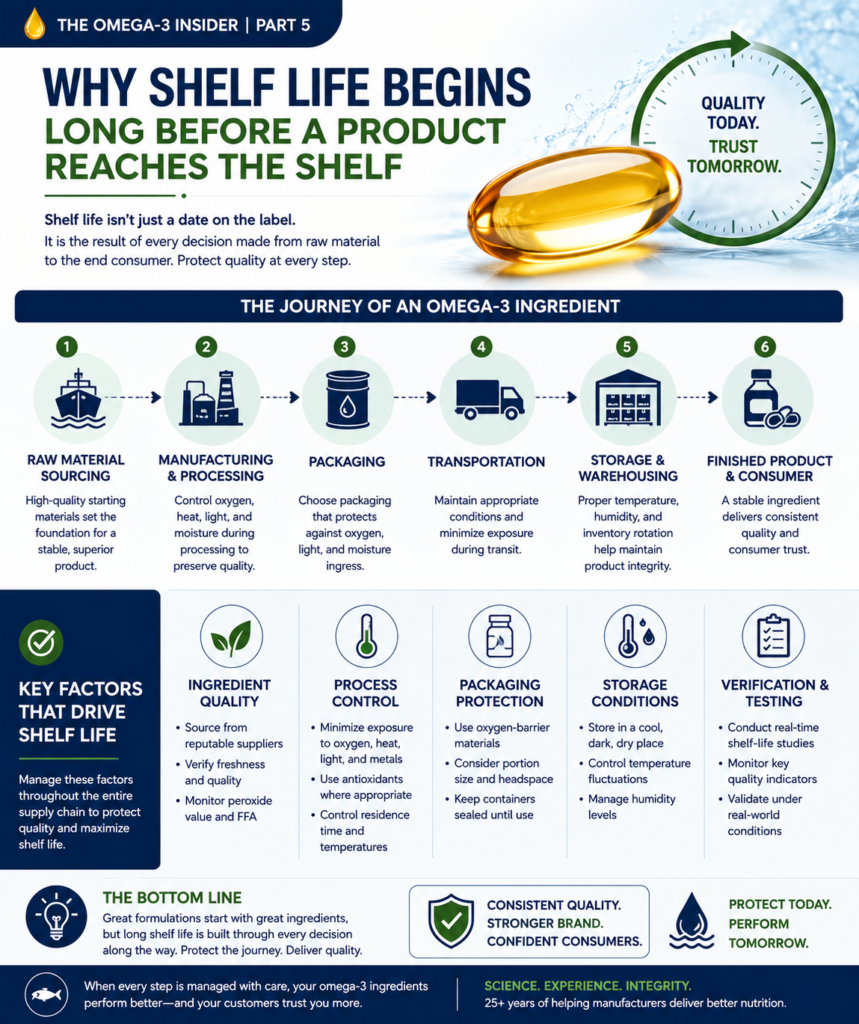
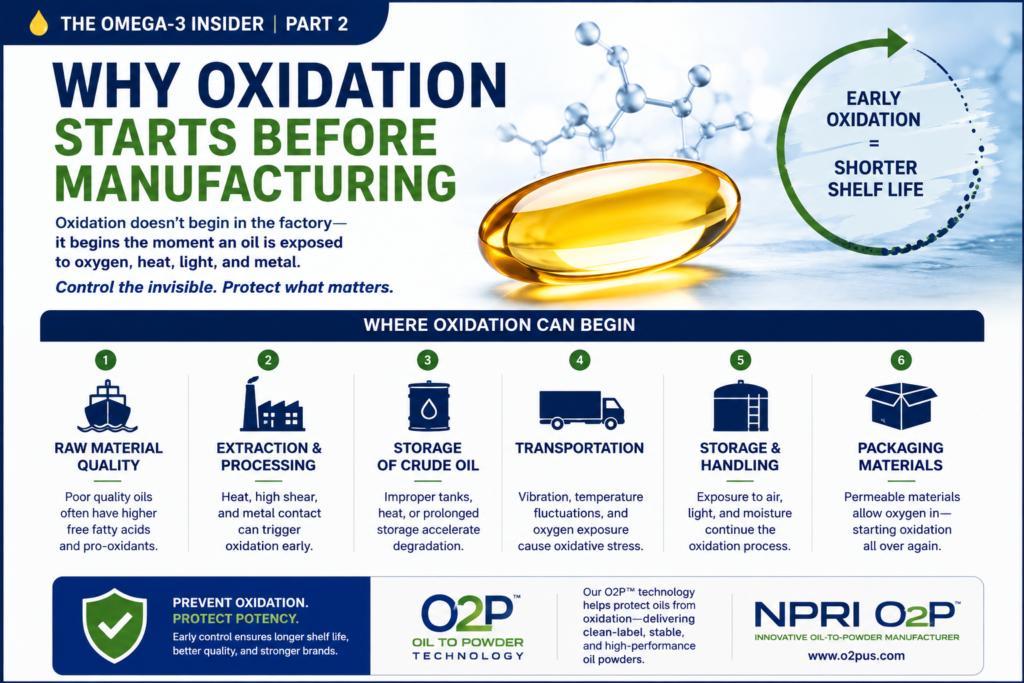
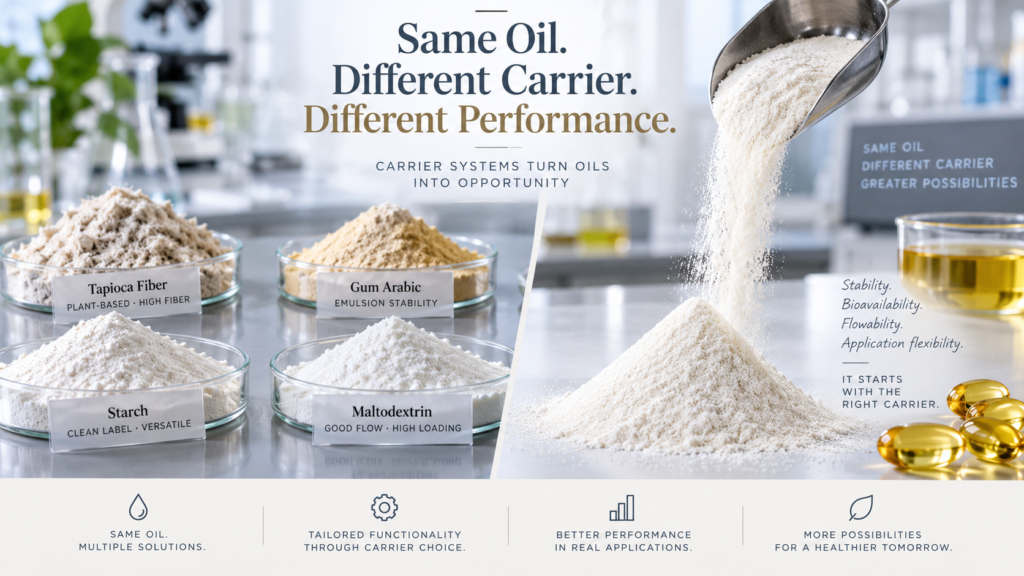
Why Shelf Life Begins Long Before a Product Reaches the Shelf
How O2P™ Technology Protects Oils from Oxidation
Shelf life begins long before a finished product reaches the consumer. Learn how raw material quality, manufacturing, packaging, storage, and transportation all contribute to product stability and long-term performance.
Oxidation begins long before oils reach the manufacturing line. Learn how raw material quality, processing, storage, transportation, and oxygen exposure can silently reduce stability, potency, and shelf life.
The carrier system can determine flowability, dispersibility, handling, storage behavior, and overall oil-powder performance. Learn why the oil itself is often not the real problem.
