
Why Bulk Density Matters in an Oil Powder
When evaluating an oil powder, buyers often focus on the obvious specifications first: oil content, active ingredient concentration, carrier system, moisture, oxidation values, or price per kilogram.
Those specifications are important.
But there is another physical characteristic that can have a major impact on how a powder behaves in actual manufacturing:
Bulk density.
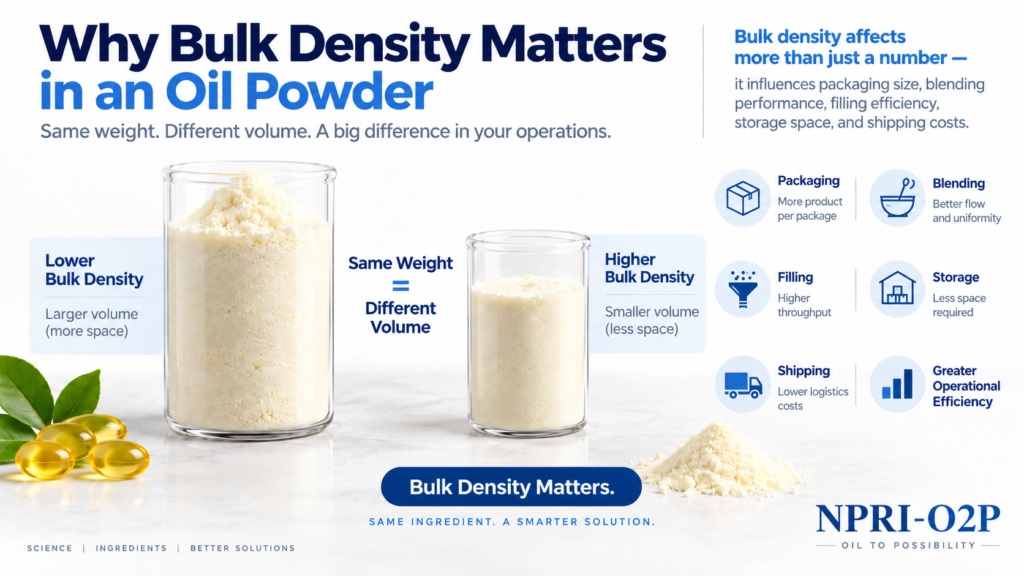
Bulk density affects how much space a powder occupies, how it flows through equipment, how it fills containers, how it blends with other ingredients, and how efficiently it can be packaged, stored, and transported.
Two oil powders can have similar chemical specifications and still behave very differently on the production floor because their physical characteristics are different.
What Is Bulk Density?
Bulk density is the mass of a powder divided by the volume it occupies.
It is commonly expressed in units such as:
g/mL, g/cm³, or kg/m³
A powder with a lower bulk density occupies more space for the same weight.
A powder with a higher bulk density occupies less space for the same weight.
For example, two powders may each weigh 10 kilograms, but one may require considerably more packaging volume than the other.
That difference can become important when manufacturing at commercial scale.
Loose Bulk Density vs. Tapped Density
Powders do not always occupy the same volume after they are handled.
Two measurements are commonly considered.
Loose Bulk Density
Loose bulk density measures the powder in its naturally settled state, without intentional compression.
This provides an indication of how much space the powder occupies when initially poured into a container.
Tapped Density
Tapped density is measured after the powder has been mechanically tapped or vibrated, allowing the particles to settle more closely together.
The difference between loose bulk density and tapped density can provide useful information about how compressible or aerated a powder may be.
A powder that settles significantly during handling may behave differently during:
- transportation
- filling
- blending
- storage
- packaging
This is one reason why a single specification does not always tell the complete story.
Why Bulk Density Matters in Packaging
Imagine that a company needs to package 500 grams of an oil powder.
A relatively dense powder may fit comfortably into the selected container.
A very low-density powder may require a substantially larger container even though the net weight is exactly the same.
This can affect:
- bottle or pouch size
- packaging costs
- carton dimensions
- pallet configuration
- warehouse space
- shipping efficiency
For consumer products, density can also influence the apparent amount of product inside the package.
The weight may be correct, but the visual fill level can be very different.
Bulk Density Can Affect Manufacturing Equipment
Commercial manufacturing equipment is often designed around both weight and volume.
A powder that occupies considerably more volume than expected may influence the efficiency of:
- hoppers
- feeders
- augers
- ribbon blenders
- filling machines
- tablet presses
- sachet equipment
- packaging lines
A formulation that performs perfectly at laboratory scale may encounter unexpected problems when transferred to larger production equipment.
This is one reason physical powder characteristics should be considered early in product development.
Density and Powder Flow Are Related — But They Are Not the Same
Bulk density should not be confused with flowability.
A dense powder does not automatically flow well.
Likewise, a low-density powder does not automatically flow poorly.
Powder flow is influenced by many factors, including:
- particle size
- particle shape
- surface characteristics
- oil loading
- moisture
- carrier selection
- electrostatic behavior
- agglomeration
- storage conditions
Bulk density is therefore one part of the overall physical profile of an oil powder.
It should be evaluated together with other characteristics rather than in isolation.
Why Density Matters During Blending
Oil powders are frequently combined with vitamins, minerals, proteins, carbohydrates, flavors, botanicals, probiotics, or other functional ingredients.
Large differences in particle density or particle size can sometimes influence blending behavior.
If ingredients separate during handling or transportation, the uniformity of the finished formulation may be affected.
Proper formulation therefore requires consideration not only of chemical compatibility but also of physical compatibility.
This becomes especially important when very small quantities of an active ingredient must be distributed evenly through a much larger batch.
Bulk Density Can Influence Serving Size
For products measured volumetrically, such as powders sold with scoops, bulk density can directly affect serving volume.
A denser powder may provide the required weight in a smaller scoop.
A lighter powder may require a larger scoop to deliver exactly the same number of grams.
This becomes important when companies are designing:
- nutritional powders
- meal replacements
- pet supplements
- beverage mixes
- powdered oils
- functional foods
The formulation may meet every chemical specification but still create packaging or serving-size challenges if powder density was not considered early enough.
Oil Loading Can Influence Physical Characteristics
Increasing the amount of oil incorporated into a powder can change the physical behavior of the material.
Depending on the oil, carrier, and formulation, changes in oil loading may influence:
- particle characteristics
- bulk density
- flowability
- cohesiveness
- compressibility
- caking tendency
This is why maximizing oil content is not always the only objective.
The finished powder must also function properly in the customer’s production environment.
Carrier Selection Also Matters
The carrier used to convert an oil into powder contributes significantly to the physical properties of the finished ingredient.
Different carrier systems can produce different particle structures and densities.
Depending on the application, carrier systems may include materials such as:
- tapioca-based ingredients
- gum arabic
- maltodextrin
- starches
- other suitable food or nutritional matrices
The appropriate carrier should therefore be selected based not only on label preference or oil capacity but also on how the finished powder needs to perform.
A Specification Sheet Is Only Part of the Story
It is possible for two oil powders to show similar information on a specification sheet:
- similar oil percentage
- similar active concentration
- similar moisture
- similar oxidation values
Yet when those powders arrive at a customer’s plant, they may perform very differently.
One may be lighter and more aerated.
Another may be denser.
One may settle significantly during transportation.
Another may remain relatively consistent.
These differences can influence manufacturing efficiency even when the chemical specifications appear comparable.
Powder Performance Should Be Application-Driven
The question should not simply be:
“What is the bulk density?”
The more useful question is:
“Is the density and physical behavior of this powder appropriate for the intended application?”
A powder intended for a capsule may have different requirements from one intended for a beverage mix, pet supplement, dry food formulation, or industrial premix.
There is rarely one physical specification that is ideal for every application.
The O2P™ Approach
At NPRI-O2P, we view oil powder development as more than simply converting a liquid oil into a dry form.
The finished ingredient must also function effectively in real manufacturing environments.
Our proprietary O2P™ process operates at room temperature and allows oil loading, carrier selection, and powder characteristics to be considered according to the requirements of the intended application.
Because ultimately, the value of an oil powder is not determined only by what appears on the specification sheet.
It is determined by how well that powder performs when the customer actually uses it.
Need Help With Your Formulation?
Whether you’re developing a new oil powder, improving product stability, or solving formulation challenges, our technical team is ready to help. Contact us for formulation guidance, product recommendations, or sample requests.
Recommended Technical Articles
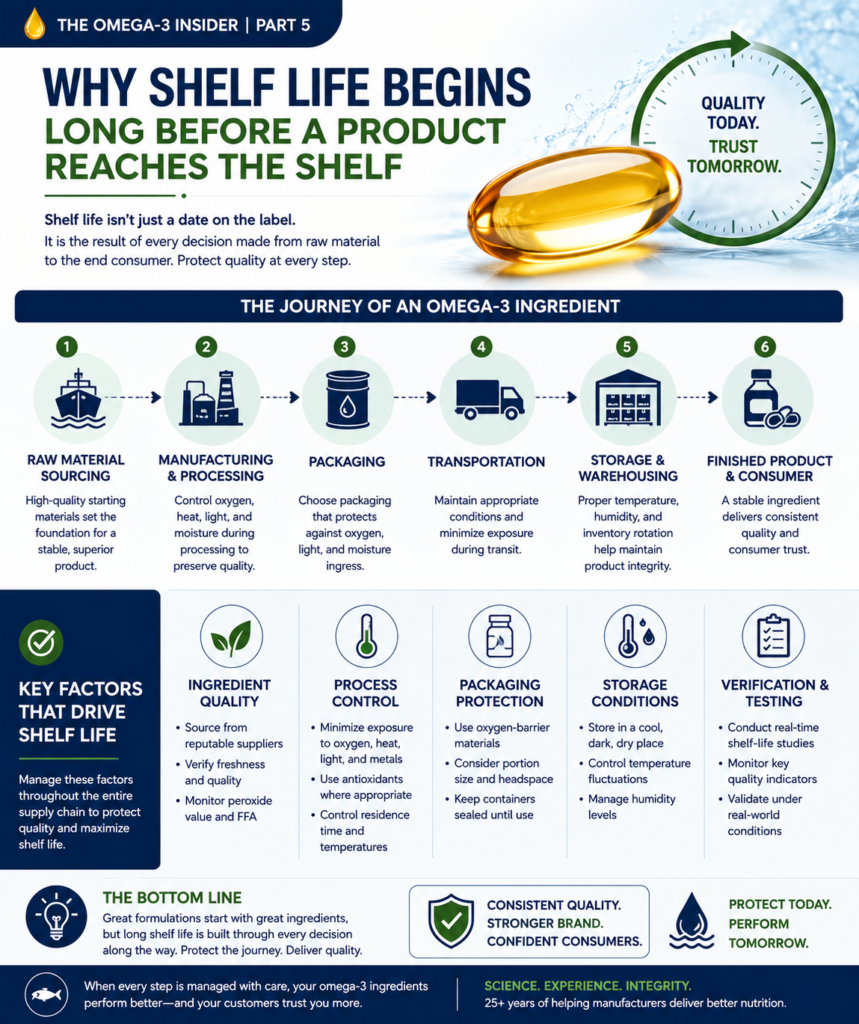
Why Shelf Life Begins Long Before a Product Reaches the Shelf
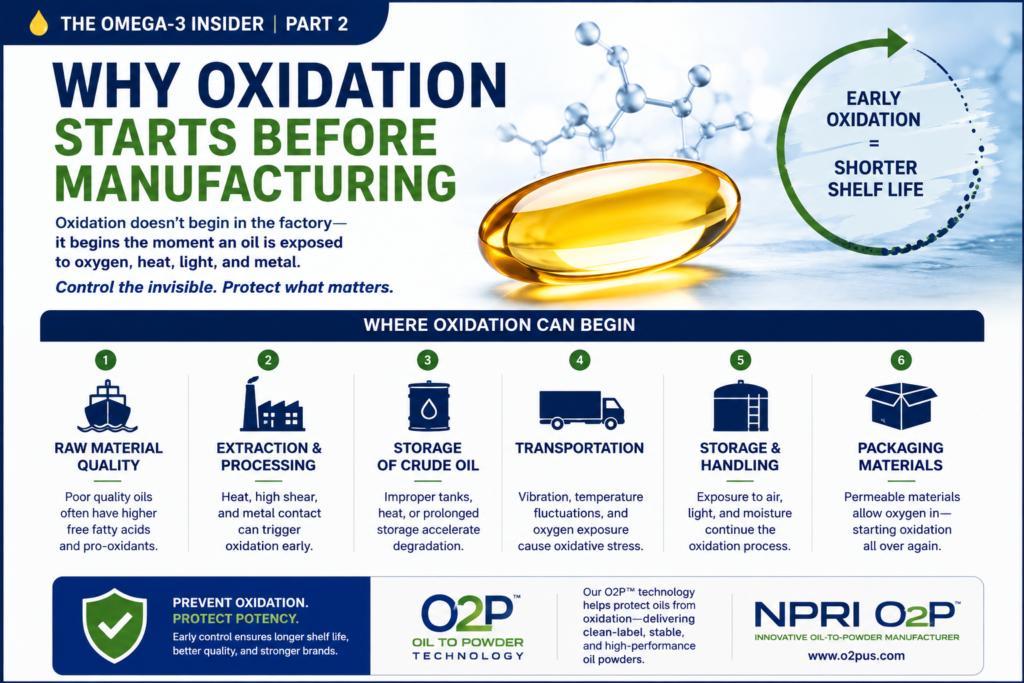
How O2P™ Technology Protects Oils from Oxidation
Shelf life begins long before a finished product reaches the consumer. Learn how raw material quality, manufacturing, packaging, storage, and transportation all contribute to product stability and long-term performance.
Oxidation begins long before oils reach the manufacturing line. Learn how raw material quality, processing, storage, transportation, and oxygen exposure can silently reduce stability, potency, and shelf life.
Bulk density can affect packaging, blending, filling, storage, and manufacturing efficiency. Learn why physical powder properties matter just as much as chemical specifications.
