
When an Ingredient Meets Specification but Still Fails in Production
A Certificate of Analysis is an essential part of ingredient qualification.
It provides important information about composition, potency, microbiological limits, physical characteristics and other specifications.
But there is something a COA cannot fully answer:
How will this ingredient actually perform in the customer’s finished product?
That distinction is particularly important when working with oil powders.
An ingredient can meet every listed specification and still create challenges once it enters a commercial formulation or manufacturing process.
The Application Matters
One of the first questions NPRI-O2P asks when evaluating a customer’s requirement is simple:
What is the intended application?
The answer can significantly influence which characteristics of an oil powder matter most.
A powder designed for a dry nutritional blend may face very different requirements from one intended for a beverage, capsule, tablet, functional food, pet supplement or other finished product.
The specification tells us what the ingredient is.
The application tells us what the ingredient needs to do.
Dispersibility Is Not Required in Every Application
For some products, dispersibility is extremely important.
A powder being added to a beverage, shake or liquid preparation may need to distribute rapidly and uniformly throughout the liquid.
By comparison, a powder going into a capsule may have little or no requirement for water dispersibility.
In that application, other characteristics such as powder flow, bulk density and manufacturing consistency may be more important.
This is why evaluating an ingredient without understanding its intended use can lead to the wrong conclusion.
Flow and Handling Characteristics
Powder handling becomes especially important in commercial production.
A material that performs acceptably in a laboratory trial may behave differently when hundreds of kilograms are being transferred, blended or filled through production equipment.
Depending on the application, manufacturers may need to consider:
- Powder flow
- Caking tendency
- Bulk density
- Blend uniformity
- Dust generation
- Compatibility with filling or blending equipment
- Moisture sensitivity
These characteristics may not be fully represented by a traditional chemical specification.
Interaction With Other Ingredients
Oil powders rarely exist by themselves in the finished product.
They may be combined with proteins, vitamins, minerals, botanical ingredients, sweeteners, flavors, fibers or other powdered materials.
Those ingredients can affect how the complete formulation behaves.
A powder that performs well independently may behave differently once introduced into a complex finished-product matrix.
That is why the complete formulation environment should be considered during product development.
Carrier Selection Can Affect Performance
The carrier system is another important consideration.
Different applications may place different demands on the finished powder.
Depending on the formulation, the customer may be concerned with factors such as:
- Label requirements
- Dispersibility
- Powder handling
- Sensory characteristics
- Ingredient compatibility
- Finished-product positioning
There is no single carrier system that is automatically ideal for every application.
The intended use should help guide the selection.
Sensory Performance Matters Too
Chemical specifications are important, but customers ultimately sell finished products to consumers.
Taste, aroma, mouthfeel and appearance can therefore be just as important as analytical composition.
This becomes especially relevant when sensitive oils are incorporated into beverages, nutritional powders, pet products and functional foods.
An ingredient may meet specification and still be unsuitable if it negatively affects the sensory characteristics of the finished product.
Storage and Environmental Conditions
The environment in which the powder will be used and stored also matters.
Exposure to humidity, repeated opening of containers, warehouse temperatures and extended storage can all influence powder performance.
For sensitive oils, appropriate handling becomes particularly important because the finished powder must maintain its intended characteristics throughout the customer’s manufacturing and storage process.
The COA Is the Starting Point — Not the Entire Evaluation
A COA remains an essential quality document.
But ingredient qualification should not stop there.
Product developers should also consider how the material will perform under the actual conditions in which it will be used.
That means asking questions such as:
How will the powder be incorporated?
What other ingredients will be present?
Does it need to disperse in liquid?
Will the product be compressed, blended or encapsulated?
What storage conditions will it encounter?
What sensory characteristics are acceptable?
These questions can be just as important as the numerical values listed on the specification sheet.
From Ingredient Supplier to Development Partner
At NPRI-O2P, we believe understanding the customer’s application is an important part of recommending an oil powder.
The goal is not simply to supply an ingredient that meets specification.
The goal is to provide an ingredient that is appropriate for the customer’s intended finished product.
Because ultimately, the most important question is not simply:
“Does the ingredient meet specification?”
It is:
“Will the ingredient perform as intended in the finished application?”
For more information about O2P oil powder technology and available oil powder applications, visit O2PUS.com.
Need Help With Your Formulation?
Whether you’re developing a new oil powder, improving product stability, or solving formulation challenges, our technical team is ready to help. Contact us for formulation guidance, product recommendations, or sample requests.
Recommended Technical Articles
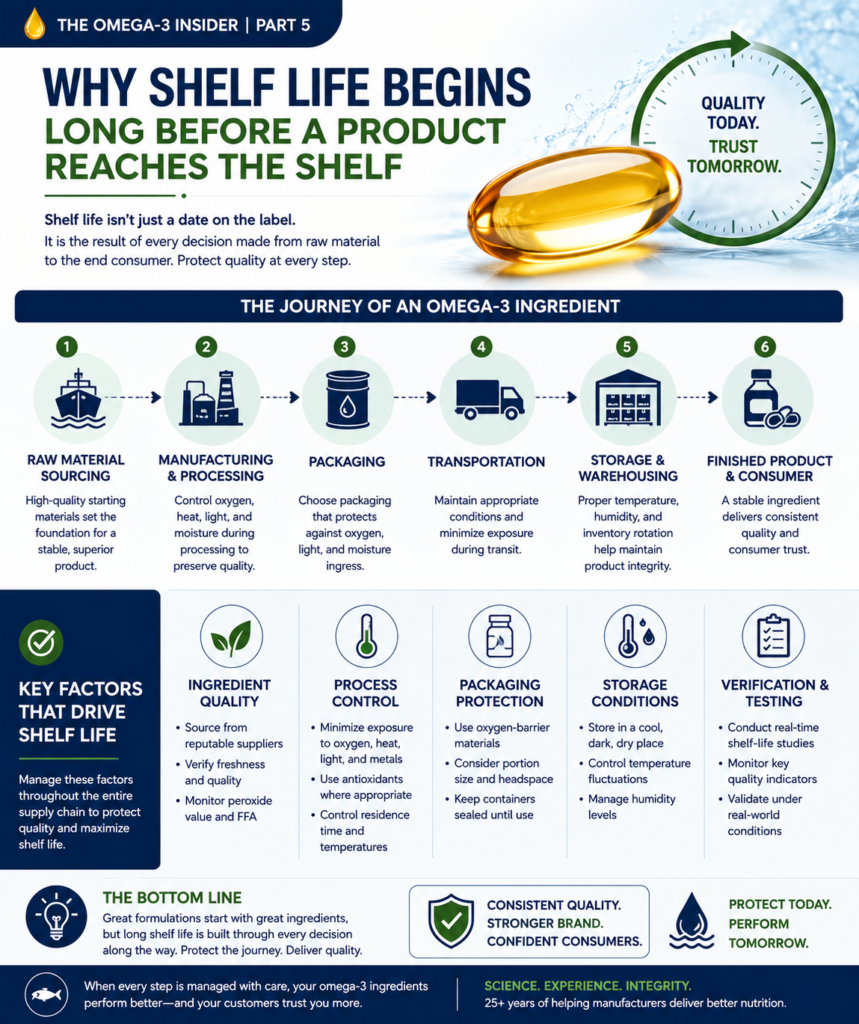
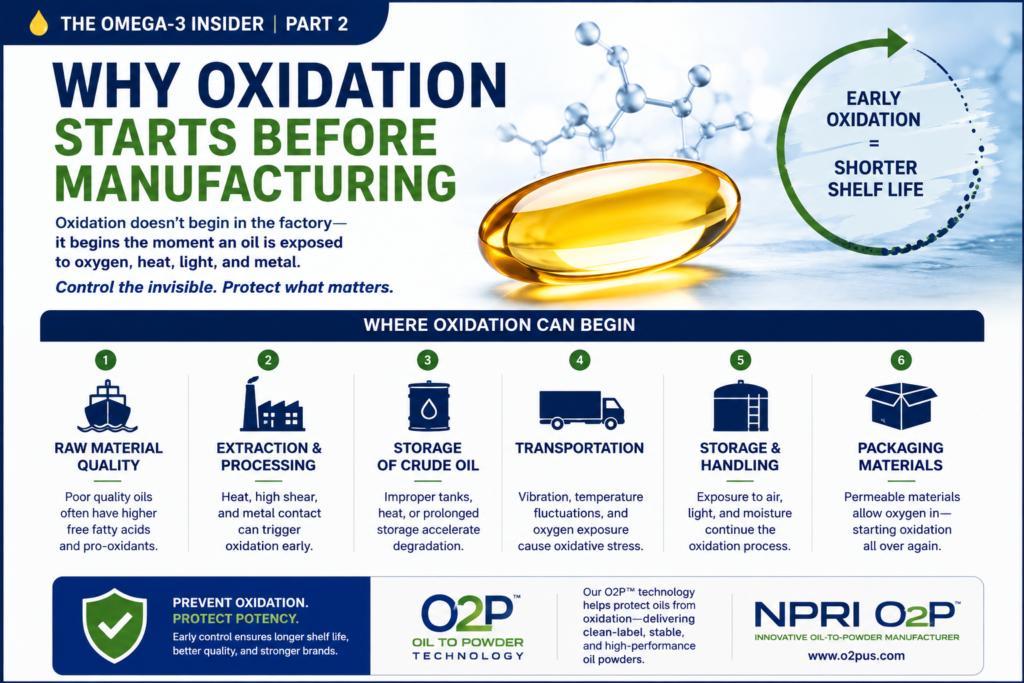
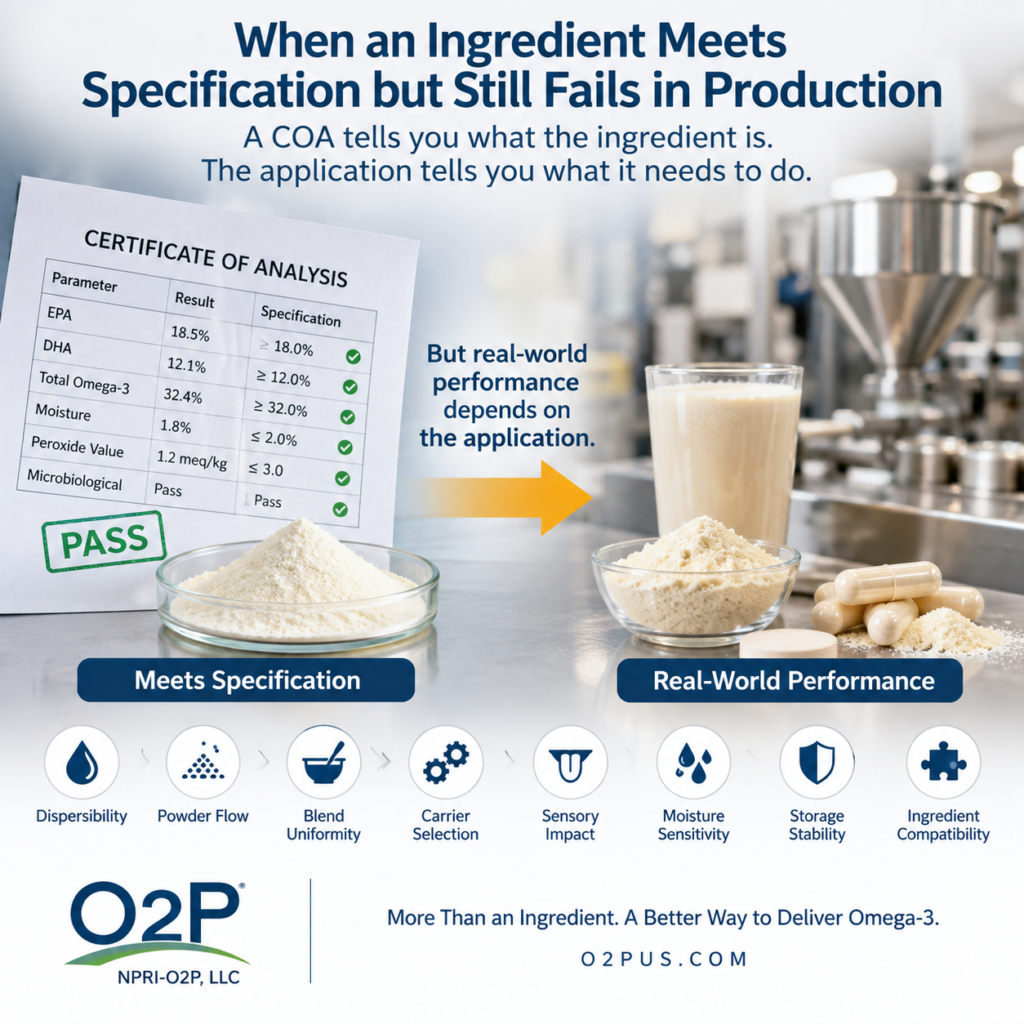
Why Shelf Life Begins Long Before a Product Reaches the Shelf
How O2P™ Technology Protects Oils from Oxidation
Shelf life begins long before a finished product reaches the consumer. Learn how raw material quality, manufacturing, packaging, storage, and transportation all contribute to product stability and long-term performance.
Oxidation begins long before oils reach the manufacturing line. Learn how raw material quality, processing, storage, transportation, and oxygen exposure can silently reduce stability, potency, and shelf life.
Meeting specification is only the beginning. Learn why application and real-world performance matter when selecting an oil powder.
