
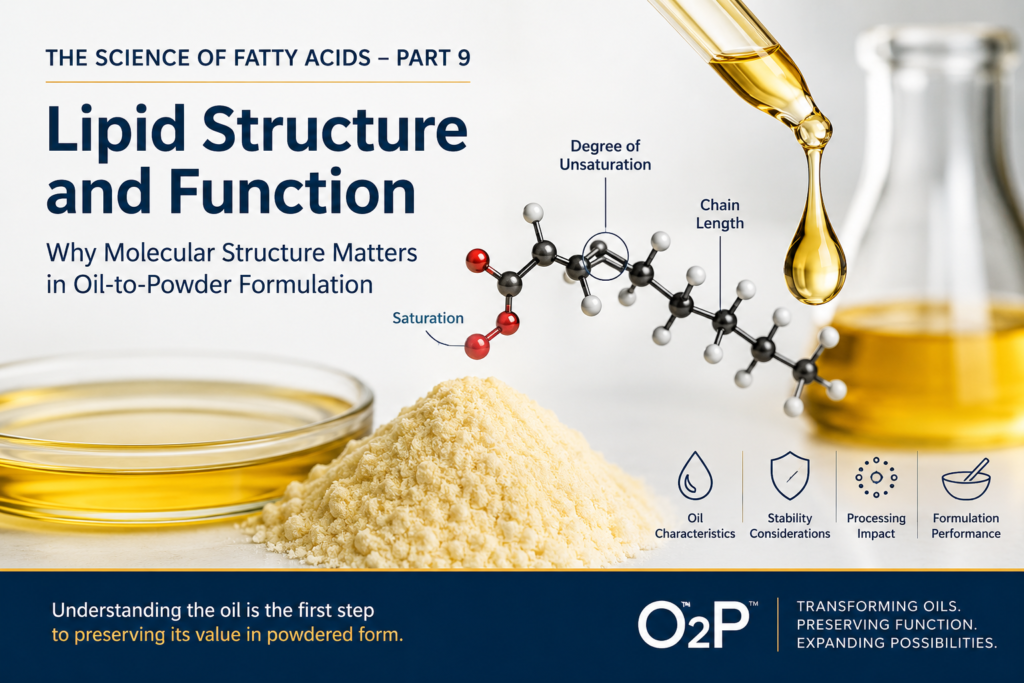
The Science of Fatty Acids – Part 9: Lipid Structure and Function — Why Molecular Structure Matters in Oil-to-Powder Formulation
In Part 9, we move deeper into the relationship between molecular structure and formulation behavior.
An oil is not simply “fat.” Its fatty-acid composition influences how it behaves physically and chemically, how it responds to processing, and how it performs when incorporated into a powdered ingredient.
For formulators, understanding these differences can be just as important as knowing the percentage of oil in the finished product.
The Structure Behind an Oil
Most edible oils consist primarily of triglycerides—molecules composed of a glycerol backbone attached to three fatty acids.
Those fatty acids may differ in several important ways:
- Carbon-chain length
- Degree of saturation
- Number and position of double bonds
- Molecular configuration
- Relative proportions within the oil
These structural differences help explain why oils can have dramatically different physical and functional characteristics even though they all belong to the same broad category of lipids.
Chain Length Matters
Fatty acids are commonly classified according to the length of their carbon chains.
Medium-chain fatty acids, for example, are prominent in MCT oils, while many conventional vegetable and marine oils contain predominantly longer-chain fatty acids.
Chain length can influence characteristics such as melting behavior, viscosity and interaction with other formulation components.
Consequently, an MCT oil cannot automatically be expected to behave in the same way as a marine omega-3 oil or a botanical oil during powder development.
The starting lipid matters.
Saturation Changes Behavior
Fatty acids may be saturated, monounsaturated or polyunsaturated.
A saturated fatty acid contains no carbon-carbon double bonds.
A monounsaturated fatty acid contains one.
A polyunsaturated fatty acid contains two or more.
These apparently small molecular differences can have significant consequences.
Increasing unsaturation generally changes both the physical characteristics of the lipid and its susceptibility to oxidative reactions.
This becomes particularly important when working with long-chain polyunsaturated fatty acids such as EPA and DHA.
Their nutritional value is one reason they are widely used in functional foods, dietary supplements and nutritional products. Their molecular structure, however, also requires careful consideration during processing, formulation and storage.
Why Oil Loading Alone Does Not Tell the Whole Story
Oil powders are frequently discussed in terms of oil loading:
30% oil.
40% oil.
50% oil.
Those numbers are useful—but they do not fully describe the formulation.
A 50% MCT oil powder and a 50% omega-3 fish oil powder may contain the same amount of lipid by weight while presenting very different formulation challenges.
The characteristics of the oil itself must also be considered.
A successful formulation therefore requires evaluating the relationship among:
the oil + the carrier system + the manufacturing process + the intended application.
Changing any one of these variables can change the behavior of the finished powder.
The Carrier Is Part of the System
Converting an oil into powder requires more than simply combining liquid oil with a dry ingredient.
The carrier system influences characteristics such as:
- Powder flow
- Dispersibility
- Bulk density
- Handling
- Oil retention
- Application performance
Different oils may therefore require different formulation strategies.
A carrier system that performs well with one lipid may not necessarily provide identical performance with another.
This is why oil-to-powder development should be approached as a formulation problem rather than simply a drying problem.
Processing Must Respect the Lipid
Once the chemistry of the starting oil is understood, the importance of processing conditions becomes clearer.
Highly unsaturated lipids deserve particular attention because their molecular structures can make them more vulnerable to deterioration under unfavorable conditions.
At NPRI-O2P, the O2P™ process approaches powder development from the perspective of preserving the characteristics of the starting oil while changing its physical form.
The process operates under controlled, room-temperature conditions and does not rely on high-temperature drying to create the finished powder.
This distinction becomes increasingly important as the sensitivity and value of the lipid increase.
Formulation Begins With Understanding the Oil
There is no single ideal oil-powder formulation for every application.
The correct approach begins by asking:
What oil are we working with?
Then:
What characteristics of that oil need to be maintained in the finished powder?
Only after those questions are understood should oil loading, carrier selection, powder characteristics and application requirements be evaluated.
This approach treats the lipid as the functional ingredient—not simply as a liquid that needs to be converted into a dry form.
The Takeaway
The molecular structure of fatty acids influences far more than their chemical names.
It helps determine how an oil behaves, how it should be formulated, and how carefully it should be handled during conversion into a powdered ingredient.
For oil-to-powder technology, understanding the starting lipid is therefore fundamental.
The objective is not simply to turn oil into powder.
It is to change the physical form while preserving the value and functionality of the oil being delivered.
Coming Next — Part 10
In The Science of Fatty Acids – Part 10, we will examine oxidation in greater depth—how oxidative reactions begin, what accelerates them, and why controlling processing and storage conditions is especially important for highly unsaturated oils.
NPRI-O2P, LLC
Advanced Oil-to-Powder Technology
O2P™ — Transforming Oils. Preserving Function. Expanding Possibilities.
Need Help With Your Formulation?
Whether you’re developing a new oil powder, improving product stability, or solving formulation challenges, our technical team is ready to help. Contact us for formulation guidance, product recommendations, or sample requests.
Recommended Technical Articles
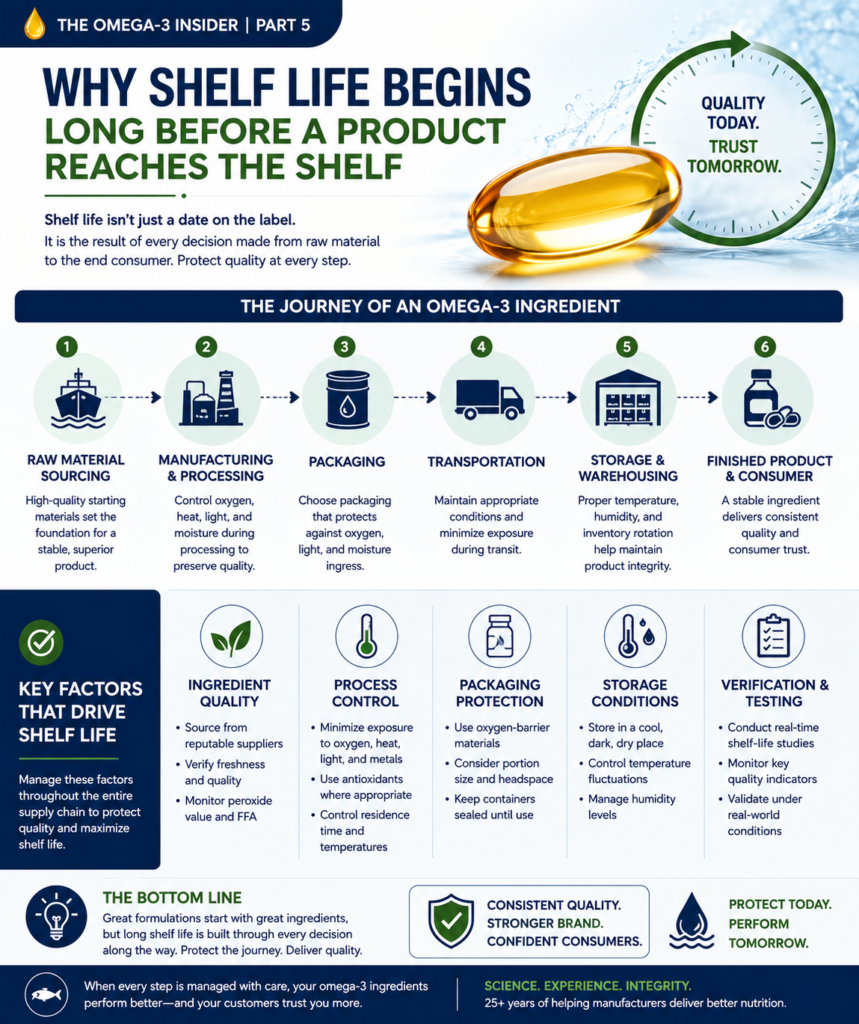
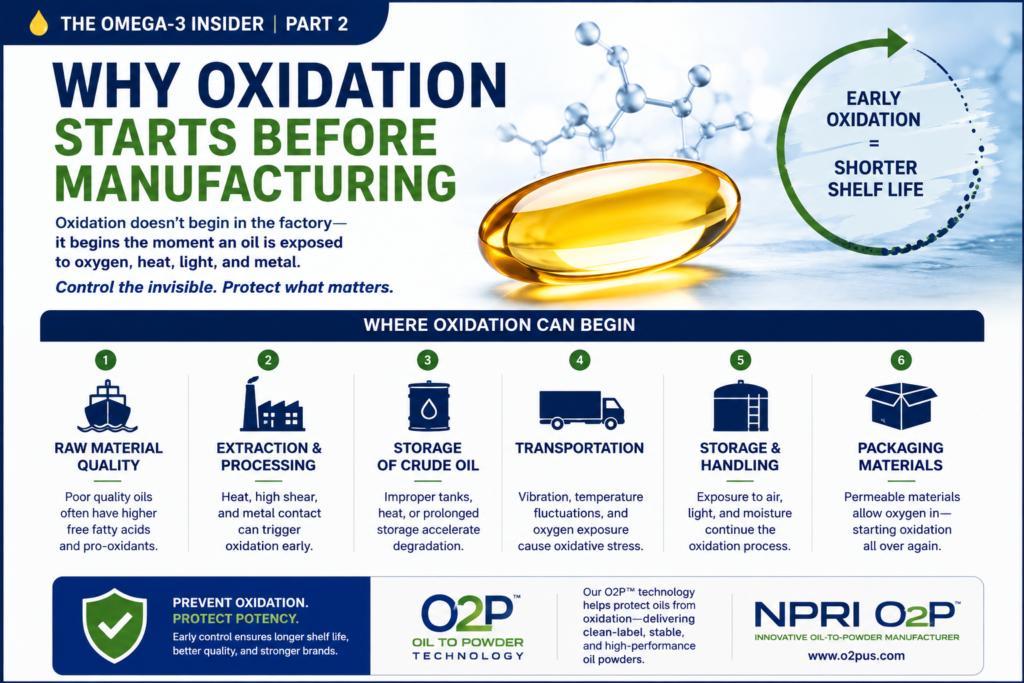
Why Shelf Life Begins Long Before a Product Reaches the Shelf
How O2P™ Technology Protects Oils from Oxidation
Shelf life begins long before a finished product reaches the consumer. Learn how raw material quality, manufacturing, packaging, storage, and transportation all contribute to product stability and long-term performance.
Oxidation begins long before oils reach the manufacturing line. Learn how raw material quality, processing, storage, transportation, and oxygen exposure can silently reduce stability, potency, and shelf life.
Throughout The Science of Fatty Acids series, we have examined fatty acids from several perspectives—from their nutritional importance to the challenges involved in maintaining their quality and stability.
