
The Science of Fatty Acids – Part 10: Understanding Lipid Oxidation — How It Begins, What Accelerates It, and Why It Matters
In Part 9, we examined how fatty-acid structure influences the physical and chemical behavior of oils.
One consequence of that structure deserves particular attention: oxidation.
Oxidation is one of the principal pathways through which oils—especially oils rich in polyunsaturated fatty acids—can deteriorate over time.
For formulators working with omega-3 oils, botanical oils and other sensitive lipids, understanding oxidation is not simply an academic exercise. It directly affects raw-material handling, processing, packaging, storage and ultimately the quality of the finished product.
Why Unsaturation Matters
A fatty acid’s susceptibility to oxidation is closely related to its molecular structure.
As discussed in Part 9, saturated fatty acids contain no carbon-carbon double bonds, while monounsaturated and polyunsaturated fatty acids contain one or multiple double bonds.
Those double bonds provide many of the characteristics that make polyunsaturated fatty acids nutritionally valuable—but they also make the molecules more susceptible to oxidative reactions.
This becomes particularly significant with long-chain omega-3 fatty acids such as EPA and DHA.
EPA contains five double bonds.
DHA contains six.
Their high degree of unsaturation is therefore accompanied by greater oxidative sensitivity, making careful handling particularly important throughout processing and storage.
Oxidation Is a Chain Reaction
Lipid oxidation is not a single event.
It is generally described as a sequence involving three stages:
Initiation → Propagation → Termination
Understanding these stages helps explain why oxidation can begin slowly and then accelerate.
1. Initiation
During initiation, a reactive species removes a hydrogen atom from a susceptible fatty-acid molecule.
This produces a lipid radical.
The initial reaction may be promoted by factors such as heat, light, reactive oxygen species or trace metals.
At this point, the oil may not necessarily show obvious sensory evidence of deterioration.
But the chemistry has begun.
2. Propagation
The lipid radical can react rapidly with oxygen to form a peroxyl radical.
That radical can then react with another lipid molecule, producing a lipid hydroperoxide and another lipid radical.
The newly created radical can continue the reaction.
This is why oxidation is described as a chain reaction.
Once initiated, one reaction can contribute to another, allowing oxidative deterioration to propagate through the lipid system.
3. Termination
Eventually, radicals may react with one another to form more stable, non-radical products, interrupting the chain reaction.
But by this stage, oxidation may already have produced a complex mixture of primary and secondary oxidation products.
The objective in handling sensitive oils is therefore not to wait for termination.
It is to reduce the conditions that encourage oxidation in the first place.
Primary Oxidation: The Damage May Not Yet Be Obvious
Among the important early products of lipid oxidation are hydroperoxides.
These are commonly referred to as primary oxidation products.
Their presence can be evaluated using measurements such as peroxide value (PV).
However, primary oxidation presents an important analytical challenge.
Hydroperoxides themselves are unstable.
As oxidation progresses, they can decompose into secondary oxidation products. Therefore, peroxide value may initially rise and later decline even though deterioration has continued.
For this reason, evaluating oxidative quality cannot always rely on a single measurement taken in isolation.
Secondary Oxidation: When Deterioration Becomes More Apparent
As hydroperoxides break down, they can form compounds including aldehydes, ketones, alcohols and other secondary oxidation products.
These compounds are particularly important because many contribute to the undesirable odors and flavors associated with rancid oils.
For marine oils, this may become recognizable as the familiar unpleasant “fishy” odor associated with deteriorated fish oil.
One commonly used analytical measurement for secondary oxidation in appropriate omega-3 oils is the p-anisidine value (p-AV).
Together, measurements of primary and secondary oxidation can provide a more complete picture of an oil’s oxidative condition than either measurement alone.
The important point for formulators is simple:
Oxidation is a progression, not a single measurable event.
What Accelerates Oxidation?
Several environmental and processing conditions can promote oxidative deterioration.
Oxygen
Oxygen is fundamental to the propagation of lipid oxidation.
Exposure can occur during raw-material storage, transfer, mixing, processing, packaging or through oxygen remaining in package headspace.
For sensitive oils, controlling unnecessary oxygen exposure is therefore an important part of maintaining quality.
Heat
Increasing temperature generally accelerates chemical reaction rates and can promote lipid oxidation.
This becomes especially relevant when highly unsaturated oils are subjected to elevated processing temperatures for extended periods.
Processing conditions should therefore be selected with the sensitivity of the lipid in mind.
Light
Light—particularly in the presence of photosensitizing compounds—can initiate or accelerate oxidative reactions through pathways that differ somewhat from conventional autoxidation.
This is one reason light protection may be important during storage and packaging of sensitive oils.
Trace Metals
Transition metals such as iron and copper can act as powerful pro-oxidants, even at relatively low concentrations.
They can accelerate the decomposition of lipid hydroperoxides and contribute to further radical formation.
Raw-material quality, equipment contact surfaces and formulation ingredients can therefore all become relevant considerations.
Time
Oxidation does not stop simply because manufacturing has been completed.
A product continues to interact with its environment during storage, transportation and distribution.
Temperature, oxygen exposure, light and packaging conditions continue to influence the lipid throughout its shelf life.
This is why oxidative stability must be considered across the entire product lifecycle.
Processing Conditions Matter
When converting a sensitive liquid oil into powder, processing is more than a physical transformation.
The conditions used during that transformation can influence the environment to which the lipid is exposed.
For highly unsaturated oils, minimizing unnecessary exposure to heat and oxygen can therefore become particularly important.
At NPRI-O2P, the proprietary O2P™ process operates under controlled, room-temperature conditions rather than relying on high-temperature drying to create the finished powder.
The purpose is straightforward:
Change the physical form of the oil while treating the lipid with the care its chemistry requires.
This becomes increasingly important when working with oxidation-sensitive materials such as EPA- and DHA-rich oils.
Packaging Is Part of the Stability Strategy
Manufacturing is only one part of protecting an oil powder.
Once produced, the ingredient must also be protected during storage and transportation.
Packaging selection can influence exposure to:
- Oxygen
- Moisture
- Light
- Environmental contaminants
- Temperature fluctuations during distribution
For sensitive lipid powders, appropriate barrier packaging and good storage practices therefore form part of the overall stability strategy.
A carefully manufactured product can still deteriorate if it is poorly packaged or improperly stored.
Antioxidants Help — But They Are Not a Substitute for Good Processing
Antioxidants can play an important role in slowing oxidative reactions.
Tocopherols, rosemary-derived antioxidants and other antioxidant systems are commonly used with oils depending on the formulation and application.
But antioxidants should not be viewed as permission to expose a sensitive oil unnecessarily to unfavorable conditions.
The stronger approach is to combine appropriate antioxidant protection, where required, with good raw-material handling, controlled processing, suitable packaging and proper storage.
In other words:
Stability should be designed into the process—not added as an afterthought.
The Formulator’s Perspective
When evaluating an oxidation-sensitive oil for conversion into powder, several questions should be considered:
- How unsaturated is the oil?
- What is its oxidative condition before processing?
- How will it be handled during manufacturing?
- What temperatures will it encounter?
- How much oxygen exposure is involved?
- Does the formulation contain potential pro-oxidants?
- What antioxidant system is present?
- What packaging will be used?
- Under what conditions will the finished product be stored and transported?
These questions are interconnected.
Oxidative stability is rarely determined by one factor alone.
It is the result of the oil + formulation + process + packaging + storage environment working together.
The Takeaway
Oxidation begins at the molecular level, but its consequences extend throughout the entire product.
For highly unsaturated fatty acids such as EPA and DHA, molecular structure creates both nutritional value and formulation responsibility.
Understanding initiation, propagation and secondary oxidation helps explain why oxygen, heat, light, trace metals and time must all be considered when developing products containing sensitive oils.
For oil-to-powder technology, the objective should therefore extend beyond simply producing a dry powder.
The objective is to convert the oil into a useful powdered form while minimizing avoidable conditions that can compromise the lipid along the way.
Preserving the value of a sensitive oil begins with understanding what can destroy it.
NPRI-O2P, LLC
Advanced Oil-to-Powder Technology
O2P™ — Transforming Oils. Preserving Function. Expanding Possibilities.
Need Help With Your Formulation?
Whether you’re developing an omega-3 powder, working with a sensitive botanical oil, or trying to improve the stability and handling of an existing formulation, our technical team can help evaluate the oil, carrier system and processing requirements for your application.
Contact NPRI-O2P for formulation guidance, product recommendations or sample requests.
Need Help With Your Formulation?
Whether you’re developing a new oil powder, improving product stability, or solving formulation challenges, our technical team is ready to help. Contact us for formulation guidance, product recommendations, or sample requests.
Recommended Technical Articles
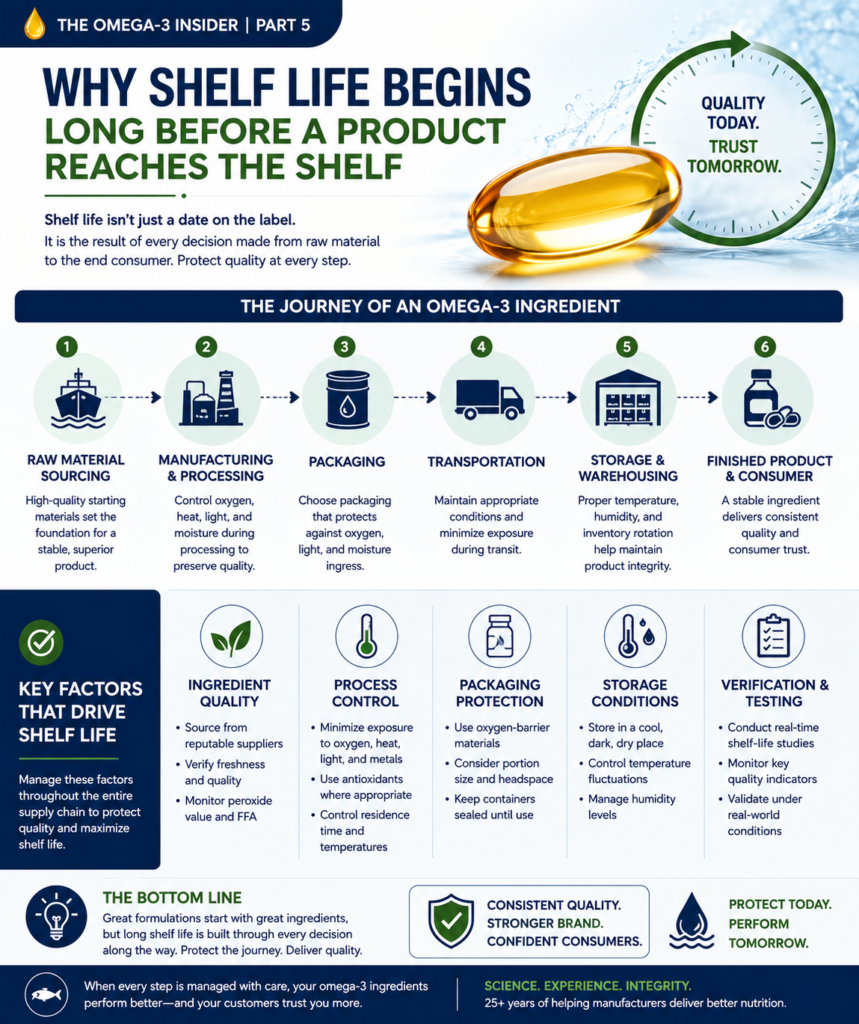
Why Shelf Life Begins Long Before a Product Reaches the Shelf
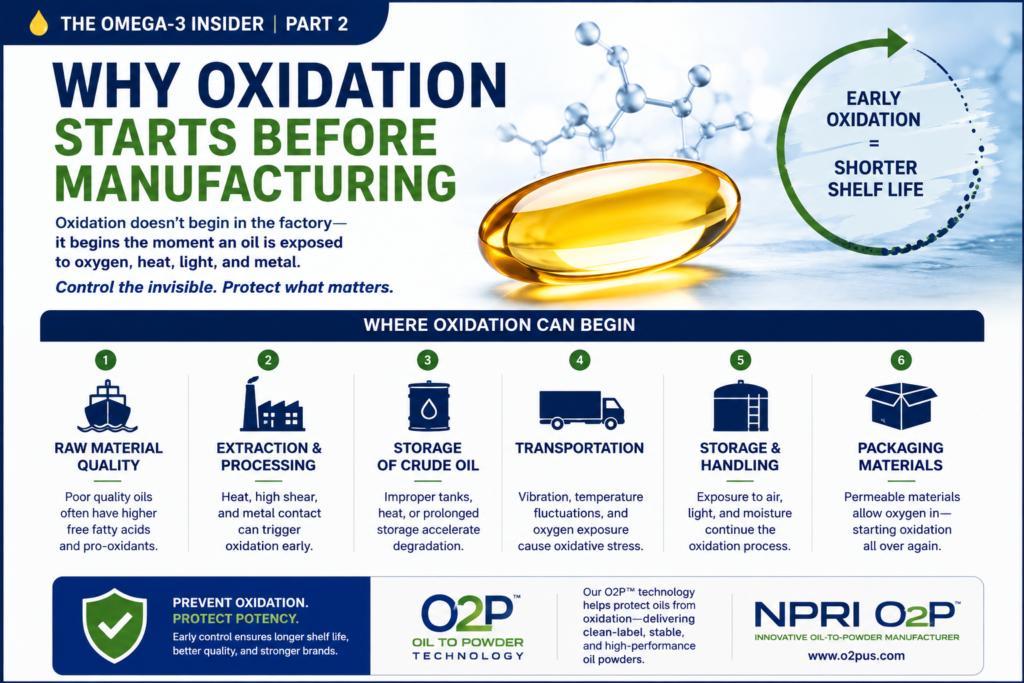
How O2P™ Technology Protects Oils from Oxidation
Shelf life begins long before a finished product reaches the consumer. Learn how raw material quality, manufacturing, packaging, storage, and transportation all contribute to product stability and long-term performance.
Oxidation begins long before oils reach the manufacturing line. Learn how raw material quality, processing, storage, transportation, and oxygen exposure can silently reduce stability, potency, and shelf life.
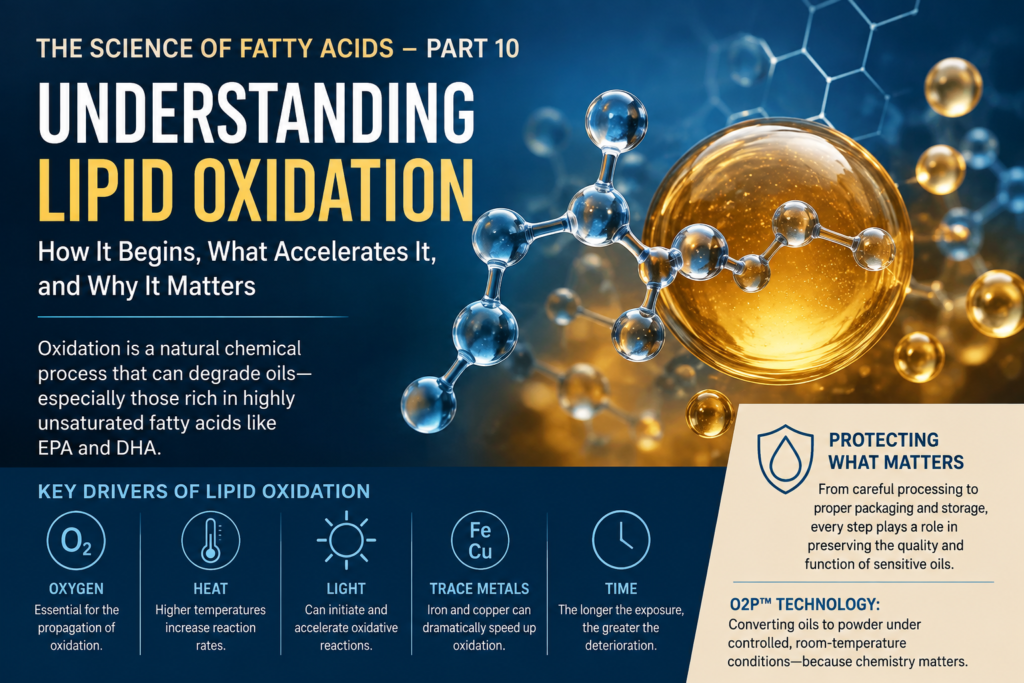
Discover how lipid oxidation begins, what accelerates it, and why controlling oxygen, heat, light, and storage conditions is critical for protecting sensitive fatty acids such as EPA and DHA.
