
The Science of Fatty Acids – Part 4: How Oxidation Changes Oil Quality
From Invisible Reactions to Real-World Impact
In Part 3 of this series, we explored the oxidation chain reaction—initiation, propagation and termination.
Understanding that chemistry is important, but for formulators and manufacturers there is an equally important question:
What does oxidation actually do to the quality of an oil?
Oxidation is not simply a theoretical chemical process. It can have practical consequences affecting flavor, aroma, nutritional integrity, stability and ultimately the performance of fats and oils in food, nutraceutical and pet-nutrition products.
1. Oxidation Can Affect Flavor and Aroma
One of the earliest noticeable consequences of lipid oxidation can be the development of undesirable odors and flavors.
During oxidation, primary oxidation products such as hydroperoxides are formed. These compounds are relatively unstable and can subsequently break down into numerous secondary oxidation products.
Depending upon the type of oil, its fatty-acid composition and the extent of oxidation, sensory changes may include:
- Cardboard-like notes
- Painty or stale characteristics
- Fishy odors
- Rancid aromas
- Other undesirable flavors and odors
This is particularly important for products containing marine oils because sensory deterioration can affect consumer acceptance even when the oil represents only a relatively small portion of the total formulation.
2. Oxidation Can Reduce Nutritional Value
The nutritional importance of many oils comes directly from their fatty-acid composition.
Long-chain omega-3 fatty acids such as EPA and DHA are particularly valuable nutritional components, but their high degree of unsaturation also makes them susceptible to oxidative deterioration.
As oxidation progresses, these fatty acids can be chemically altered or degraded.
From a formulation perspective, this creates an important distinction:
The amount of a nutrient originally added to a product is not necessarily the only consideration. Its stability throughout processing and shelf life also matters.
Protecting oxidation-sensitive fatty acids therefore helps protect the nutritional intent of the formulation.
3. Oxidation Produces Secondary Compounds
As discussed in Part 3, lipid oxidation initially produces hydroperoxides.
However, hydroperoxides are not particularly stable.
They can decompose into numerous secondary oxidation compounds, including:
- Aldehydes
- Ketones
- Alcohols
- Hydrocarbons
- Other volatile and nonvolatile compounds
These secondary products are particularly important because many contribute directly to the odors and flavors associated with oxidized oils.
Consequently, measuring and understanding oxidation involves more than simply determining whether oxygen has interacted with an oil.
It involves understanding how far the oxidation process has progressed and what degradation products have been produced.
4. Oxidation Can Affect Shelf Life and Stability
Oxidation is progressive.
Once initiated, the chain reaction can continue unless it is interrupted or sufficiently controlled.
As deterioration progresses, an oil may experience changes in:
- Aroma and flavor
- Color
- Chemical composition
- Nutritional integrity
- Physical properties
- Overall product stability
Eventually, these changes may reach a point at which the ingredient or finished product no longer meets its intended quality specifications.
This is one reason oxidative stability is an important consideration when establishing ingredient handling practices, packaging systems and finished-product shelf life.
5. Oxidation Can Affect Product Consistency
Manufacturers depend upon ingredient consistency.
If the oxidative condition of an oil varies from batch to batch, that variability may ultimately influence the characteristics of the finished product.
For formulators, controlling oxidation is therefore not only about preventing rancidity.
It is also about maintaining predictable ingredient quality.
This becomes particularly important in premium nutritional products where manufacturers expect consistent sensory characteristics, nutritional composition and performance from production batch to production batch.
Oxidation May Begin Before You Can See It
One of the challenges associated with lipid oxidation is that deterioration does not necessarily begin with an obvious visual or sensory warning.
Chemical changes can occur before dramatic differences in appearance, odor or flavor become apparent.
By the time an oil smells noticeably rancid, oxidation may already have progressed considerably.
For this reason, oxidation management is generally more effective when approached proactively rather than waiting for sensory deterioration to become obvious.
Why This Matters for Highly Unsaturated Oils
The more highly unsaturated an oil is, the greater the importance of managing its exposure to conditions that promote oxidation.
This is particularly relevant for oils rich in EPA and DHA.
Their nutritional value makes them desirable ingredients in human nutrition, nutraceutical and pet-nutrition formulations, while their highly unsaturated molecular structures simultaneously make oxidative stability an important formulation consideration.
The challenge therefore becomes:
How can manufacturers obtain the nutritional and functional benefits of sensitive oils while helping protect them from the conditions that promote deterioration?
That brings us naturally to the next part of this series.
Coming Next — Part 5: Protecting Sensitive Oils from Oxidation
In Part 5, we will examine the major strategies used to help protect oxidation-sensitive oils, including:
- Limiting oxygen exposure
- Managing temperature
- Protecting ingredients from light
- Controlling exposure to pro-oxidant metals
- Antioxidant strategies
- Packaging considerations
- Processing technology
We will also examine why the method used to convert a sensitive liquid oil into a functional powdered ingredient can become an important part of the overall oxidation-management strategy.
The Bottom Line
Oxidation is a natural chemical process that cannot simply be ignored.
For manufacturers working with sensitive fats and oils, understanding how oxidation affects sensory quality, nutritional integrity, stability and consistency is the first step toward managing it effectively.
The objective is not merely to process an oil.
The objective is to protect what makes that oil valuable.
NPRI-O2P, LLC
O2P™ — Oil-to-Powder Technology
Converting functional oils into free-flowing, water-dispersible powders for food, nutraceutical and pet-nutrition applications.
Need Help With Your Formulation?
Whether you’re developing a new oil powder, improving product stability, or solving formulation challenges, our technical team is ready to help. Contact us for formulation guidance, product recommendations, or sample requests.
Recommended Technical Articles
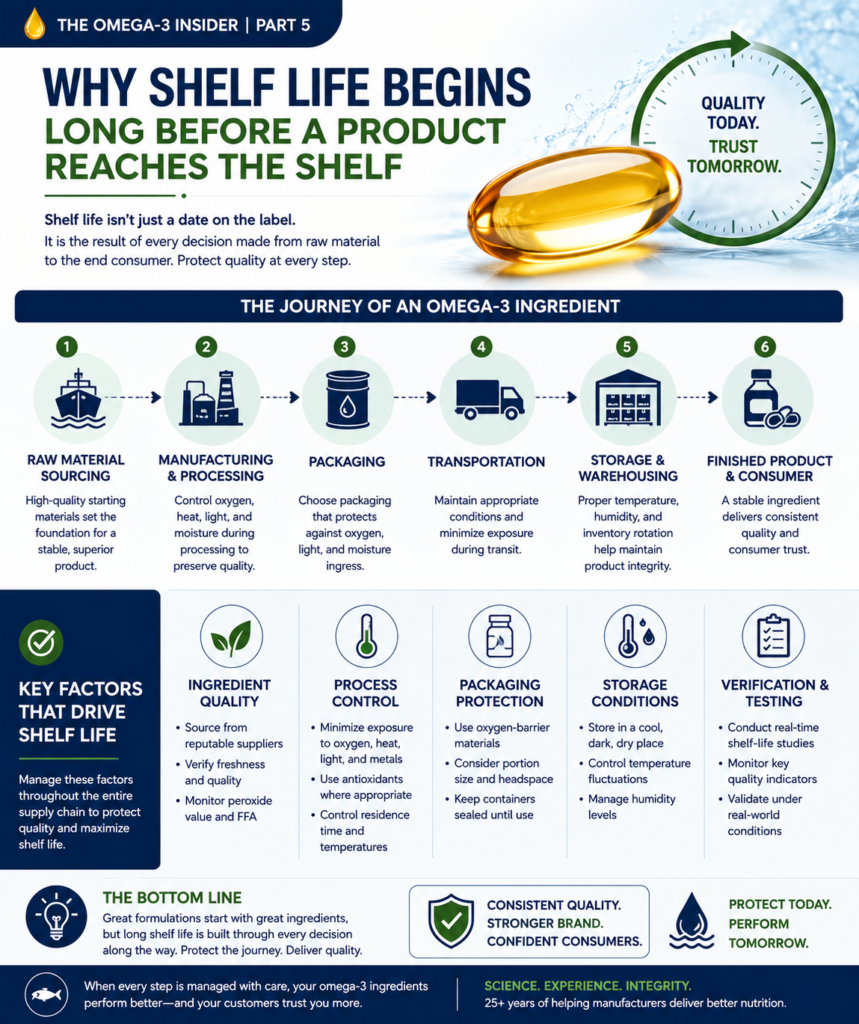
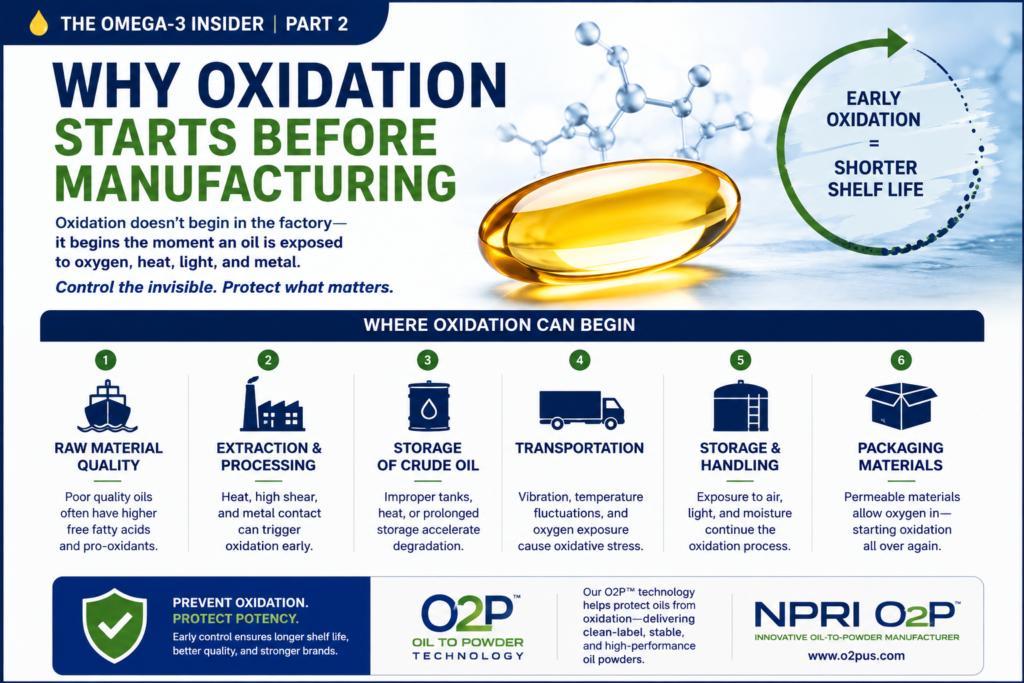
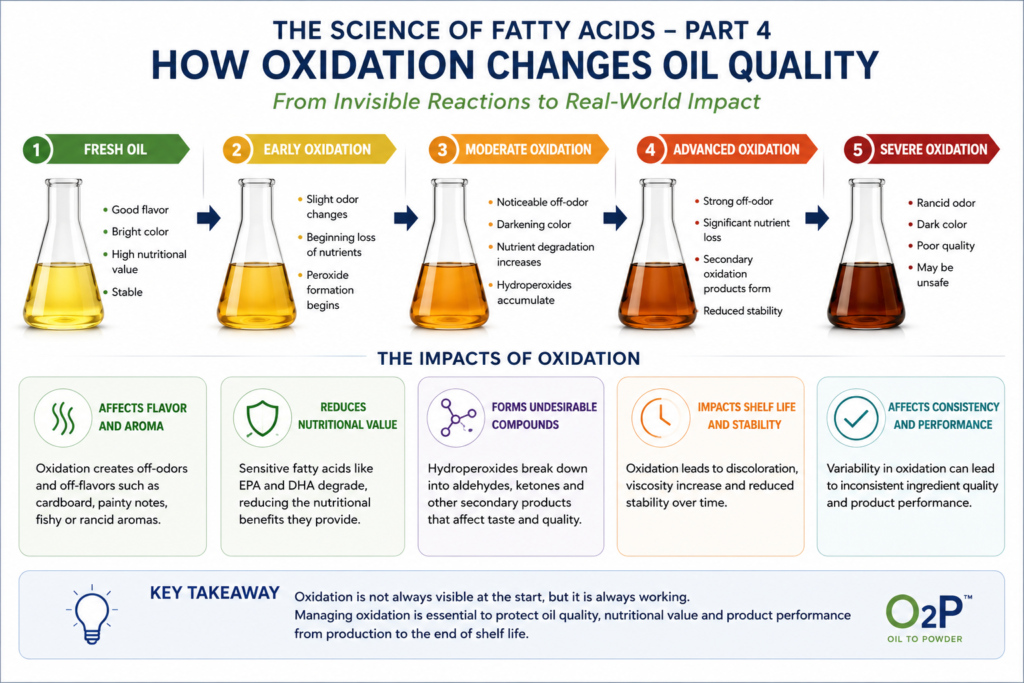
Why Shelf Life Begins Long Before a Product Reaches the Shelf
How O2P™ Technology Protects Oils from Oxidation
Shelf life begins long before a finished product reaches the consumer. Learn how raw material quality, manufacturing, packaging, storage, and transportation all contribute to product stability and long-term performance.
Oxidation begins long before oils reach the manufacturing line. Learn how raw material quality, processing, storage, transportation, and oxygen exposure can silently reduce stability, potency, and shelf life.
Discover how oxidation affects flavor, nutritional value, stability, and shelf life—and why protecting sensitive oils is essential for maintaining product quality.
