
The Science of Fatty Acids – Part 5: Protecting Sensitive Oils from Oxidation
In Part 4 of this series, we examined what happens when oils oxidize—and why oxidation can affect flavor, aroma, nutritional value, stability, and ultimately the useful life of an oil-containing product.
The next question is equally important:
What can we do to protect sensitive oils from oxidation?
The answer is not simply “add an antioxidant.”
Oxidative stability is the result of an entire system. Raw-material quality, exposure to oxygen, temperature, light, trace metals, processing conditions, packaging, and storage can all influence how quickly an oil deteriorates.
Understanding these factors is especially important when working with highly unsaturated oils such as omega-3 fatty acids.
1. Oxygen: The Fundamental Reactant
Oxidation cannot proceed without oxygen.
Every time an oil is exposed to air—during storage, pumping, mixing, processing, filling, or packaging—there is an opportunity for oxygen to interact with susceptible fatty acids.
This makes oxygen management one of the fundamental principles of lipid stability.
Manufacturers may attempt to reduce oxygen exposure through closed processing systems, nitrogen blanketing, reduced headspace, oxygen-barrier packaging, or other controlled handling techniques.
But the principle remains simple:
The less opportunity oxygen has to interact with an unstable oil, the better the opportunity to preserve that oil.
2. Temperature: Heat Accelerates the Reaction
Chemical reactions generally proceed more rapidly as temperature increases, and lipid oxidation is no exception.
This is particularly important when processing oils rich in polyunsaturated fatty acids.
EPA and DHA, for example, contain multiple double bonds. Those double bonds provide important nutritional properties, but they also make these fatty acids particularly susceptible to oxidative attack.
Processing an oxidation-sensitive oil at elevated temperatures can therefore create an additional stability challenge.
Temperature control should not be considered only during storage. It should be considered throughout the manufacturing process.
3. Light: An Often-Overlooked Catalyst
Certain wavelengths of light can accelerate oxidation, particularly when photosensitizing compounds are present.
This is why light-sensitive oils are commonly stored in opaque containers, dark bottles, metal drums, or other protective packaging.
A product may be manufactured under carefully controlled conditions and still lose stability if it is subsequently exposed to inappropriate lighting or packaging.
Protection therefore needs to continue throughout the product’s life cycle.
4. Trace Metals Can Accelerate Oxidation
Very small quantities of certain metals—particularly iron and copper—can promote oxidative reactions.
These metals may originate from raw materials, water, processing equipment, contamination, or other ingredients within a formulation.
This illustrates an important point:
Oxidative stability is affected by the entire formulation and manufacturing environment, not simply by the oil itself.
Good equipment design, appropriate material selection, raw-material control, and manufacturing practices all contribute to protecting oxidation-sensitive ingredients.
5. Antioxidants Help—but They Are Not a Complete Solution
Antioxidants can play an important role in slowing oxidation.
Depending upon the application, manufacturers may use tocopherols or other antioxidant systems to help interrupt oxidative chain reactions.
However, antioxidants should not be viewed as a substitute for proper processing and handling.
If an oil is repeatedly exposed to oxygen, excessive heat, light, or pro-oxidant conditions, asking an antioxidant to compensate for the entire manufacturing environment places too much responsibility on one component of the formulation.
A more effective approach is to reduce the factors that promote oxidation and use an appropriate antioxidant strategy where necessary.
6. Packaging Is Part of the Stability System
Oxidative protection does not end when manufacturing is completed.
The packaging system can determine how much oxygen, moisture, and light reach the product during transportation and storage.
Depending upon the application, manufacturers may consider oxygen-barrier materials, appropriate seals, controlled headspace, light protection, and suitable storage conditions.
This is why shelf-life engineering should begin during product development rather than after the formulation has already been finalized.
Processing Technology Matters
There is another factor that deserves particular attention: how the oil is processed in the first place.
When oxidation-sensitive oils are converted into powders, the processing method can become especially important.
Conventional oil-to-powder technologies may expose an oil to combinations of heat and oxygen during processing. For relatively stable oils, this may be manageable. For highly unsaturated oils, however, the processing environment deserves careful consideration.
This leads to a broader formulation question:
If the objective is to protect an oxidation-sensitive oil, should the conversion process itself introduce conditions known to accelerate oxidation?
At NPRI-O2P, this question has guided the development of our O2P™ oil-to-powder technology.
The O2P™ process converts liquid oils into free-flowing powders under controlled, room-temperature conditions without intentionally applying the high-temperature processing traditionally associated with spray drying.
The objective is straightforward: minimize unnecessary stress on the oil while creating a commercially useful powdered ingredient.
This becomes particularly relevant for sensitive lipid systems such as omega-3 oils and other highly unsaturated fatty acids.
Stability Begins with the Process
Protecting sensitive oils is not accomplished by any single ingredient or manufacturing step.
It requires a systems approach:
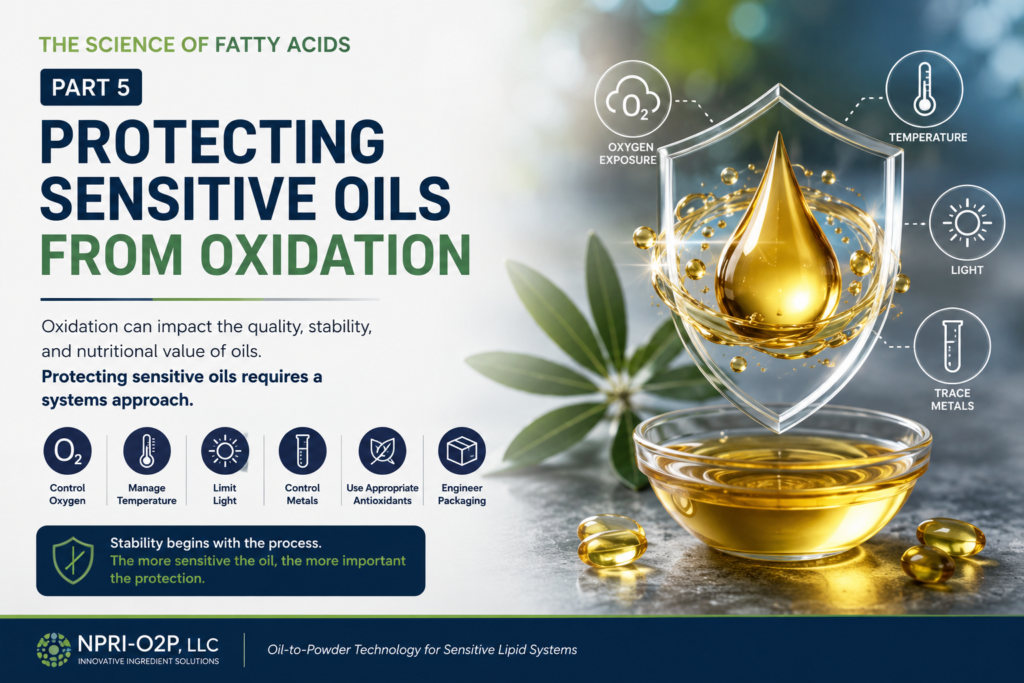
Control oxygen. Manage temperature. Limit light exposure. Control pro-oxidant metals. Select appropriate antioxidants. Engineer suitable packaging. And choose a processing technology appropriate for the sensitivity of the oil.
The chemistry of the fatty acid does not change simply because we want to manufacture it into a convenient dosage form.
The more unsaturated the oil, the more carefully its processing environment should be considered.
Coming in Part 6
In the next article, we will take the discussion one step further and examine what happens when liquid oils are converted into powders—and why the method used to create an oil powder can influence stability, functionality, and ultimately product performance.
NPRI-O2P, LLC
Oil-to-Powder Technology for Sensitive Lipid Systems
Need Help With Your Formulation?
Whether you’re developing a new oil powder, improving product stability, or solving formulation challenges, our technical team is ready to help. Contact us for formulation guidance, product recommendations, or sample requests.
Recommended Technical Articles
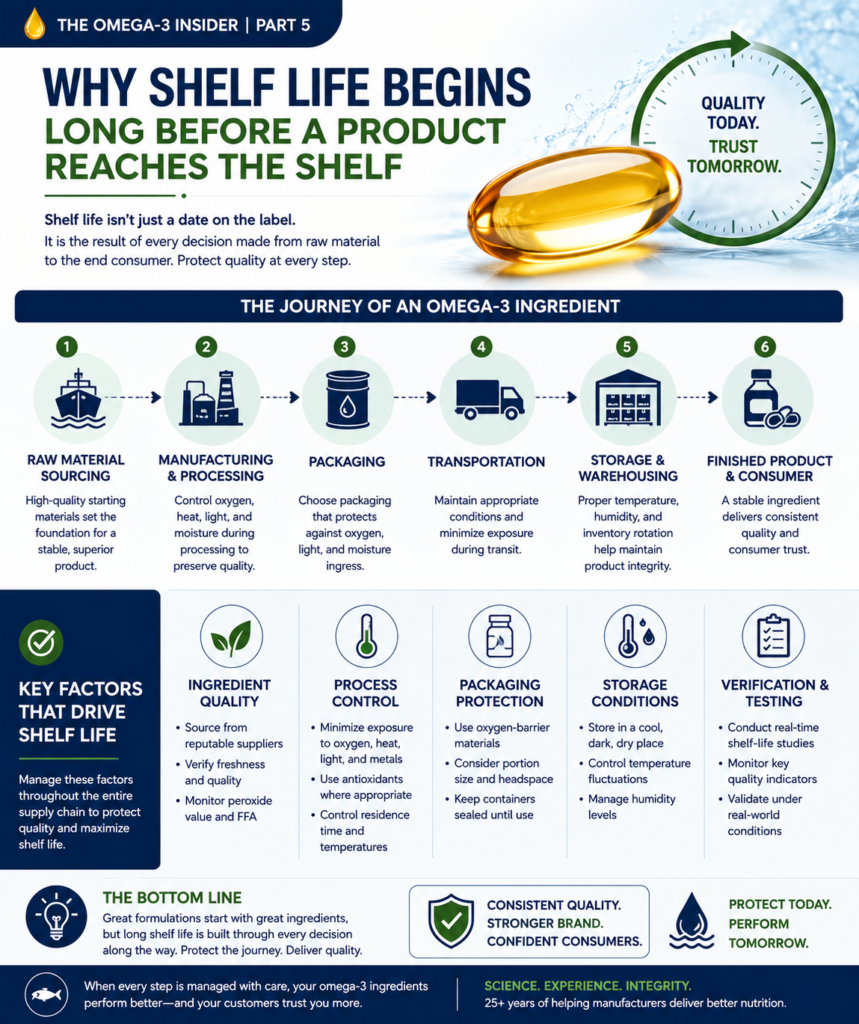
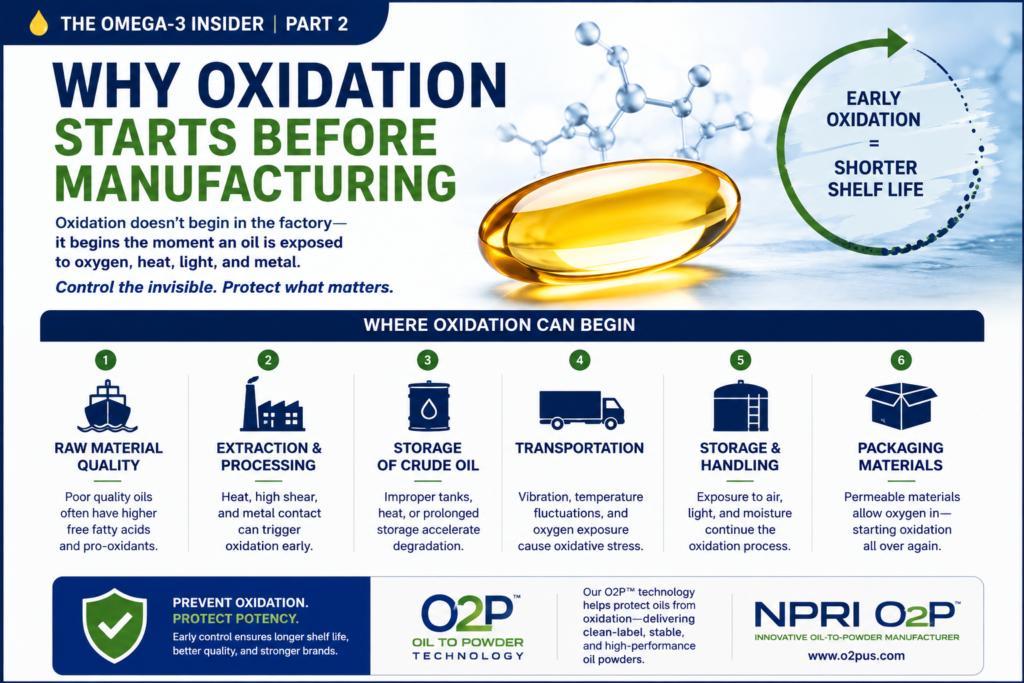
Why Shelf Life Begins Long Before a Product Reaches the Shelf
How O2P™ Technology Protects Oils from Oxidation
Shelf life begins long before a finished product reaches the consumer. Learn how raw material quality, manufacturing, packaging, storage, and transportation all contribute to product stability and long-term performance.
Oxidation begins long before oils reach the manufacturing line. Learn how raw material quality, processing, storage, transportation, and oxygen exposure can silently reduce stability, potency, and shelf life.
Discover how oxidation affects flavor, nutritional value, stability, and shelf life—and why protecting sensitive oils is essential for maintaining product quality.
