
Oil Quality Starts Before Processing: The Overlooked Importance of Proper Oil Handling
Manufacturers spend considerable time evaluating the quality of oils before they are approved for production. Specifications such as peroxide value, anisidine value, fatty-acid composition, moisture, and other quality parameters may all be carefully reviewed.
But there is another part of oil quality management that receives far less attention:
What happens to the oil after it enters the warehouse and before—and during—production?
For oxidation-sensitive oils, particularly fish oils and other oils rich in polyunsaturated fatty acids, warehouse and production handling can have a significant impact on the condition of the oil ultimately entering the manufacturing process.
A high-quality oil can arrive at a facility within specification and still be unnecessarily exposed to oxygen, heat, light, moisture, or contamination through improper handling.
Protecting oil quality therefore does not begin at the processing equipment.
It begins at receiving.
Every Time an Oil Container Is Opened, Conditions Change
A sealed drum of oil is a controlled environment. Depending on the supplier and product, the headspace may have been flushed or blanketed with nitrogen or another inert gas before shipment.
Once the drum is opened, however, that controlled environment can be disturbed.
Air enters the container. Oil may be pumped or poured from the drum. The container may remain open during production. Afterward, the drum may simply be closed and returned to storage.
For relatively stable oils, the consequences may develop slowly.
For highly unsaturated oils such as omega-3 fish oils, however, oxygen exposure deserves considerably more attention because these fatty acids are particularly susceptible to oxidative deterioration.
The Half-Used Drum Problem
Consider a simple production situation.
A manufacturer receives a full drum of an oxidation-sensitive oil. Production requires only approximately half of the drum.
The warehouse or production employee opens the drum, removes the required quantity, closes the drum and returns the remaining oil to storage.
At first glance, everything appears normal.
But there is an important difference.
The space previously occupied by the removed oil is now headspace, and that headspace can contain oxygen from the surrounding air.
Closing the drum does not remove that oxygen.
The remaining oil is therefore being stored under conditions very different from those of the original sealed drum.
This is precisely why proper inert-gas handling is so important.
Closing the Drum Is Not the Same as Protecting the Oil
When a partially used drum of an oxidation-sensitive oil is returned to storage, the headspace should be managed according to a validated handling procedure and the oil supplier’s recommendations.
For many sensitive oils, this includes purging the headspace with nitrogen or another appropriate inert gas before the container is securely resealed.
The objective is straightforward: displace oxygen-containing air in the headspace and reduce continued oxygen exposure during storage.
This principle is well established in the handling of oxidation-sensitive oils. Industry guidance for omega-3 oils specifically recommends minimizing headspace and, when headspace develops after oil is removed, carefully flushing it with nitrogen or another suitable inert gas.
A very simple operational rule can therefore have major importance:
Use what production requires. Protect what remains.
Nitrogen Purging Is Preventive—Not Corrective
Nitrogen should not be viewed as a method for restoring oil that has already oxidized.
It cannot reverse oxidation products that have already formed.
Instead, nitrogen purging and blanketing are preventive measures intended to reduce further contact between the oil and oxygen.
This distinction is important.
If an oil has already experienced excessive oxidation through prolonged air exposure, inappropriate temperature, poor storage conditions, or other handling problems, replacing the headspace with nitrogen does not return the oil to its original condition.
The objective must therefore be to prevent unnecessary exposure from occurring in the first place.
Transfers Matter Too
Oxidation control is not limited to what happens inside the drum.
How the oil is transferred into production also matters.
Unnecessary splashing, cascading, vigorous agitation and poorly designed transfer procedures can increase contact between oil and air. Pumps, hoses and transfer systems should be appropriate for the product and maintained in clean, dry condition.
Where oxidation control is critical, transfer procedures should be designed to minimize aeration.
The same principle applies throughout the operation:
Minimize opportunities for oxygen to contact the oil.
Warehouse Employees Are Part of the Quality System
Oil preservation cannot be the responsibility of the laboratory or QA/QC department alone.
The employees receiving, storing, opening, transferring and resealing the oil are directly involved in protecting its quality.
A robust oil-handling SOP should address, where appropriate:
- Receiving inspection and verification of container integrity
- Appropriate storage temperature
- Protection from excessive heat and light
- Cleanliness of pumps, hoses and transfer equipment
- Minimization of unnecessary container opening
- Prevention of prolonged exposure to ambient air
- Procedures for partially used drums
- Nitrogen or inert-gas headspace purging where required
- Proper resealing of opened containers
- Identification of the date and time a container was opened
- Recording the quantity remaining
- Maintaining lot traceability
- Appropriate inventory rotation and disposition requirements
These are relatively simple operational controls, but their effect on sensitive raw materials can be substantial.
Training Matters as Much as Equipment
A facility may have nitrogen available and still fail to protect its oils properly if employees do not understand why the procedure matters.
For example, an employee may believe that tightening the bung on a half-used drum adequately protects the remaining oil.
Mechanically, the drum may indeed be sealed.
Chemically, however, oxygen may still be present in the headspace.
Training should therefore go beyond instructions such as “purge before closing.”
Employees should understand the reason:
We are trying to minimize oxygen exposure because oxygen can initiate and propagate oxidative deterioration of the oil.
When employees understand the science behind a procedure, compliance becomes part of quality management rather than simply another warehouse task.
The Best Processing Technology Cannot Undo Poor Raw-Material Handling
This point is particularly important for manufacturers working with sensitive lipid ingredients.
Considerable effort may be invested in selecting high-quality oil, establishing raw-material specifications, controlling processing conditions and developing technologies designed to protect sensitive fatty acids.
But none of those measures can completely compensate for oil that has already deteriorated because it was improperly handled before entering the process.
At NPRI-O2P, LLC, our O2P™ technology is based on processing oils under carefully controlled conditions without intentionally applying the high temperatures traditionally associated with many conventional powder-manufacturing processes.
But protecting an oil during conversion is only one part of the quality equation.
The condition of the oil entering the process matters just as much.
That is why proper receiving, storage, transfer, partial-drum management and oxygen control should be viewed as integral parts of an overall oil-quality program.
Quality Is a Chain
Oil quality does not depend on one test, one employee, one piece of equipment or one manufacturing step.
It is a chain.
The oil producer protects it.
Transportation protects it.
Receiving protects it.
The warehouse protects it.
Production protects it.
Processing technology protects it.
Packaging protects it.
And ultimately, the finished-product manufacturer depends on every link in that chain having done its job correctly.
Sometimes one of the most important quality-control actions in an entire manufacturing operation is also one of the simplest:
When only part of a drum is used, do not simply close it and put it back on the shelf. Protect the remaining oil from oxygen.
That small step can help preserve the quality that everyone upstream worked so hard to create.
Need Help With Your Formulation?
Whether you’re developing a new oil powder, improving product stability, or solving formulation challenges, our technical team is ready to help. Contact us for formulation guidance, product recommendations, or sample requests.
Recommended Technical Articles
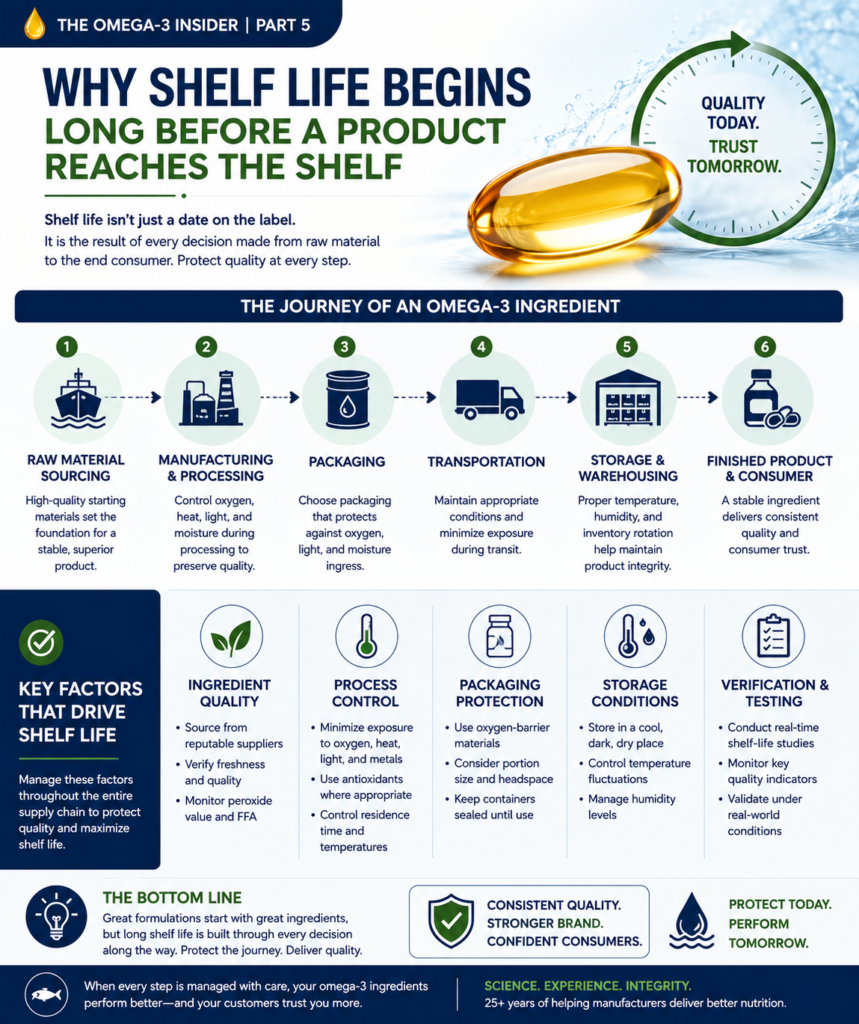
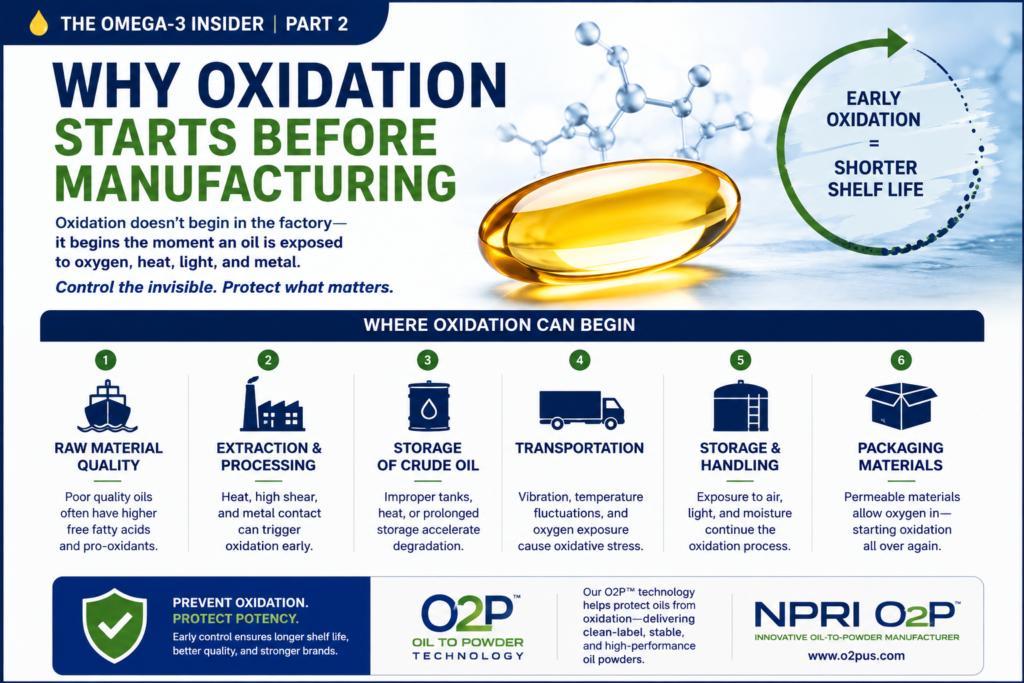
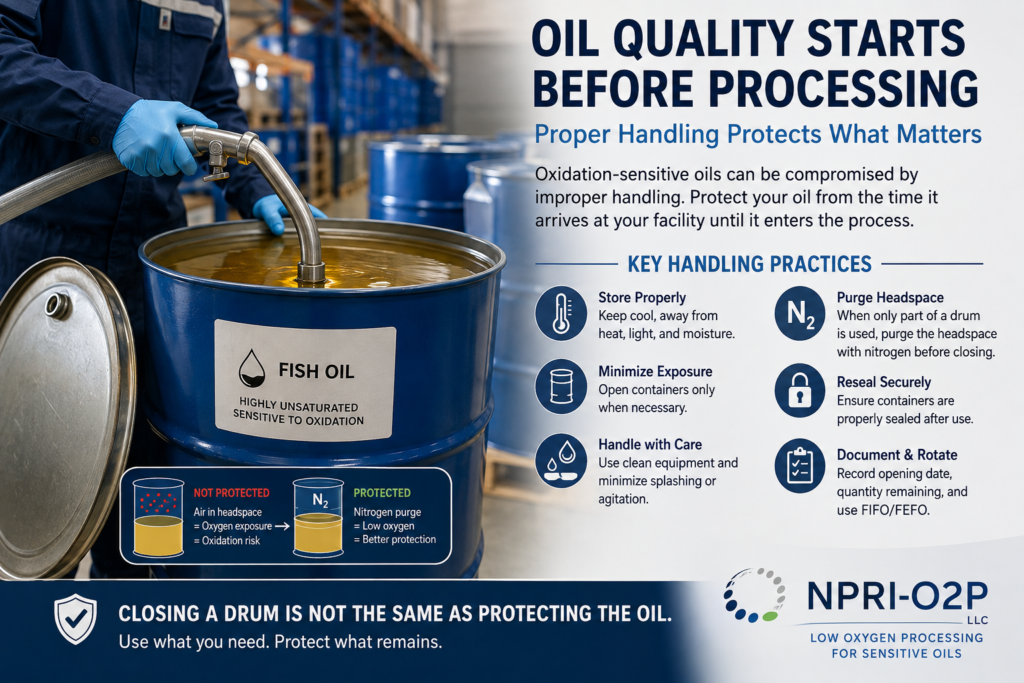
Why Shelf Life Begins Long Before a Product Reaches the Shelf
How O2P™ Technology Protects Oils from Oxidation
Shelf life begins long before a finished product reaches the consumer. Learn how raw material quality, manufacturing, packaging, storage, and transportation all contribute to product stability and long-term performance.
Oxidation begins long before oils reach the manufacturing line. Learn how raw material quality, processing, storage, transportation, and oxygen exposure can silently reduce stability, potency, and shelf life.
Proper oil handling, storage, and nitrogen purging of partially used drums can help minimize oxidation and protect sensitive oils before they enter production.
