
Can Plant-Based Omega-3 Oils Replace EPA and DHA from Fish Oil and Algae?
Understanding the nutritional distinctions between botanical omega-3 precursors, metabolic conversion, and preformed long-chain omega-3 fatty acids.
Introduction: Can Botanical Oils Provide the Same Omega-3 Nutrition?
As uncertainty in the global fish oil supply chain encourages manufacturers to diversify omega-3 sourcing, botanical oils are increasingly being considered as alternatives to conventional marine-derived ingredients.
Flaxseed oil, chia seed oil, and stearidonic acid-rich seed oils offer several attractive characteristics, including agricultural sourcing flexibility, plant-based positioning, and the ability to supply nutritionally important fatty acids.
However, a critical scientific question remains:
Can conventional botanical omega-3 oils replace the EPA and DHA supplied directly by fish oil or algae-derived omega-3 ingredients?
The answer depends on the fatty-acid composition of the ingredient, the body’s ability to convert precursor fatty acids, and the nutritional objectives of the finished product.
A high total omega-3 content does not necessarily mean an ingredient provides the specific fatty acids a formulation requires.
Understanding this distinction is essential for formulation scientists, product developers, and ingredient purchasing professionals.
1. Not All Omega-3 Fatty Acids Are the Same
Omega-3 refers to a family of polyunsaturated fatty acids with different chemical structures, metabolic pathways, and physiological functions.
Several members of this family are particularly relevant to nutritional formulation.
| Fatty acid | Abbreviation | Structure | Nutritional significance |
|---|---|---|---|
| Alpha-linolenic acid | ALA | C18:3 n-3 | Essential omega-3 fatty acid and metabolic precursor |
| Stearidonic acid | SDA | C18:4 n-3 | Precursor capable of increasing circulating EPA |
| Eicosapentaenoic acid | EPA | C20:5 n-3 | Long-chain omega-3 involved in lipid-mediator pathways |
| Docosapentaenoic acid | DPA | C22:5 n-3 | Long-chain omega-3 involved in omega-3 metabolism |
| Docosahexaenoic acid | DHA | C22:6 n-3 | Important structural fatty acid in neural and retinal tissues |
Although all belong to the omega-3 family, their nutritional roles are not identical.
For example, an oil containing 60% total omega-3 fatty acids, predominantly as ALA, cannot automatically be considered equivalent to an oil containing 40% preformed DHA.
Both may be valuable ingredients, but their fatty-acid compositions and expected nutritional delivery differ.
Total omega-3 concentration alone does not establish nutritional equivalence.
2. Understanding Botanical Omega-3 Sources
Botanical oils vary considerably in their fatty-acid profiles.
Flaxseed oil
Flaxseed oil is naturally rich in ALA, an essential omega-3 fatty acid. It is widely used in nutritional formulations seeking plant-derived omega-3 content.
However, it generally does not provide meaningful quantities of preformed EPA or DHA.
Chia seed oil
Chia seed oil is another botanical source of ALA. Like flaxseed oil, it offers a plant-derived omega-3 option but should not be treated as a direct source of preformed EPA or DHA.
SDA-rich botanical oils
Some seed oils, including Ahiflower oil derived from Buglossoides arvensis, contain stearidonic acid.
SDA offers a metabolic distinction from ALA because it bypasses the initial delta-6 desaturation step involved in ALA conversion.
As a result, SDA can increase circulating EPA more efficiently than conventional ALA-rich oils under studied conditions.
These botanical oils can therefore serve different nutritional and formulation purposes.
The important consideration is not whether one source is categorically better than another, but whether the ingredient supplies the fatty acids required by the intended product.
3. How the Body Converts Botanical Omega-3 Fatty Acids
The body can convert ALA toward EPA through a series of desaturation and elongation reactions.
However, the conversion efficiency varies and is influenced by factors such as dietary composition, individual physiology, and metabolic regulation.
The pathway from ALA to DHA requires several additional reactions, and DHA synthesis from shorter-chain precursors is generally limited in humans.
SDA enters the pathway beyond the initial delta-6 desaturation step.
This provides an advantage when the objective is to increase circulating EPA.
However, improved EPA formation does not establish equivalent DHA formation.
A precursor that increases EPA status is not automatically an adequate substitute for an ingredient supplying preformed DHA.
This distinction becomes especially important in products with quantitative EPA or DHA declarations.
4. What Does Human Clinical Research Demonstrate?
A randomized, double-blind, placebo-controlled trial published by Lefort and colleagues in 2017 investigated an SDA-rich botanical oil commercially known as Ahiflower.
The study involved 88 healthy adults who consumed different proportions of Ahiflower and high-oleic sunflower oil over 28 days.
Researchers evaluated fatty-acid composition in plasma and mononuclear cells, along with selected immune-response markers.
The findings demonstrated increases in several omega-3 fatty acids, including:
Alpha-linolenic acid (ALA)
Eicosatetraenoic acid (ETA)
Eicosapentaenoic acid (EPA)
Docosapentaenoic acid (DPA)
A comparable increase in DHA was not observed during the study period.
The researchers also reported changes in stimulated interleukin-10 production, suggesting additional biological activity worthy of further investigation.
These findings support the nutritional relevance of SDA-rich botanical oils.
However, the 28-day study did not establish long-term clinical equivalence between SDA-rich oils and preformed EPA/DHA sources.
A separate scientific review by Baker and colleagues in 2016 examined the metabolism and functional effects of plant-derived omega-3 fatty acids.
The review supports the distinction between more efficient conversion of SDA to EPA and the generally limited conversion of shorter-chain precursors into DHA.
Research disclosure: The Lefort study disclosed partial research funding received by one investigator from Nature’s Crops International, the commercial producer of Ahiflower oil. Funding alone does not invalidate the reported results, but transparent disclosure is appropriate when interpreting the evidence.
These findings illustrate an important formulation principle: increasing certain circulating long-chain omega-3 fatty acids does not necessarily provide the same nutritional delivery as consuming preformed EPA and DHA.
5. Why the Difference Between EPA and DHA Matters
EPA and DHA are both important long-chain omega-3 fatty acids, but they perform different physiological roles.
DHA contributes to the structure of cell membranes and is particularly important in neural and retinal tissues.
EPA participates in metabolic pathways associated with the formation of lipid mediators involved in inflammatory regulation.
Although EPA and DHA are metabolically related, an increase in circulating EPA cannot automatically be interpreted as equivalent to supplying a specified dietary quantity of DHA.
Consider a nutritional formulation designed to deliver 300 mg of DHA per serving.
Replacing its DHA-rich fish oil or algae oil with conventional ALA-rich or SDA-rich botanical oil would not preserve the same preformed DHA content.
Some precursor conversion may occur after consumption, but this does not substitute for analytically verifying the DHA quantity in the finished product.
Before making such a substitution, manufacturers must examine both the intended nutritional outcome and the actual composition of the proposed replacement ingredient.
6. Can Botanical Omega-3 Oils Complement Fish or Algae Oils?
Yes. In many applications, combining different fatty-acid sources may be preferable to treating them as direct substitutes.
For example, an SDA-rich botanical oil may contribute additional precursor fatty acids and support EPA status, while DHA-rich algae oil supplies preformed DHA.
Commercial products combining Ahiflower oil with algae-derived DHA illustrate this complementary approach.
Such formulations recognize that different ingredient sources may serve distinct nutritional purposes.
Likewise, manufacturers may combine selected botanical oils with fish oil where the intended product specification and regulatory requirements permit.
The objective should be to achieve a suitable fatty-acid profile rather than simply maximize the quantity of total omega-3.
Complementary ingredient formulation should not be confused with nutritional equivalence between individual fatty acids.
7. Algae-Derived EPA and DHA: A Different Approach
DHA-rich algae oil offers manufacturers an alternative to conventional fish oil when the objective is to deliver preformed DHA.
Unlike conventional botanical oils rich in ALA or SDA, DHA-rich algae oil contains DHA directly.
This allows manufacturers to formulate toward a defined DHA concentration without depending on metabolic conversion.
Algae-derived omega-3 ingredients may offer advantages for:
Fish-free nutritional formulations
Products requiring specified DHA content
Diversified omega-3 sourcing
Human nutrition and pet nutrition applications
Functional foods and powdered nutritional systems
However, algae oils differ in their EPA and DHA compositions.
Many commercial grades are predominantly DHA-rich, while certain specialty algae oils contain substantial EPA or combinations of EPA and DHA.
Higher-EPA and balanced EPA/DHA grades may have different cost and supply considerations.
Manufacturers should therefore assess the individual algae oil grade rather than assume all algae oils have the same nutritional profile.
It is also important to recognize that emerging genetically engineered oilseed crops can produce preformed EPA and DHA. Consequently, the limitations described for conventional ALA- and SDA-rich botanical oils do not apply universally to every plant-derived omega-3 source.
8. What Should Formulators Evaluate Before Replacing an Omega-3 Ingredient?
The search for alternative omega-3 sources is commercially and scientifically justified.
However, ingredient substitution should be based on measurable nutritional and formulation requirements.
Five considerations deserve particular attention.
1. Required fatty-acid composition
Determine whether the formulation requires ALA, SDA, EPA, DHA, or a defined combination.
2. Direct delivery versus metabolic conversion
Establish whether the ingredient supplies the required fatty acids directly or relies on conversion within the body.
3. Nutritional evidence
Differentiate between research demonstrating changes in circulating fatty acids and research establishing specific clinical outcomes.
4. Product quality and regulatory suitability
Evaluate oxidative stability, sensory characteristics, fatty-acid specifications, storage conditions, and applicable regulatory requirements.
5. Economic comparison
Compare ingredients on the basis of the amount of the required fatty acid delivered, not only the price per kilogram of oil or percentage of total omega-3.
For example, a botanical oil may be economically attractive when the objective is ALA supplementation, while a DHA-rich algae oil may be more appropriate when the objective is delivering a specified quantity of preformed DHA.
A meaningful cost comparison must account for the actual nutritional specification.
9. Where NPRI-O2P Technology Fits
NPRI-O2P, LLC specializes in converting compatible specialty oils into powdered ingredients using its proprietary room-temperature O2P oil-to-powder technology.
Our capabilities include:
DHA-rich algae oil in liquid and powder formats
Omega-3 fish oil powders
Specialty botanical oil powders
MCT oil powders
Custom oil-to-powder manufacturing
Incorporation of compatible oils into selected dry formulation ingredients
Our technology offers formulation flexibility for manufacturers developing nutritional powders, dry premixes, specialty food ingredients, and pet nutrition products.
Depending on the application, compatible liquid oils may be incorporated into a suitable carrier or existing dry formulation ingredient.
Oil selection, loading level, carrier compatibility, oxidative stability, packaging, and storage requirements must be evaluated for each formulation.
The conversion process does not make one fatty acid nutritionally equivalent to another.
For example, a powdered ingredient containing ALA-rich flaxseed oil remains compositionally different from a powdered ingredient containing DHA-rich algae oil.
Processing technology can change an ingredient’s physical format, but it cannot make nutritionally different fatty acids interchangeable.
NPRI-O2P’s objective is to help manufacturers select and incorporate suitable specialty oils into formulations consistent with their nutritional and processing requirements.
Conclusion: The Right Omega-3 Depends on the Formulation Objective
Botanical omega-3 oils have legitimate nutritional value and important applications in modern food and nutritional formulation.
ALA-rich oils offer an established source of an essential fatty acid, while SDA-rich botanical oils can support increases in circulating EPA through metabolic conversion.
Fish oils and suitable algae oils offer a different nutritional proposition by supplying preformed EPA, DHA, or both.
These ingredients are not necessarily competitors. In many applications, they can complement one another.
The appropriate choice depends on the desired fatty-acid composition, intended nutritional outcome, regulatory suitability, product stability, and economic considerations.
For manufacturers seeking alternatives to conventional fish oil, both botanical omega-3 oils and algae-derived ingredients deserve consideration—but not necessarily for identical nutritional purposes.
The correct question is not simply how much omega-3 an ingredient contains. It is which omega-3 fatty acids it delivers—and whether those are the fatty acids the formulation actually requires.
About NPRI-O2P, LLC
NPRI-O2P, LLC specializes in proprietary room-temperature oil-to-powder manufacturing for human nutrition, pet nutrition, and food applications.
Our capabilities include DHA-rich algae oil in liquid and powder formats, omega-3 fish oil powders, specialty botanical oil powders, and custom oil-to-powder conversion.
We work with manufacturers seeking formulation flexibility, suitable specialty oil ingredients, and alternative powdered delivery formats.
For technical inquiries and formulation discussions, visit https://o2pus.com.
Scientific References
Lefort, N., LeBlanc, R., & Surette, M. E. (2017). Dietary Buglossoides Arvensis Oil Increases Circulating n-3 Polyunsaturated Fatty Acids in a Dose-Dependent Manner and Enhances Lipopolysaccharide-Stimulated Whole Blood Interleukin-10—A Randomized Placebo-Controlled Trial. Nutrients, 9(3), 261.
https://pubmed.ncbi.nlm.nih.gov/28287415/Baker, E. J., Miles, E. A., Burdge, G. C., Yaqoob, P., & Calder, P. C. (2016). Metabolism and functional effects of plant-derived omega-3 fatty acids in humans. Progress in Lipid Research, 64, 30–56.
https://pubmed.ncbi.nlm.nih.gov/27496755/Baker, E. J. (2024). Alternative sources of bioactive omega-3 fatty acids: what are the options?
https://pubmed.ncbi.nlm.nih.gov/38126230/National Institutes of Health, Office of Dietary Supplements. Omega-3 Fatty Acids — Health Professional Fact Sheet.
https://ods.od.nih.gov/factsheets/Omega3FattyAcids-HealthProfessional/
Disclosure: The 2017 Lefort et al. study disclosed partial research funding from Nature’s Crops International. Commercial examples of botanical/algae oil blends are discussed as product-formulation examples, not as independent evidence of clinical equivalence.
Need Help With Your Formulation?
Whether you’re developing a new oil powder, improving product stability, or solving formulation challenges, our technical team is ready to help. Contact us for formulation guidance, product recommendations, or sample requests.
Recommended Technical Articles
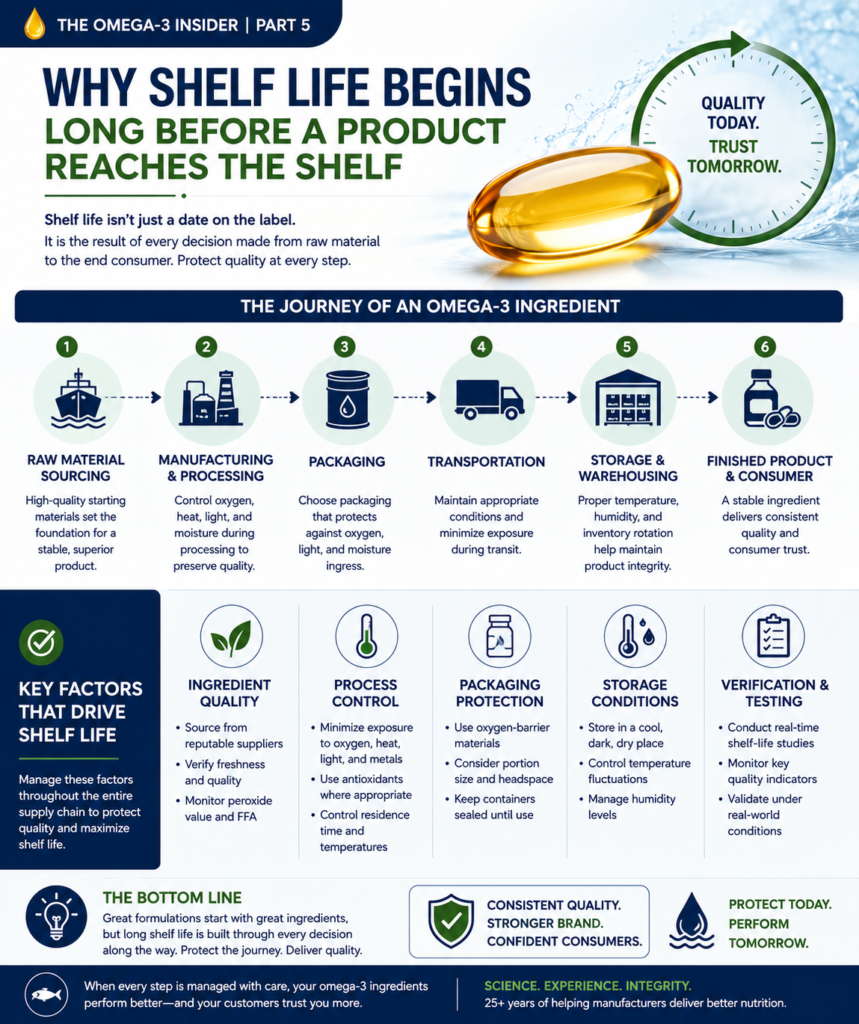
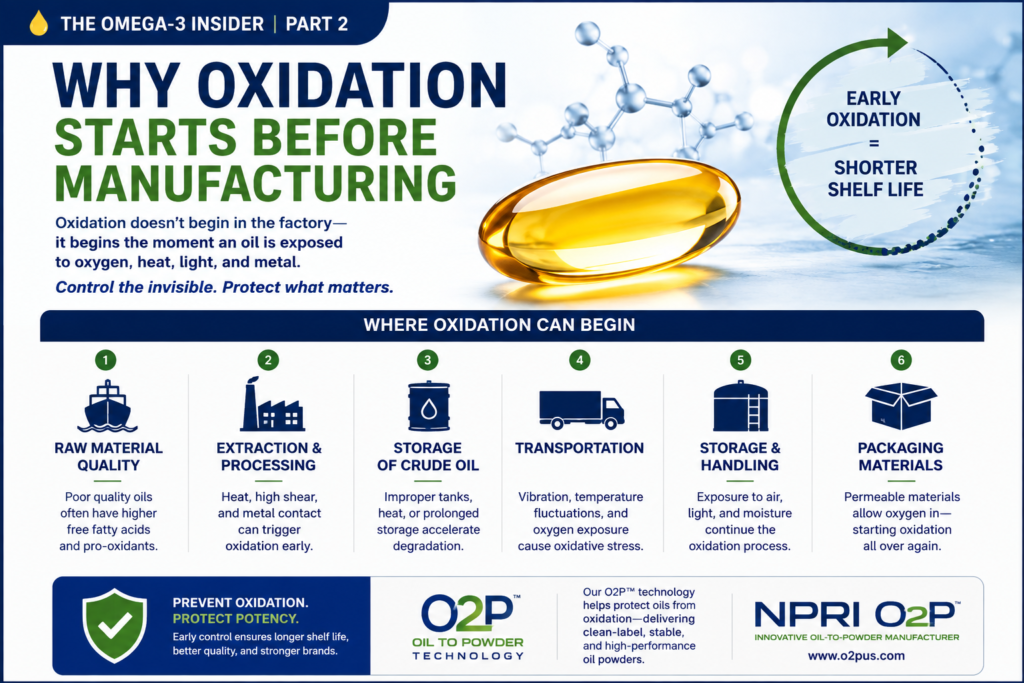
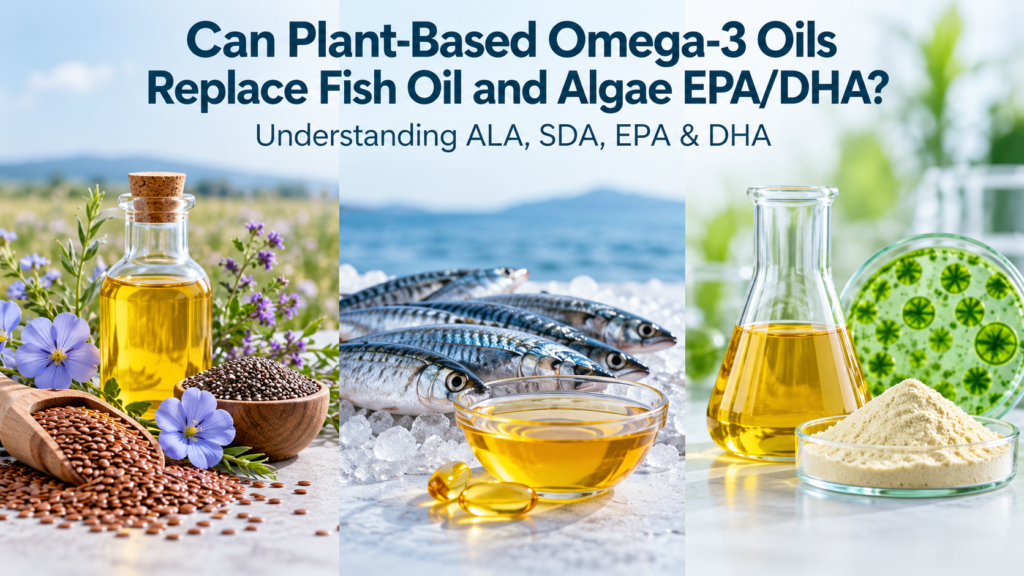
Why Shelf Life Begins Long Before a Product Reaches the Shelf
How O2P™ Technology Protects Oils from Oxidation
Shelf life begins long before a finished product reaches the consumer. Learn how raw material quality, manufacturing, packaging, storage, and transportation all contribute to product stability and long-term performance.
Oxidation begins long before oils reach the manufacturing line. Learn how raw material quality, processing, storage, transportation, and oxygen exposure can silently reduce stability, potency, and shelf life.
Not all omega-3 fatty acids are nutritionally equivalent. Explore how botanical oils, fish oil, and algae-derived omega-3 differ in EPA/DHA content, metabolic conversion, and formulation applications.