
An Omega-3 Oil Powder May Contain 50% Oil — But How Much EPA and DHA Does It Actually Deliver?
Why oil loading alone does not tell the complete story when selecting omega-3 ingredients
Understanding What Is Actually in an Omega-3 Powder
When evaluating omega-3 oil powders, formulators and purchasing professionals frequently encounter specifications describing the percentage of oil contained in the finished powder.
For example, an omega-3 powder may be described as containing 50% fish oil.
But does this tell the formulator how much EPA (eicosapentaenoic acid) and DHA (docosahexaenoic acid) the powder actually delivers?
The answer is no.
Two omega-3 oil powders can have identical oil loading percentages yet deliver substantially different quantities of EPA and DHA.
Understanding this distinction is essential when formulating nutritional supplements, functional foods, beverages, and companion animal nutrition products.
Oil Loading Is Not the Same as Omega-3 Potency
Oil loading refers to the proportion of oil incorporated into the finished powder.
For example, a powder containing 50% fish oil typically contains approximately 500 mg of fish oil per gram of powder.
However, fish oils are not all compositionally identical.
Different fish oil concentrates and naturally occurring marine oils contain varying percentages of EPA and DHA.
Consequently, the nutritional potency of a finished oil powder depends not only on the amount of oil incorporated but also on the fatty acid composition of that oil.
A Practical Formulation Example
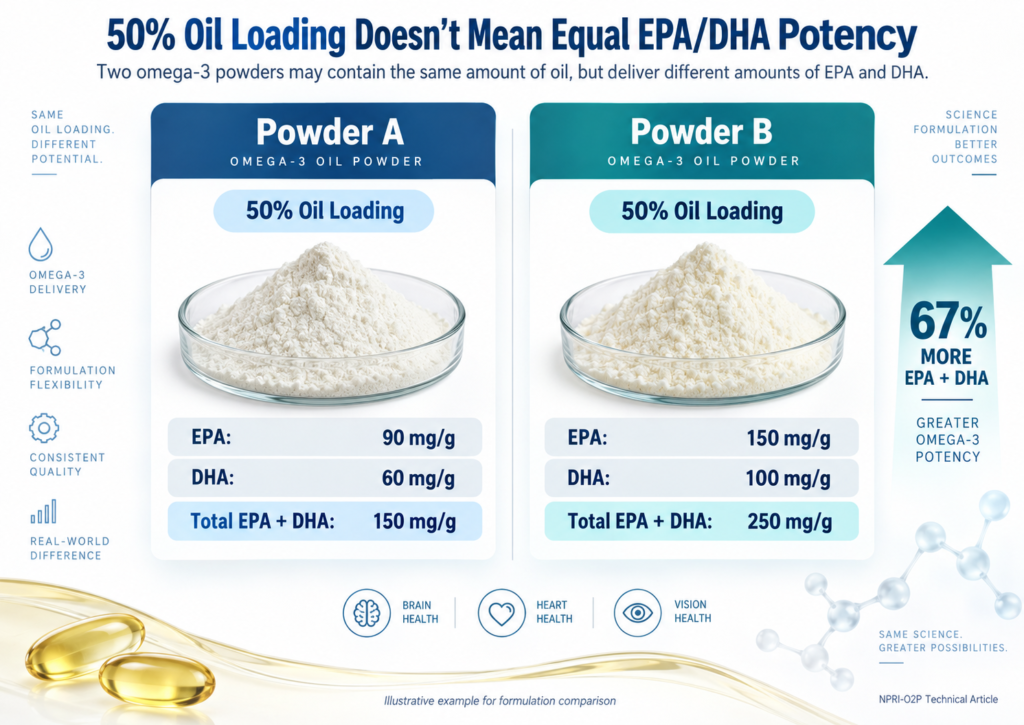
Consider two hypothetical omega-3 powders, both containing 50% fish oil.
| Specification | Powder A | Powder B |
|---|---|---|
| Total fish oil loading | 50% | 50% |
| EPA concentration in oil | 18% | 30% |
| DHA concentration in oil | 12% | 20% |
| EPA per gram of powder | 90 mg | 150 mg |
| DHA per gram of powder | 60 mg | 100 mg |
| Total EPA + DHA per gram | 150 mg | 250 mg |
Figures are illustrative, assuming compatible weight-based specifications and no processing losses.
Although both powders contain the same quantity of fish oil, Powder B delivers approximately 67% more combined EPA and DHA per gram.
This difference becomes particularly important when developing formulations with specific nutritional targets.
Why This Matters to Product Developers
Suppose a finished supplement is designed to deliver 500 mg of combined EPA and DHA per serving.
Using the hypothetical ingredients above:
Powder A would require approximately 3.33 g per serving.
Powder B would require approximately 2.00 g per serving.
Both powders contain 50% oil, but the amount required to achieve the intended nutritional target is significantly different.
This can influence formulation decisions involving serving size, capsule or tablet count, ingredient cost per serving, available space for other ingredients, and product positioning.
A lower-priced oil powder is not necessarily the more economical ingredient when evaluated against the quantity of EPA and DHA it delivers.
The Importance of Carrier Systems
Beyond EPA and DHA concentration, formulators must also consider the carrier system used to convert the liquid oil into a powder.
A carrier can influence powder flowability, dispersibility, handling characteristics, compatibility with other ingredients, and storage stability.
For example, two powders with identical fatty acid concentrations may behave differently during mixing, filling, or incorporation into a finished product because of differences in their carrier systems.
The carrier is therefore not merely a passive component. It can play an important role in the functionality and performance of the finished powder.
Can Oil Powders Be Customized to Specific Formulation Requirements?
Not every formulation requires the same EPA-to-DHA ratio.
Some applications require DHA-rich oils, while others call for a more balanced EPA/DHA profile or a higher EPA concentration.
The selected source oil must reflect the intended nutritional objectives of the finished product.
At NPRI-O2P, our proprietary O2P oil-to-powder technology provides flexibility in converting a variety of specialty oils into dry powder ingredients.
Our room-temperature manufacturing process avoids the application of processing heat during oil incorporation.
Depending on the characteristics of the oil and dry ingredient system, oil loading levels can be customized to meet specific formulation requirements.
O2P technology also allows certain suitable dry formulation ingredients to serve as the carrier for the oil, potentially reducing the need to introduce additional excipients.
This capability can offer advantages when developing complex nutritional formulations containing multiple functional ingredients.
What Should Formulators Request From Their Oil Powder Suppliers?
When evaluating an omega-3 oil powder, the following information can be more meaningful than the oil loading percentage alone:
Actual EPA and DHA concentrations in the finished powder.
Total oil loading and the fatty acid profile of the source oil.
EPA-to-DHA ratio and the ability to accommodate specific nutritional targets.
Carrier system and compatibility with the intended formulation.
Oxidative stability specifications, including appropriate peroxide and anisidine values where applicable.
Lot-specific analytical documentation and testing methods.
Recommended storage conditions and shelf life.
Understanding these parameters helps ensure that the selected ingredient is appropriate for its intended application.
Conclusion: Evaluate the Nutritional Value, Not Just the Oil Percentage
Oil loading is an important specification, but it represents only one part of the formulation equation.
The actual concentration of EPA and DHA determines how much of these fatty acids the ingredient can deliver.
For product developers, formulation scientists, and purchasing professionals, comparing oil powders solely on their percentage of oil or price per kilogram can lead to misleading conclusions.
A more meaningful evaluation considers fatty acid potency, carrier functionality, product stability, and the quantity required to achieve the intended nutritional target.
At NPRI-O2P, we work with formulators to develop specialty oil powder ingredients tailored to their nutritional and processing requirements.
For technical inquiries or to discuss a formulation project, visit www.o2pus.com or contact info@o2pus.com.
Need Help With Your Formulation?
Whether you’re developing a new oil powder, improving product stability, or solving formulation challenges, our technical team is ready to help. Contact us for formulation guidance, product recommendations, or sample requests.
Recommended Technical Articles
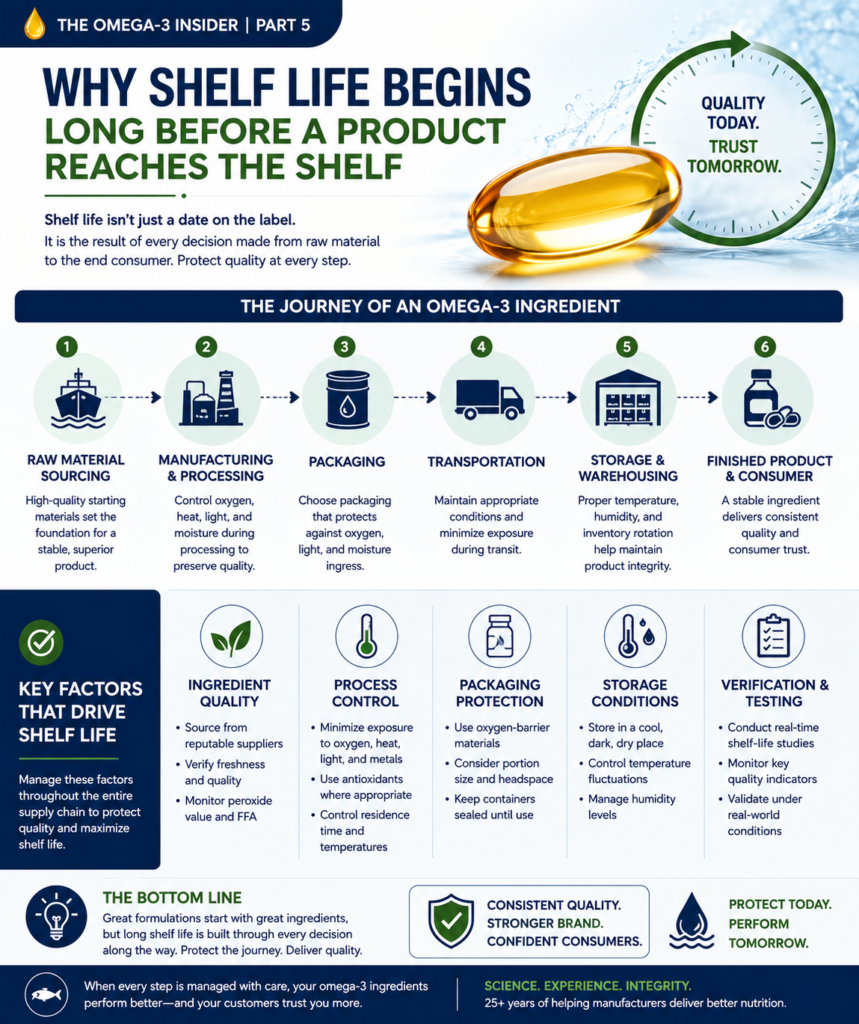
Why Shelf Life Begins Long Before a Product Reaches the Shelf
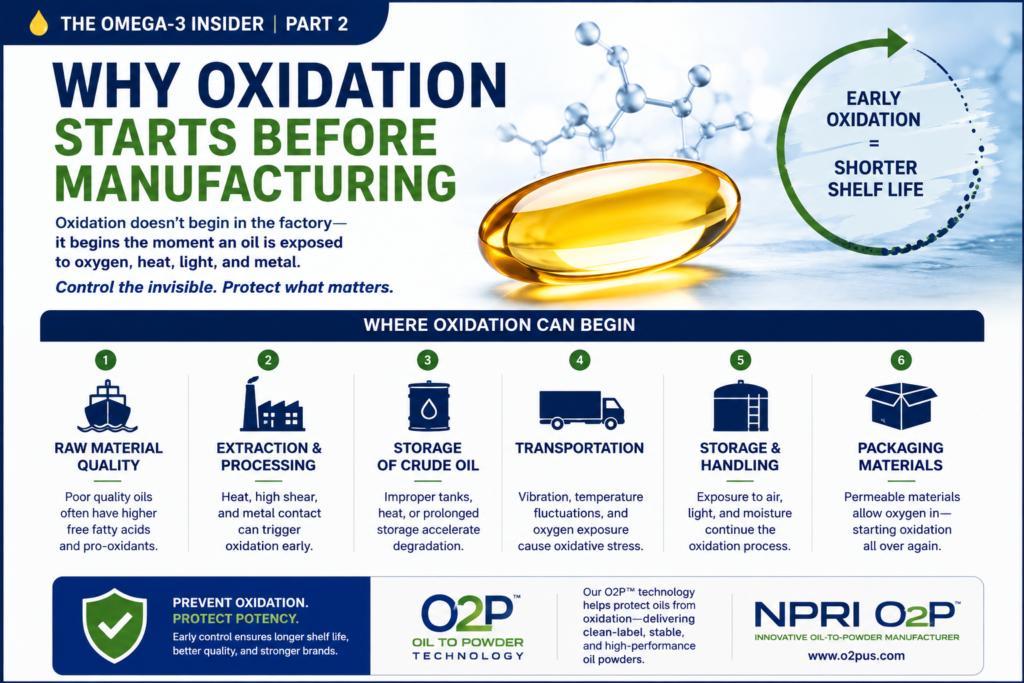
How O2P™ Technology Protects Oils from Oxidation
Shelf life begins long before a finished product reaches the consumer. Learn how raw material quality, manufacturing, packaging, storage, and transportation all contribute to product stability and long-term performance.
Oxidation begins long before oils reach the manufacturing line. Learn how raw material quality, processing, storage, transportation, and oxygen exposure can silently reduce stability, potency, and shelf life.
Discover why two omega-3 powders with identical oil loadings can deliver significantly different EPA and DHA concentrations—and what formulators should evaluate.
