
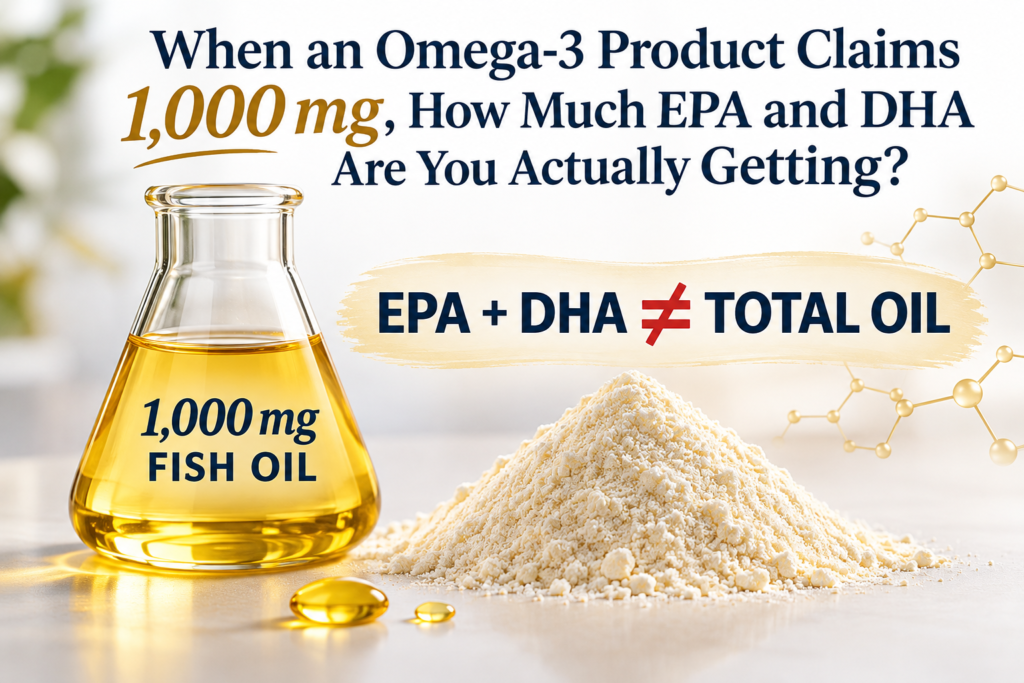
When an Omega-3 Product Claims 1,000 mg, How Much EPA and DHA Are You Actually Getting?
When you see an Omega-3 supplement advertising 1,000 mg of fish oil, what does that number actually tell you?
Does it mean you’re getting 1,000 mg of Omega-3 fatty acids? Or 1,000 mg of the two Omega-3s most frequently discussed in nutritional research — EPA and DHA?
The distinction is important, and not always obvious.
Fish Oil and EPA+DHA Are Not the Same Measurement
According to the National Institutes of Health (NIH), a typical 1,000 mg fish oil supplement may contain approximately:
180 mg EPA (eicosapentaenoic acid)
120 mg DHA (docosahexaenoic acid)
300 mg combined EPA+DHA
That means just 30% of the stated fish oil quantity consists of EPA and DHA.
The remaining portion contains other fatty acids and lipid components naturally present in the oil.
This doesn’t mean the product is inferior or misleading. It simply means that fish oil weight and EPA+DHA concentration describe two different things.
Why Concentration Matters
Not all fish oils contain the same proportions of EPA and DHA.
Some oils are concentrated to provide higher EPA and DHA levels, while others retain a more conventional fatty acid profile.
Consider two hypothetical products, each containing 1,000 mg of fish oil:
| Product A | Product B | |
|---|---|---|
| Fish oil | 1,000 mg | 1,000 mg |
| EPA | 180 mg | 330 mg |
| DHA | 120 mg | 220 mg |
| Total EPA+DHA | 300 mg | 550 mg |
Both products contain the same amount of fish oil, yet Product B delivers considerably more EPA and DHA.
For consumers, this is a reason to look beyond the largest number on the front label.
For formulators, it is a reminder to start with the intended EPA and DHA delivery rather than simply the quantity of oil.
What Happens When Fish Oil Becomes a Powder?
The calculation becomes particularly interesting when Omega-3 oils are converted into dry powder ingredients.
A finished oil powder contains both oil and the materials used to create its dry, usable form.
For example, consider a fish oil containing 330 mg EPA and 220 mg DHA per gram of oil.
If that oil is incorporated into a powder at a 50% oil loading, a 1,000 mg serving of finished powder would theoretically provide:
500 mg fish oil
165 mg EPA
110 mg DHA
275 mg combined EPA+DHA
The remaining 500 mg consists of carrier materials and other non-oil ingredients in the powder.
These are theoretical formulation calculations; actual finished-product specifications should be confirmed through analytical testing.
This is why an Omega-3 powder’s total weight should never be confused with its EPA and DHA content.
The Important Question for Product Developers
When developing an Omega-3 supplement, beverage, functional food, or pet nutrition product, three measurements deserve particular attention:
How much EPA and DHA should the finished product provide per serving?
What is the EPA and DHA concentration of the starting oil?
If the ingredient is supplied as a powder, how much oil does the finished powder actually contain?
These questions influence ingredient selection, serving size, formulation feasibility, and ultimately product cost.
A higher oil concentration does not automatically make a product better. The appropriate ingredient depends on the nutritional target and the requirements of the finished application.
Where Oil-to-Powder Technology Fits In
At NPRI-O2P, LLC, our proprietary Oil-to-Powder (O2P™) technology converts functional liquid oils into dry, water-dispersible powders using a room-temperature process without applying heat.
The process changes the physical delivery format of the oil without changing its chemical identity.
For customers developing products with specific EPA and DHA targets, the important consideration is matching the starting oil’s fatty acid profile with an appropriate powder oil loading.
Whether the application involves fish-derived Omega-3s, algae DHA, or another functional oil, understanding the actual active ingredient concentration is essential.
A Final Thought
Perhaps the most useful question isn’t:
“How much fish oil does this product contain?”
But rather:
“How much EPA and DHA does each serving actually deliver?”
For consumers, that provides a clearer understanding of what they’re purchasing.
For formulators, it is the starting point for developing a product that delivers what it promises.
NPRI-O2P, LLC — Proprietary Oil-to-Powder Technology
Website: https://o2pus.com
For ingredient development and formulation inquiries: godfrey@o2pus.com
Need Help With Your Formulation?
Whether you’re developing a new oil powder, improving product stability, or solving formulation challenges, our technical team is ready to help. Contact us for formulation guidance, product recommendations, or sample requests.
Recommended Technical Articles
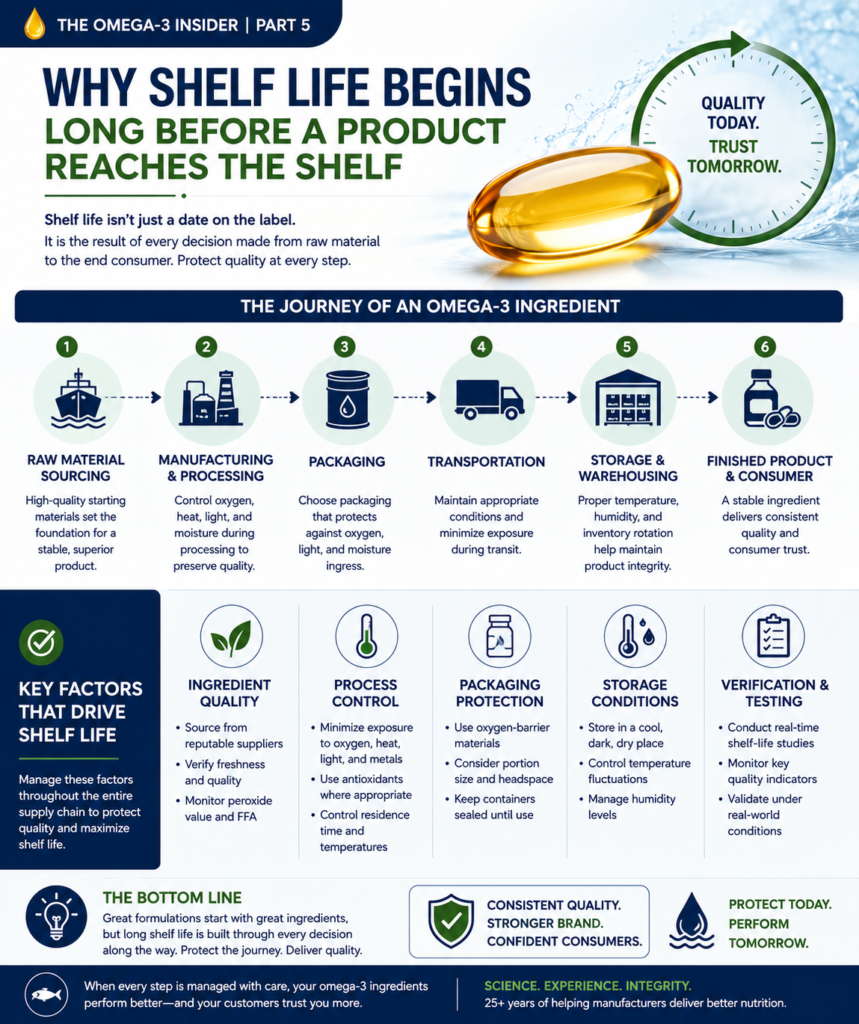
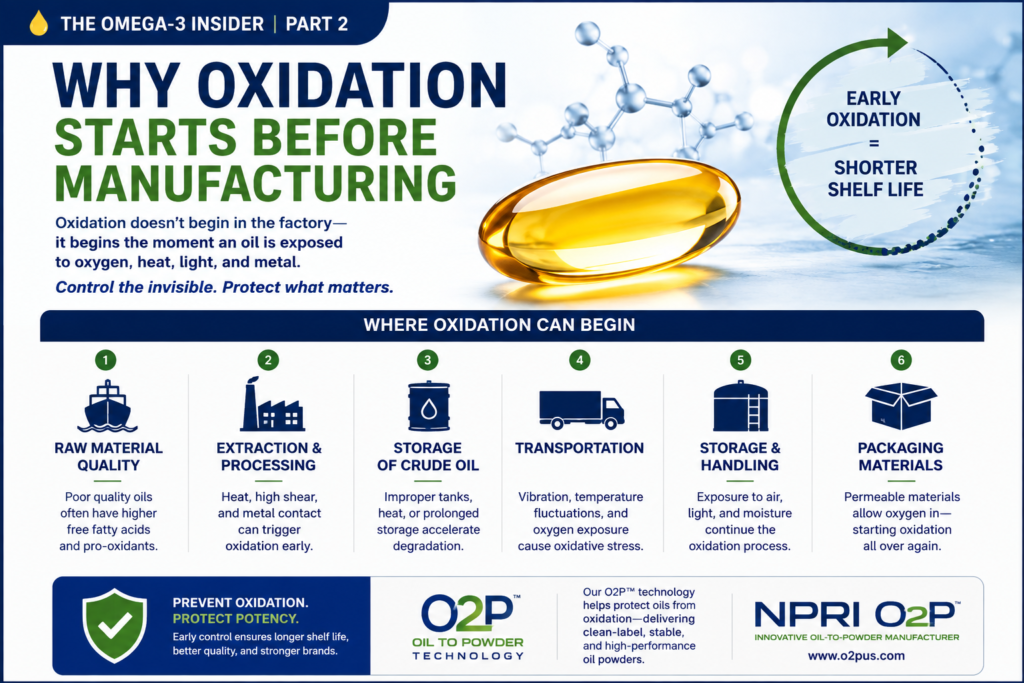
Why Shelf Life Begins Long Before a Product Reaches the Shelf
How O2P™ Technology Protects Oils from Oxidation
Shelf life begins long before a finished product reaches the consumer. Learn how raw material quality, manufacturing, packaging, storage, and transportation all contribute to product stability and long-term performance.
Oxidation begins long before oils reach the manufacturing line. Learn how raw material quality, processing, storage, transportation, and oxygen exposure can silently reduce stability, potency, and shelf life.
A 1,000 mg fish oil claim doesn’t tell the whole story. Discover how EPA/DHA concentration and powder oil loading affect actual delivery per serving.