
Why Oil Powders Require Different Storage and Handling Than Herbal Powders
At first glance, an oil powder and an herbal powder may look very similar. Both are dry, free-flowing materials supplied in bags or drums and used as ingredients in food, nutritional supplements, beverages, and pet products.
But from a storage and handling standpoint, they are not the same.
The key difference is simple: an oil powder still contains oil.
Even after a liquid oil has been converted into a powder, the lipid portion remains chemically sensitive to its surrounding environment. Depending on the type of oil, the powder may require considerably more attention to temperature, oxygen exposure, humidity, packaging integrity, and warehouse conditions than a conventional dry botanical ingredient.
A Powdered Oil Is Still an Oil-Containing System
Many herbal powders are produced by drying and grinding plant material. Although they can certainly be affected by excessive moisture, heat, light, contamination, and poor storage practices, their behavior is primarily that of a dried solid.
An oil powder is different.
It is a formulated system in which oil is incorporated into or associated with a carrier material so that the resulting ingredient can be handled as a powder.
The powder may feel dry to the touch, but internally it can contain a substantial amount of lipid.
That lipid does not lose its chemical characteristics simply because the physical form has changed.
This is particularly important with oils containing significant levels of polyunsaturated fatty acids, such as omega-3 oils.
Temperature Matters
Warehouse temperature can have a major effect on oil-containing powders.
As temperature increases, several things can occur.
The rate of oxidation may increase. The physical characteristics of the oil fraction may change. The powder may become softer or more prone to agglomeration. In some formulations, elevated temperatures can also contribute to oil migration or changes in flow characteristics.
A powder that performs well under controlled storage conditions may behave very differently after prolonged exposure to excessive warehouse heat.
This is especially relevant in warm climates, non-climate-controlled warehouses, shipping containers, trailers, or storage areas exposed to seasonal temperature swings.
For oil powders, warehouse temperature should therefore be treated as part of ingredient quality management rather than simply as a logistical consideration.
Oxygen Exposure Remains Important
One of the major concerns with many nutritional oils is oxidation.
Converting an oil into powder can improve handling and may provide physical protection for the oil, but powdering does not make the lipid immune to oxidation.
Once packaging is opened, oxygen can enter the container. Repeated opening and closing, partially filled containers, poor package seals, or prolonged exposure to air can all increase the opportunity for oxidation.
For sensitive oils, particularly those rich in EPA, DHA, or other highly unsaturated fatty acids, limiting unnecessary oxygen exposure remains important even after the oil has been converted into powder.
This is why packaging design, nitrogen flushing where appropriate, package integrity, and proper resealing procedures can be important parts of oil-powder handling.
Humidity Affects More Than Appearance
Moisture and humidity can also influence the behavior of an oil powder.
Many carrier materials used in powdered ingredients can absorb moisture from the surrounding environment.
As moisture increases, powders may begin to:
- lose flowability
- form lumps or agglomerates
- become more difficult to discharge
- experience changes in bulk density
- become more difficult to blend uniformly
Humidity can therefore affect both physical handling and manufacturing performance.
An operator may initially interpret these changes as a product-quality problem when the actual cause is improper storage or prolonged exposure to humid air after the package has been opened.
Oil Migration Can Occur
Another characteristic that distinguishes oil powders from many conventional dry powders is the possibility of oil migration.
An oil powder is carefully formulated to hold or distribute the oil within a dry carrier structure. But storage conditions can influence that structure.
Excessive heat, pressure, prolonged storage, inappropriate oil loading, or unsuitable formulation characteristics may contribute to oil moving toward the surface of the powder.
The result can be increased stickiness, reduced flowability, clumping, or visible oiling.
This does not mean that oil powders are inherently unstable. It means that they need to be treated according to the properties of the ingredient they contain.
Packaging Is Part of the Product Protection System
With conventional dry powders, packaging is often viewed primarily as a method of containment.
With sensitive oil powders, packaging can also be part of the stability strategy.
A well-designed package can help reduce exposure to:
oxygen, moisture, light, contamination, and environmental fluctuations.
Once that protective package is compromised, the storage environment becomes much more important.
For this reason, oil powders should generally remain sealed until needed and should be properly resealed after opening.
Manufacturers should also avoid transferring sensitive powders unnecessarily into poorly sealed intermediate containers.
Why Warehouse Personnel Need to Understand the Difference
One challenge is that warehouse personnel may see two bags of powder and reasonably assume that they can be treated the same way.
Visually, there may be little difference.
Chemically, however, there can be a very large difference.
A botanical powder may primarily require protection from excessive moisture and contamination.
An oil powder containing a sensitive lipid may require protection from heat, moisture, oxygen, light, and prolonged environmental exposure.
This difference becomes especially important when the oil powder contains highly unsaturated fats.
Proper Handling Continues After Manufacturing
Oil-powder stability does not depend only on how the powder was manufactured.
It continues through:
manufacturing → packaging → transportation → warehousing → customer storage → formulation → finished product.
A technically well-manufactured oil powder can still be compromised by improper handling later in the supply chain.
For that reason, storage recommendations should not be treated as optional fine print on a specification sheet.
They are part of maintaining the intended quality of the ingredient.
The Bottom Line
Oil powders offer important advantages by converting difficult-to-handle liquid oils into convenient dry ingredients.
But the word “powder” can sometimes create the wrong expectation.
An oil powder should not automatically be treated like a conventional herbal or botanical powder simply because both appear dry.
The lipid inside the powder still responds to temperature, oxygen, moisture, and time.
Understanding that difference can help prevent caking, oil migration, oxidation, loss of flowability, and other storage-related problems before they occur.
At NPRI-O2P, LLC, we believe successful oil-powder formulation extends beyond converting a liquid into a dry form. Proper formulation, packaging, transportation, storage, and handling all contribute to how the powder ultimately performs in the customer’s application.
A powder may look dry on the outside. What is inside still matters.
Need Help With Your Formulation?
Whether you’re developing a new oil powder, improving product stability, or solving formulation challenges, our technical team is ready to help. Contact us for formulation guidance, product recommendations, or sample requests.
Recommended Technical Articles
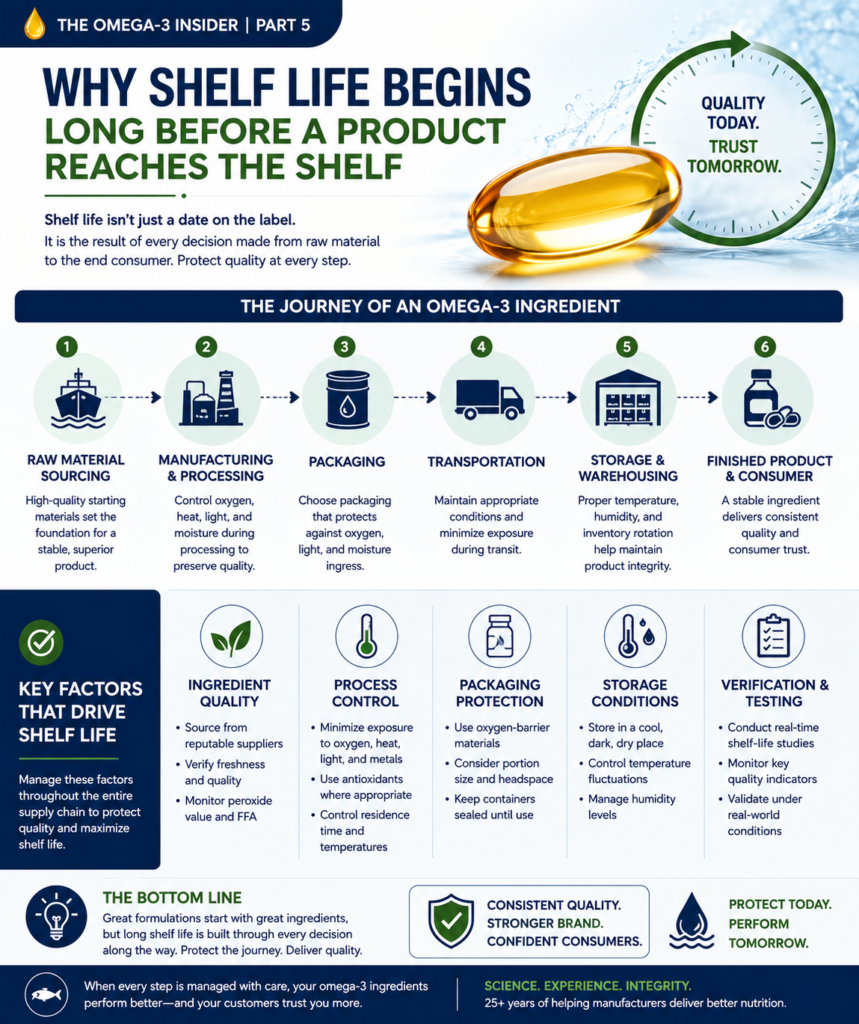
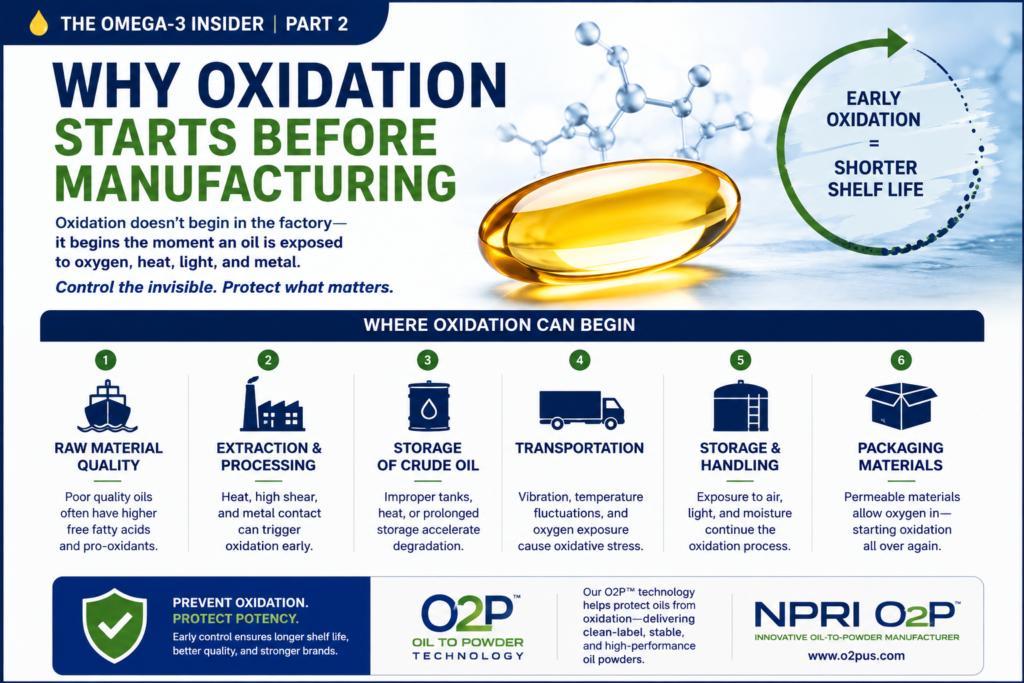
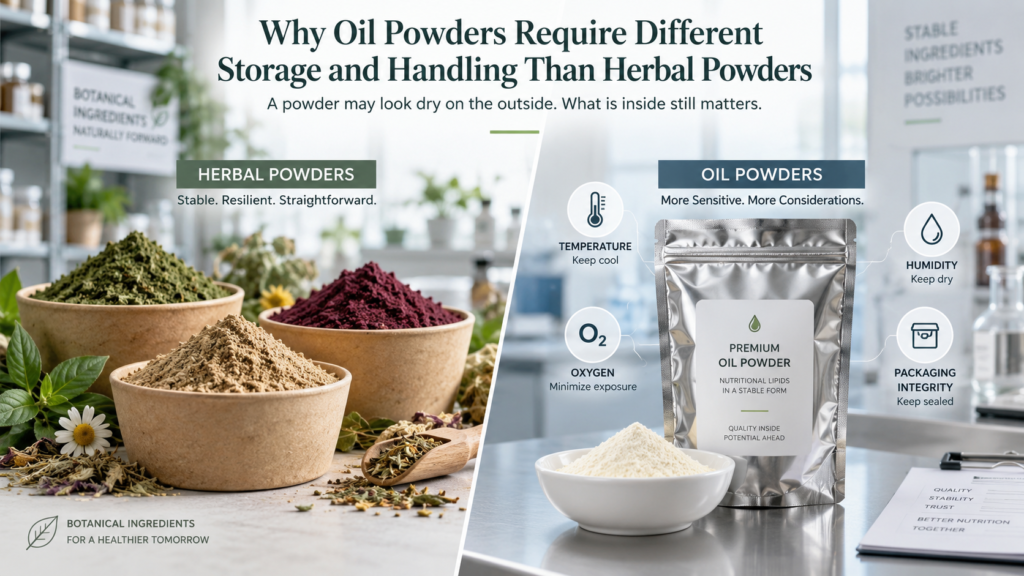
Why Shelf Life Begins Long Before a Product Reaches the Shelf
How O2P™ Technology Protects Oils from Oxidation
Shelf life begins long before a finished product reaches the consumer. Learn how raw material quality, manufacturing, packaging, storage, and transportation all contribute to product stability and long-term performance.
Oxidation begins long before oils reach the manufacturing line. Learn how raw material quality, processing, storage, transportation, and oxygen exposure can silently reduce stability, potency, and shelf life.
Oil powders may look like conventional dry ingredients, but the oils inside remain sensitive to heat, oxygen and humidity. Learn why proper storage, packaging and handling are essential to maintaining powder quality and performance.
