
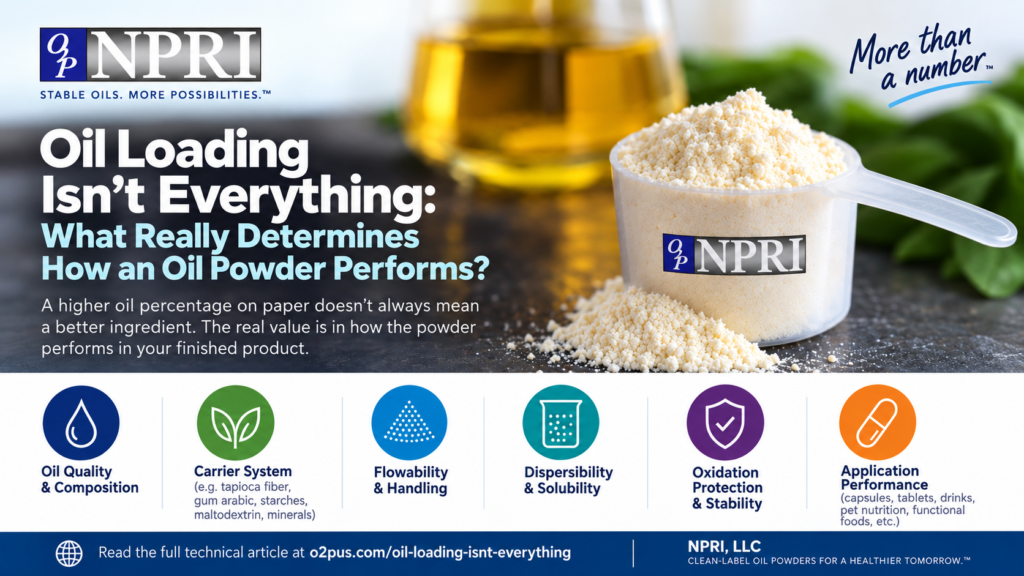
Oil Loading Isn’t Everything: What Really Determines How an Oil Powder Performs?
When evaluating an oil powder, one of the first numbers buyers and formulators often look at is the percentage of oil in the finished powder.
A 50% oil powder may be compared with a 60% or 70% oil powder, and the natural assumption is that the higher percentage must represent the better product.
That conclusion can be misleading.
Oil loading is important, but it is only one part of the formulation. The true value of an oil powder depends on how well the entire powder system performs in the customer’s finished product.
The Highest Oil Loading Is Not Always the Best Formulation
An oil powder has to do more than simply contain oil.
It has to be manufactured, packaged, stored, transported, handled and incorporated into another product. Depending on the application, it may also need to flow through production equipment, blend uniformly with other ingredients, disperse in liquid or remain stable over the intended shelf life.
As oil loading increases, the physical characteristics of the powder can also change.
A formulation that looks attractive on paper because of a very high oil percentage may become less attractive if it is difficult to handle, has poor flow characteristics, creates processing problems or does not perform properly in the finished application.
The goal should therefore be to identify the optimum oil loading, not simply the highest possible oil loading.
Start With the Finished Application
Before selecting an oil powder, the most important question is:
What is the powder going into?
The requirements for a powder used in a capsule can be very different from those for a powdered beverage.
Likewise, a formulation intended for a pet supplement may have different requirements from one used in a functional food, tablet, sachet or nutritional premix.
Application affects decisions involving oil concentration, carrier selection, flow characteristics, dispersibility, bulk density, active ingredient concentration, oxidative stability, packaging and handling requirements.
This is why NPRI-O2P routinely asks customers about the intended finished application before recommending a formulation.
Carrier Selection Matters
The carrier is not simply an inactive material added to reduce the percentage of oil.
It plays an important role in how the powder behaves.
Depending on the formulation and customer requirements, carrier systems may include materials such as:
- Tapioca fiber
- Tapioca dextrin
- Gum arabic
- Maltodextrin
- Modified starches
- Other starch systems
- Selected mineral-based materials
Each carrier can influence the physical properties of the finished powder.
For customers seeking a cleaner-label positioning, tapioca fiber can be particularly attractive, depending on the application and formulation requirements.
However, there is no universal carrier that is ideal for every oil and every end use.
The right carrier should be selected according to the oil, the desired loading, the finished product and the customer’s manufacturing requirements.
Flowability Can Determine Whether a Powder Is Practical
A powder may meet its chemical specification and still cause problems during production.
Poor flow can affect blending, conveying, filling, dosing, packaging and manufacturing consistency.
This becomes especially important when powders are used in automated production environments.
A high-loading powder that creates handling problems can ultimately be less useful than a slightly lower-loading powder that processes consistently and efficiently.
For commercial manufacturing, physical performance matters just as much as the headline percentage printed on the specification sheet.
Dispersibility Is Application-Specific
Not every oil powder needs to dissolve completely in water.
But for applications such as powdered beverages, nutritional drinks or certain functional food systems, dispersibility can be extremely important.
The formulation must therefore be designed with the final use in mind.
A powder intended primarily for encapsulation may be optimized differently from a powder intended to disperse rapidly in a liquid.
Again, the percentage of oil alone tells very little about how the powder will behave.
Sensitive Oils Require More Than High Loading
Many oils used in nutraceutical, food and pet nutrition applications are chemically sensitive.
Omega-3 oils are a good example.
EPA and DHA contain multiple double bonds, which make them nutritionally valuable but also more susceptible to oxidation.
Other specialty oils can present similar stability challenges.
When working with sensitive oils, the formulation must therefore balance oil concentration with factors such as protection, handling and shelf-life requirements.
Loading more oil into a powder has limited value if the formulation cannot adequately maintain the quality of that oil through manufacturing, storage and use.
Compare the Active Ingredient Delivered Per Gram
Another common mistake is comparing oil powders only by total oil content.
What may matter more is the amount of the desired active ingredient delivered by each gram of powder.
Consider two omega-3 powders.
One may have a higher total oil loading but use an oil with a lower EPA and DHA concentration.
Another may contain slightly less total oil but use a more concentrated omega-3 source.
Depending on the formulation, the second powder could actually deliver more EPA and DHA per gram of finished powder.
For this reason, formulators should evaluate:
Active ingredient per gram of powder — not simply total oil percentage.
This is especially important when dosage size, capsule count, serving size or finished-product cost is being optimized.
Powder Performance Is a System
A successful oil powder is the result of several variables working together:
Oil quality + oil concentration + carrier system + physical properties + stability + finished application
Changing one variable can affect the others.
That is why two powders with the same stated oil percentage can behave very differently during manufacturing and in the finished product.
The specification sheet may look similar.
The actual performance may not be.
Higher Loading Can Still Be Valuable
None of this means that high oil loading is undesirable.
In many applications, a higher concentration can provide important benefits.
It may reduce the amount of powder required to deliver a target dose, reduce serving size or allow more formulation space for other ingredients.
The key is determining whether the higher loading remains practical for the specific oil and application.
NPRI-O2P can formulate oil powders across a broad range of oil concentrations depending on the oil, carrier system and application requirements.
The appropriate concentration should ultimately be determined by the customer’s product objectives rather than by pursuing the highest percentage simply for marketing purposes.
Ask a Better Question
When evaluating an oil powder supplier, instead of asking only:
“What is your maximum oil loading?”
Consider asking:
- What loading is appropriate for my application?
- What carrier system should be used?
- How will the powder handle during manufacturing?
- Will it disperse as required?
- How much active ingredient will it deliver per gram?
- How does the formulation address the sensitivity of the oil?
- Can the powder be customized around my finished product?
Those questions provide much more useful information than oil percentage alone.
The Bottom Line
Oil loading is an important formulation parameter, but it should never be evaluated in isolation.
The best oil powder is not necessarily the one with the highest percentage of oil.
It is the powder that delivers the required active ingredients while providing the handling, stability, dispersibility and manufacturing performance needed for the finished product.
At NPRI-O2P, we work with customers by first understanding the intended application and then developing an oil powder around those requirements.
Because the real question is not:
“How much oil can you put into a powder?”
It is:
“What powder will perform best in my finished product?”
To discuss an oil-to-powder application or tolling project, visit https://.o2pus.com.
Need Help With Your Formulation?
Whether you’re developing a new oil powder, improving product stability, or solving formulation challenges, our technical team is ready to help. Contact us for formulation guidance, product recommendations, or sample requests.
Recommended Technical Articles
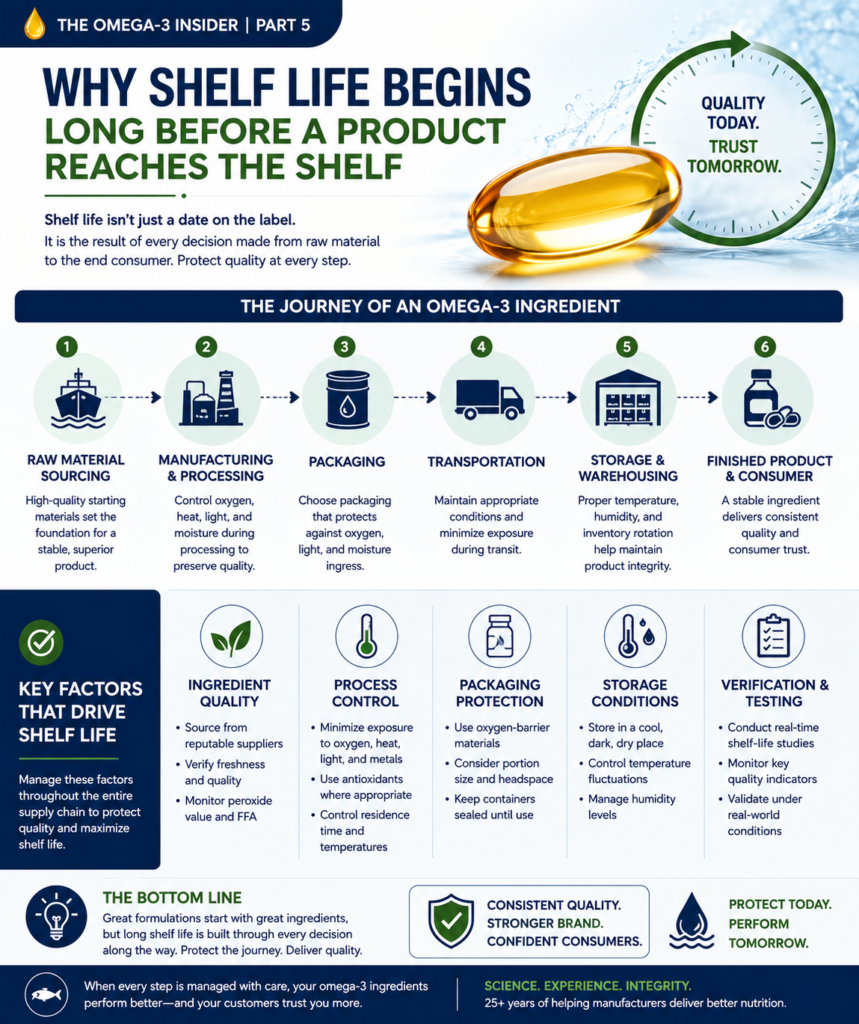
Why Shelf Life Begins Long Before a Product Reaches the Shelf
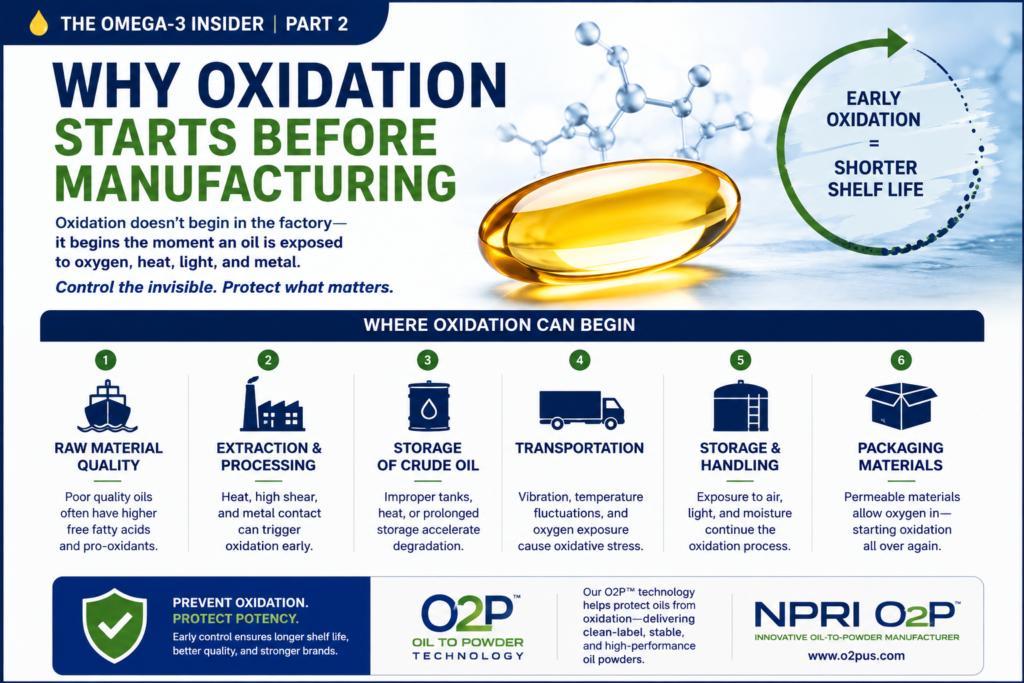
How O2P™ Technology Protects Oils from Oxidation
Shelf life begins long before a finished product reaches the consumer. Learn how raw material quality, manufacturing, packaging, storage, and transportation all contribute to product stability and long-term performance.
Oxidation begins long before oils reach the manufacturing line. Learn how raw material quality, processing, storage, transportation, and oxygen exposure can silently reduce stability, potency, and shelf life.
A higher oil percentage does not always mean better performance. Learn how carrier selection, flowability, dispersibility, stability, active concentration, and the final application determine how well an oil powder actually performs.
