
Moisture Content Is Not Water Activity — Why the Difference Matters in Oil Powders
When evaluating an oil powder, moisture content is often one of the first specifications examined.
That makes sense. Excess moisture can contribute to poor flow, caking, reduced physical stability, and other storage problems.
But moisture content does not tell the entire story.
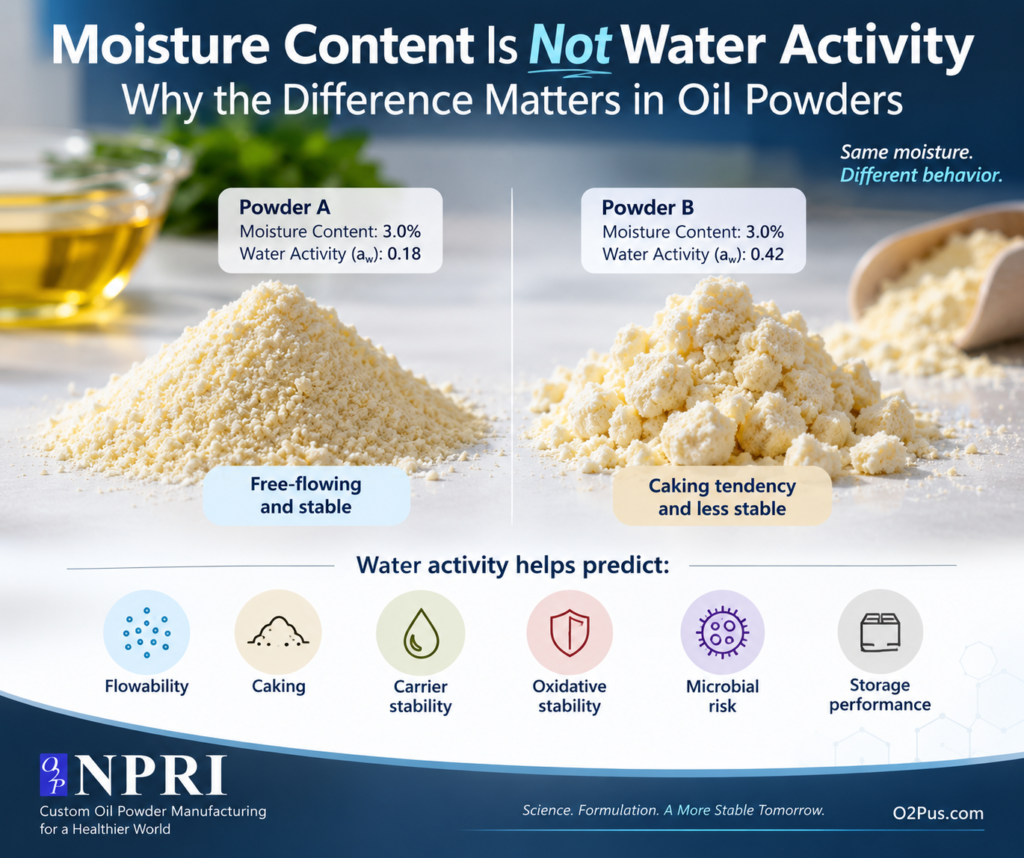
Two powders can contain similar amounts of moisture and still behave very differently.
One reason is water activity.
Moisture Content and Water Activity Are Not the Same
Moisture content measures the total amount of water present in a material.
Water activity, usually expressed as aw, describes something different: how available that water is to participate in physical, chemical, or microbiological processes.
This distinction matters because not all water contained within a powder behaves the same way.
Some water may be strongly associated with the carrier matrix or other components of the formulation. Other water may be more mobile and available to interact with the surrounding material.
As a result, knowing that a powder contains a certain percentage of moisture does not necessarily tell a formulator how that moisture will affect the product.
Why This Matters in an Oil Powder
Oil powders are complex systems.
They contain an oil phase together with a carrier system designed to convert that liquid oil into a manageable dry ingredient.
The relationship between the oil, carrier, moisture, particle structure, packaging and storage environment can influence how the powder behaves over time.
Water activity provides an additional piece of information about that system.
For example, increased moisture exposure may contribute to:
- changes in powder flow and physical properties;
- caking or agglomeration;
- deterioration of the carrier matrix;
- increased susceptibility to certain chemical reactions;
- changes in oxidative stability, depending on the formulation;
- increased microbiological risk when water activity becomes sufficiently high; and
- reduced overall storage stability.
These subjects deserve consideration, but the important point is that moisture percentage alone cannot fully describe them.
Two Powders Can Have Similar Moisture Levels but Behave Differently
Consider two oil powders with nearly identical moisture-content results.
At first glance, they might appear equally stable.
But if the water within one powder is held differently within its carrier system, its water activity can differ from that of the other powder.
The two ingredients may therefore respond differently to humidity, storage conditions or subsequent processing even though their moisture percentages appear similar.
This is one reason formulation performance cannot always be predicted from a single specification.
The Carrier System Matters
The carrier used to produce an oil powder plays an important role in how the finished ingredient interacts with water.
Different carbohydrates, fibers, gums, starches and other carrier materials have different moisture-binding and hygroscopic characteristics.
Consequently, changing the carrier system can affect much more than oil loading or powder appearance.
It can also influence:
- moisture absorption;
- water mobility;
- physical stability;
- powder handling; and
- behavior during storage.
This is particularly important when sensitive oils such as omega-3 fatty acids are involved.
The oil and the carrier should therefore be considered as a single formulation system, rather than evaluating each component independently.
Packaging and Storage Still Matter
Even a well-designed powder can change after manufacturing if it is exposed to humidity.
Many powdered ingredients are hygroscopic to some degree. Once a package is opened—or if the packaging does not provide sufficient moisture protection—the powder can begin exchanging moisture with its environment.
That means water activity is not necessarily a fixed characteristic throughout the product’s life.
Storage temperature, relative humidity, packaging barrier properties and handling practices can all influence what happens after production.
For sensitive oil powders, controlling exposure after manufacturing can therefore be just as important as controlling moisture during manufacturing.
What Should Product Developers Look At?
Moisture content remains an important specification.
The point is not to replace it.
Instead, product developers should recognize that moisture content and water activity answer different questions.
Moisture content asks:
How much water is present?
Water activity asks:
How available is that water to affect the product?
Understanding both can provide a more complete picture of how a powder may behave during processing, storage and its eventual use in a finished product.
The Bigger Lesson
A powder can meet its moisture specification and still behave differently from another powder carrying approximately the same amount of water.
That does not necessarily mean the specification is wrong.
It means that one number rarely describes the entire behavior of a complex oil-powder system.
For formulators working with sensitive oils, evaluating water activity alongside moisture content can provide additional insight into ingredient stability, carrier behavior and storage performance.
At NPRI-O2P, our approach to oil-powder development considers the interaction between the oil, carrier system, processing environment and finished-powder characteristics—not simply the percentage of oil or moisture shown on a specification sheet.
Need Help With Your Formulation?
Whether you’re developing a new oil powder, improving product stability, or solving formulation challenges, our technical team is ready to help. Contact us for formulation guidance, product recommendations, or sample requests.
Recommended Technical Articles
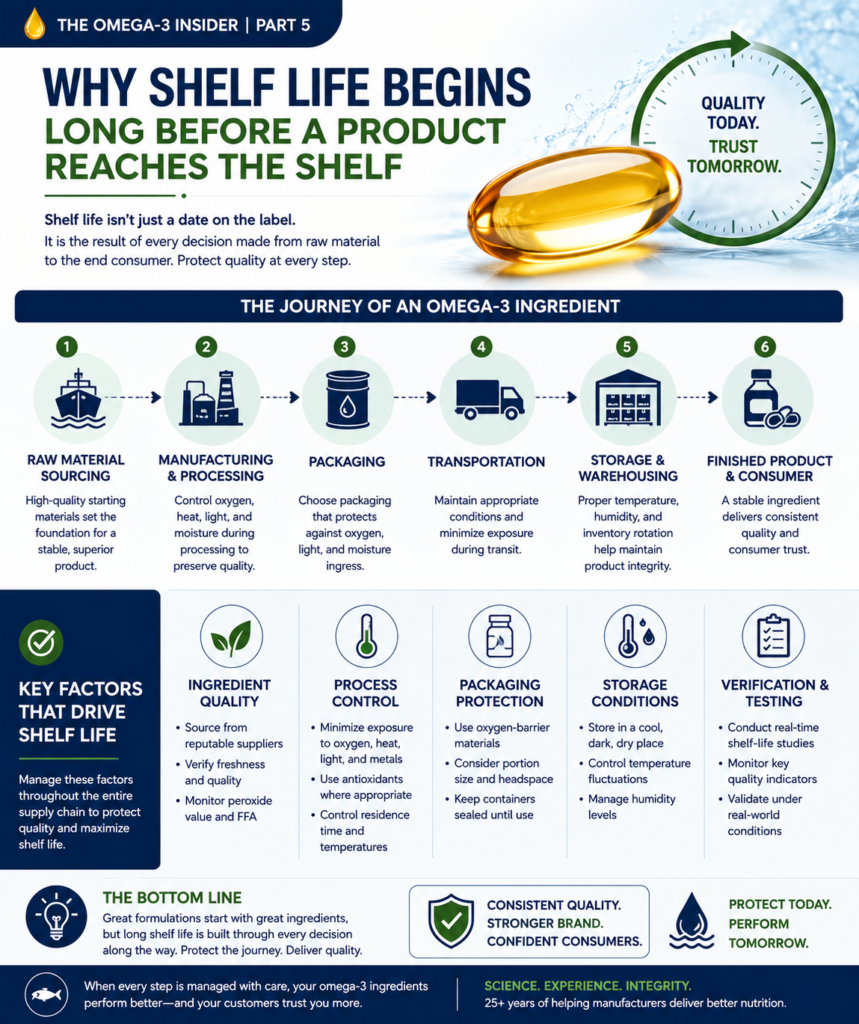
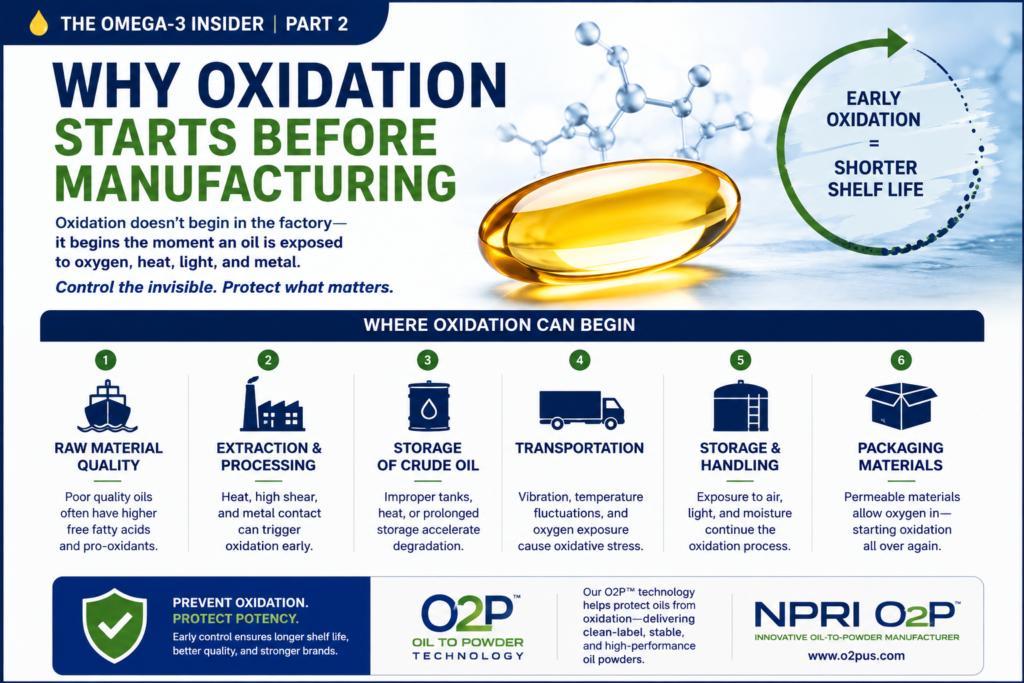
Why Shelf Life Begins Long Before a Product Reaches the Shelf
How O2P™ Technology Protects Oils from Oxidation
Shelf life begins long before a finished product reaches the consumer. Learn how raw material quality, manufacturing, packaging, storage, and transportation all contribute to product stability and long-term performance.
Oxidation begins long before oils reach the manufacturing line. Learn how raw material quality, processing, storage, transportation, and oxygen exposure can silently reduce stability, potency, and shelf life.
Moisture content tells only part of the story. Learn why water activity provides added insight into oil-powder stability, carrier behavior, storage performance, and product quality.
