
Why Are Some Functional Oils Still Difficult to Incorporate Into Dry Formulations?
Functional oils are widely used in nutritional supplements, functional foods, beverages, and pet nutrition products. From omega-3 fish and algae oils to MCT, coconut, and specialty botanical oils, these ingredients offer valuable opportunities for product innovation.
But incorporating liquid oils into dry formulations is not always straightforward.
For product developers working with powdered supplements, stick packs, tablets, capsules, or dry food blends, the challenge often extends beyond selecting the right oil.
How do you incorporate a liquid ingredient into a predominantly dry formulation while maintaining practical manufacturing and handling characteristics?
The Challenge of Working with Liquid Oils
Liquid oils can introduce complications into otherwise straightforward dry manufacturing processes.
Depending on the formulation and equipment, manufacturers may encounter:
Uneven distribution of oil throughout a dry blend
Powder agglomeration or clumping
Reduced powder flowability
Difficulties with consistent filling and processing
Additional handling or manufacturing requirements
These challenges become particularly important when a product contains multiple ingredients that must remain uniformly distributed.
For manufacturers, the issue is not necessarily the nutritional value of the oil. It is how that oil behaves within the finished formulation.
Can Converting an Oil Into Powder Simplify Formulation?
Converting liquid oils into dry powder ingredients offers another approach.
Instead of introducing liquid oil directly into a dry blend, formulators can work with an oil-containing powder designed for incorporation into their manufacturing process.
This can offer practical advantages in ingredient handling, weighing, blending, and formulation development.
However, not every oil powder behaves identically.
Powder performance depends on factors such as oil loading, carrier selection, particle characteristics, moisture, storage conditions, and the intended application.
A powder that performs well in one product may require additional evaluation before being used in another.
Oil Loading: How Much Oil Should the Powder Contain?
An important formulation consideration is oil loading—the proportion of oil contained in the finished powder.
A powder containing 50% oil, for example, provides 500 mg of oil per gram of powder.
Higher oil loading may reduce the amount of powder required to deliver a particular oil dosage. However, selecting the highest possible oil concentration is not necessarily the best formulation decision.
Product developers must also consider:
Powder flowability and handling
Compatibility with other ingredients
Carrier requirements
Finished product serving size
Manufacturing practicality
The appropriate oil loading depends on the oil itself and the intended finished product.
Does Carrier Selection Matter?
Absolutely.
The carrier is an important part of an oil powder formulation. It influences the powder’s physical properties and can affect its suitability for different applications.
Depending on the oil and formulation requirements, carriers may include tapioca dextrin, maltodextrin, gum arabic, tapioca fiber, or other suitable food-grade materials.
For some manufacturers, ingredient labeling and non-GMO or vegan preferences may be important considerations.
Others may prioritize powder handling, oil concentration, or compatibility with their existing production processes.
The right carrier should be selected with the final product in mind—not simply because it is commonly used.
What About Products Containing More Than One Functional Oil?
Another interesting consideration arises when manufacturers want to incorporate multiple functional oils into a single product.
For example, a formulation may require two different botanical oils or a combination of oils with complementary fatty acid profiles.
Depending on their compatibility and physical characteristics, it may be possible to blend the oils before converting them into a single powder ingredient.
This approach could simplify ingredient handling and reduce the need for multiple separate oil powders.
However, compatibility, desired proportions, and finished powder characteristics must be evaluated before selecting this approach.
An Alternative Approach: Room-Temperature Oil-to-Powder Technology
At NPRI-O2P, LLC, we manufacture specialty functional oil powders using our proprietary O2P™ Oil-to-Powder technology.
Unlike conventional processes that require thermal drying, our technology operates at room temperature without applying heat or chemically modifying the oil.
The process converts liquid functional oils into free-flowing, water-dispersible powder ingredients while maintaining the oil’s molecular identity.
Depending on the oil and selected carrier system, we manufacture powders with different oil-loading concentrations for applications across human nutrition, pet nutrition, and functional foods.
Importantly, converting an oil into powder does not automatically eliminate its natural taste or odor. Those characteristics remain important considerations when selecting the starting oil and developing the final formulation.
The Question Worth Asking
When developing a new dry nutritional product containing functional oils, perhaps the most useful question is not simply:
Which oil should we use?
It may also be:
What physical form of that oil will work best in our finished product and manufacturing process?
Considering that question early in product development may help manufacturers avoid unnecessary formulation challenges later.
At NPRI-O2P, we welcome discussions with product developers and R&D teams exploring practical ways to incorporate functional oils into dry nutritional formulations.
NPRI-O2P, LLC
Direct Manufacturer | Proprietary O2P™ Oil-to-Powder Technology
Website: https://o2pus.com
Email: godfrey@o2pus.com
Need Help With Your Formulation?
Whether you’re developing a new oil powder, improving product stability, or solving formulation challenges, our technical team is ready to help. Contact us for formulation guidance, product recommendations, or sample requests.
Recommended Technical Articles
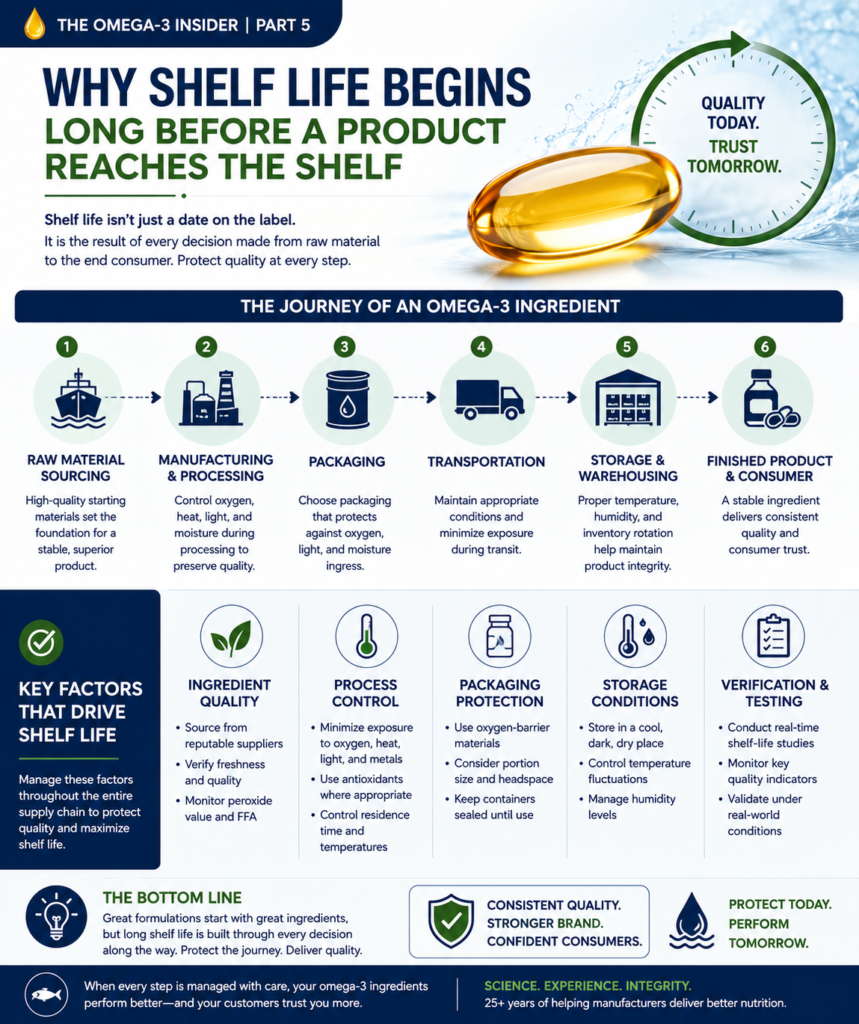
Why Shelf Life Begins Long Before a Product Reaches the Shelf
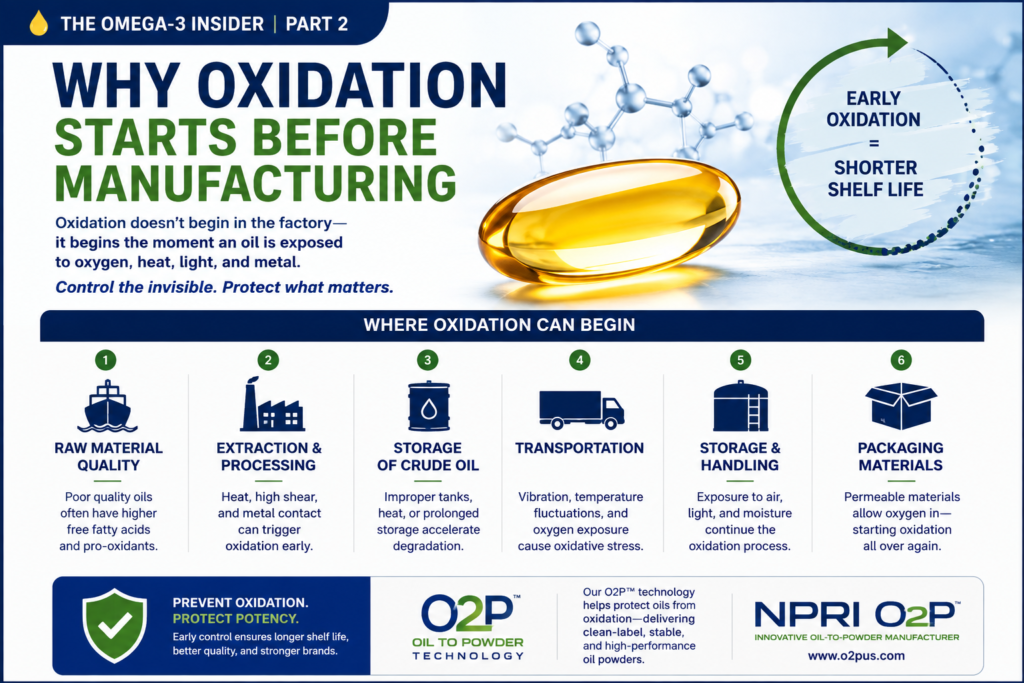
How O2P™ Technology Protects Oils from Oxidation
Shelf life begins long before a finished product reaches the consumer. Learn how raw material quality, manufacturing, packaging, storage, and transportation all contribute to product stability and long-term performance.
Oxidation begins long before oils reach the manufacturing line. Learn how raw material quality, processing, storage, transportation, and oxygen exposure can silently reduce stability, potency, and shelf life.
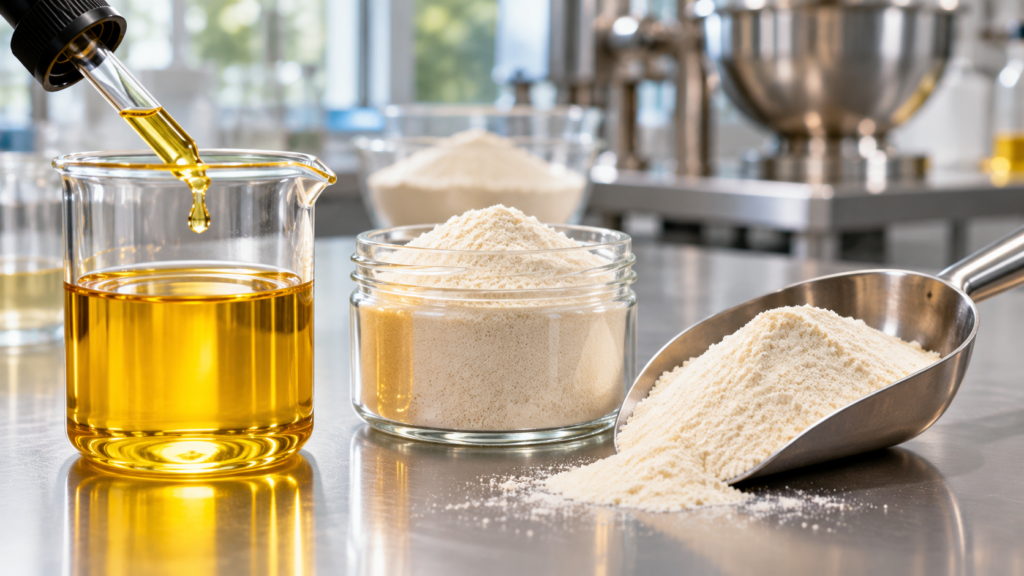
Discover how oil loading, carrier selection, and oil-to-powder technology can influence the development of dry nutritional products.