
The Science of Fatty Acids – Part 6: From Oil Stability to Powder Stability
In the previous articles in this series, we examined the structure of fatty acids, the significance of double bonds, and the chain reaction responsible for lipid oxidation.
The next question is practical:
What happens when a sensitive functional oil must be converted into a powder?
For manufacturers working with omega-3 oils, essential oils, seed oils and other functional lipids, this question is important because the method used to transform an oil into a powder can influence the condition of the oil entering the finished formulation.
The Challenge of Converting Oil Into Powder
Functional oils offer valuable nutritional and formulation benefits, but they can also present practical challenges.
Liquid oils may be difficult to incorporate uniformly into dry blends, tablets, capsules, powdered beverages, premixes and pet nutrition products. Converting the oil into a free-flowing powder can make handling, weighing, blending and formulation considerably easier.
But conversion alone is not the objective.
The objective should be to create a functional powder while protecting the characteristics of the original oil as much as possible.
This is particularly important with highly unsaturated oils.
As discussed earlier in this series, every additional double bond creates another potential point of oxidative vulnerability. EPA- and DHA-rich marine oils, for example, contain multiple double bonds and therefore require careful consideration during processing and storage.
Processing Conditions Matter
Oxidation does not begin only after a finished ingredient reaches the warehouse.
Oxidative stress can potentially occur throughout an ingredient’s lifecycle — including processing.
Several factors deserve particular attention:
Oxygen Exposure
Oxygen is one of the fundamental participants in lipid oxidation. Once oxidative reactions are initiated, oxygen can participate in the propagation reactions that allow oxidation to continue.
Reducing unnecessary exposure to oxygen is therefore an important consideration when handling oxidation-sensitive oils.
Temperature
Temperature affects reaction kinetics.
As processing temperatures rise, many chemical reactions proceed more rapidly. For sensitive lipids, thermal exposure therefore becomes an important variable when designing a manufacturing process.
This does not mean that every use of heat automatically damages an oil. The relationship depends upon temperature, exposure time, oil composition, antioxidants and other processing conditions.
The important principle is simpler:
Processing history matters.
Surface and Interfacial Exposure
When oils are dispersed into very small droplets, their interfacial area can increase dramatically.
This can be useful for emulsification and encapsulation, but it also means that the physical environment surrounding the lipid becomes increasingly important. Oxygen availability, carrier structure, droplet characteristics and the resulting powder matrix can all influence oxidative behavior.
Not All Oil Powders Are Produced the Same Way
There are multiple technologies available for transforming oils into powdered ingredients.
Different approaches may involve emulsification, drying, encapsulation, carrier matrices or combinations of these techniques.
Each technology has advantages and appropriate applications.
The important question for a formulator should therefore not simply be:
“Is this ingredient an oil powder?”
A more useful question is:
“How was the oil converted into a powder, and what happened to the oil during that process?”
That distinction becomes increasingly important as the degree of unsaturation of the oil increases.
The Role of the Powder Matrix
A properly designed oil powder is more than oil mixed with a dry carrier.
The surrounding matrix can influence powder flow, dispersibility, handling characteristics, oil loading and exposure of the lipid to the surrounding environment.
Research into encapsulated oils has demonstrated an important principle: separating oxidation-sensitive lipids from environmental oxygen through an appropriate matrix can help reduce oxygen transport to the oil.
This is why carrier selection and powder architecture deserve consideration alongside the fatty-acid profile itself.
A Different Approach: O2P™
At NPRI-O2P, these considerations led us to develop a different approach to converting functional oils into powders.
Our proprietary O2P™ Oil-to-Powder Technology operates at room temperature and is designed to avoid the deliberate application of high processing heat while limiting unnecessary oxygen exposure during conversion.
The objective is straightforward:
Convert a functional oil into a practical, free-flowing powder while minimizing processing conditions that can contribute to degradation of sensitive lipids.
This approach allows a wide range of functional oils to be transformed into powder formats suitable for nutraceutical, food, beverage and pet nutrition applications.
Depending upon the formulation and application, carrier systems can also be selected to address characteristics such as dispersibility, powder flow, clean-label positioning and finished-product requirements.
From Molecular Structure to Manufacturing Strategy
The six parts of this series have followed one continuous scientific story:
Fatty-acid structure determines the number and position of double bonds.
Double bonds influence susceptibility to oxidation.
Oxidation proceeds through chemical chain reactions.
Environmental and processing conditions influence those reactions.
And therefore:
The way a functional oil is processed matters.
Understanding lipid chemistry is not simply an academic exercise. It helps formulators, product developers and ingredient manufacturers make better decisions about sourcing, processing, stabilization and application.
For sensitive functional oils, protecting quality should begin long before the finished product reaches the shelf.
It should begin with the manufacturing process itself.
NPRI-O2P, LLC
Functional Oil Powders • O2P™ Oil-to-Powder Technology
Manufactured in Las Vegas, Nevada, USA
Need Help With Your Formulation?
Whether you’re developing a new oil powder, improving product stability, or solving formulation challenges, our technical team is ready to help. Contact us for formulation guidance, product recommendations, or sample requests.
Recommended Technical Articles
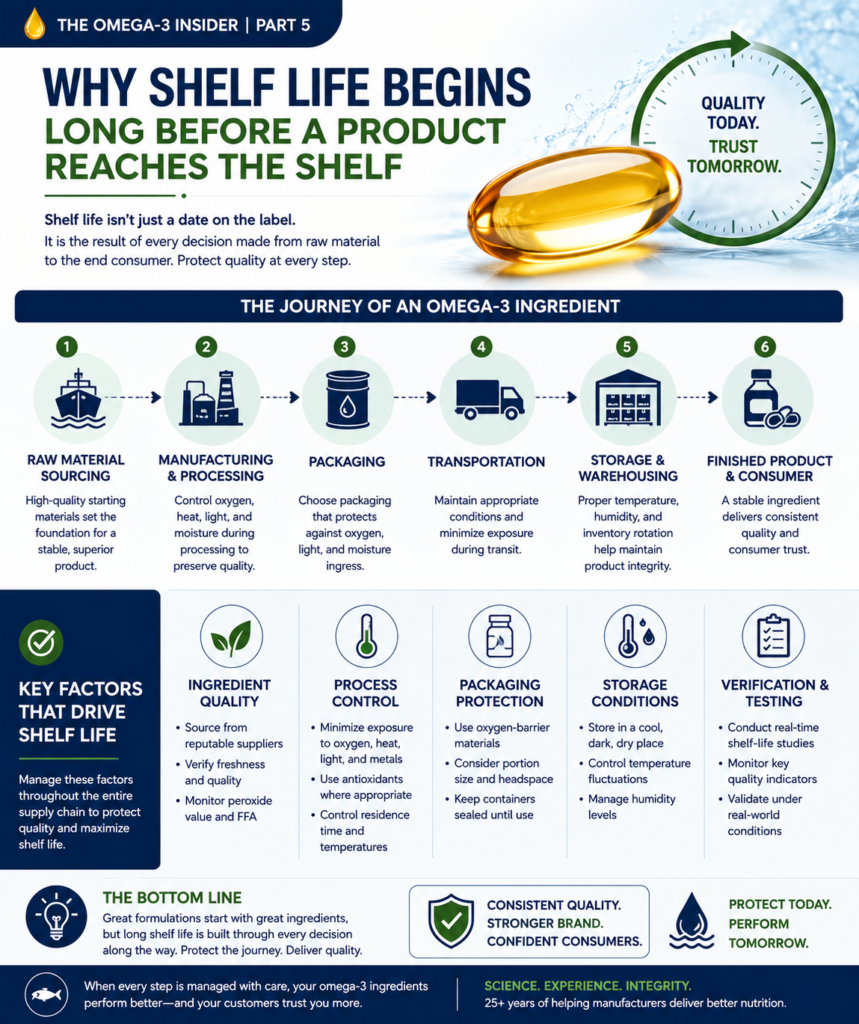
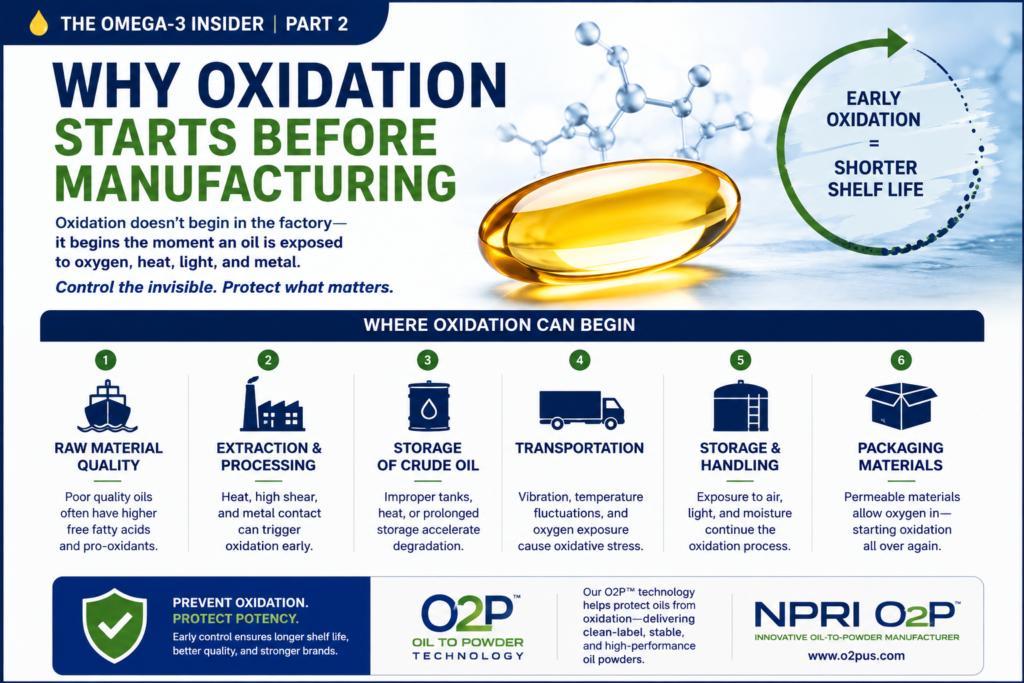
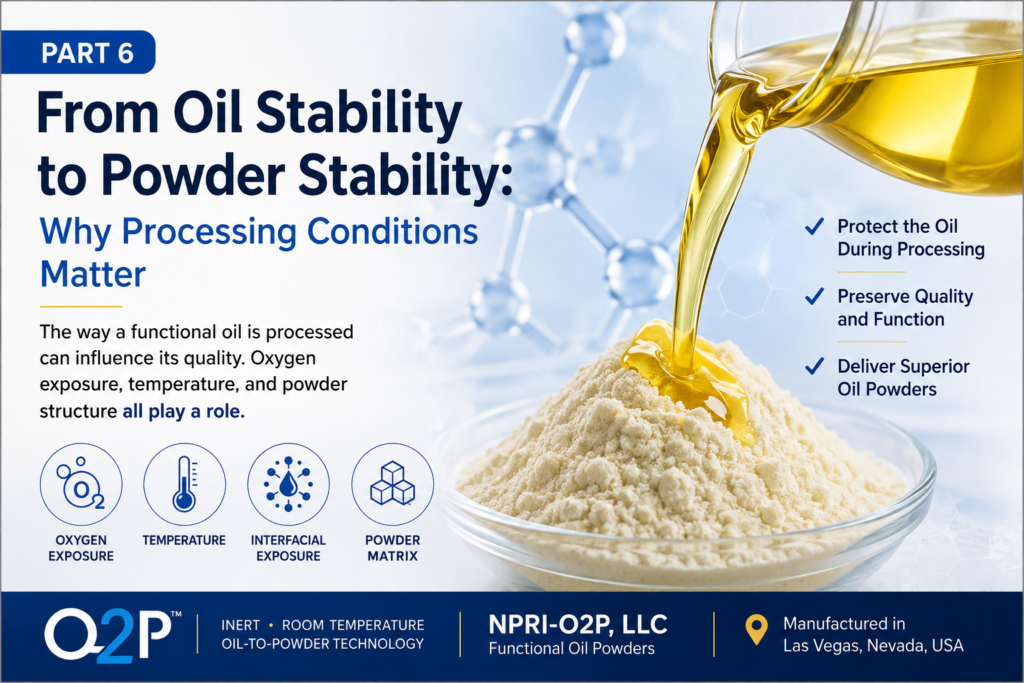
Why Shelf Life Begins Long Before a Product Reaches the Shelf
How O2P™ Technology Protects Oils from Oxidation
Shelf life begins long before a finished product reaches the consumer. Learn how raw material quality, manufacturing, packaging, storage, and transportation all contribute to product stability and long-term performance.
Oxidation begins long before oils reach the manufacturing line. Learn how raw material quality, processing, storage, transportation, and oxygen exposure can silently reduce stability, potency, and shelf life.
How processing conditions, oxygen exposure, temperature and powder structure can influence the stability of sensitive functional oils during oil-to-powder conversion.
