
When the Formula Itself Becomes the Carrier: A Different Way to Add Oils to Dry Products
Formulating oils into a dry nutritional product often creates an unnecessary complication.
A formulator may need only a modest amount of omega-3, MCT oil, botanical oil or another fatty acid source in the finished product. But because the oil is supplied as a conventional powder, the ingredient may also bring with it substantial quantities of carrier materials that were never required by the original formulation.
This raises an interesting question:
What if some of the dry ingredients already present in the formula could become the carrier for the oil?
That is one of the capabilities of O2P™ technology.
The Conventional Approach
Oil powders are commonly manufactured by combining an oil with a dedicated carrier system and converting the combination into a dry ingredient.
The finished oil powder therefore contains two things:
- the desired oil, and
- the carrier materials required to produce the powder.
For many applications this works perfectly well.
But consider a powdered nutritional formula containing ten or fifteen dry ingredients where only a relatively small amount of fatty acid is required.
Adding another oil powder may introduce additional maltodextrin, starch, gum or another carrier purely because the oil needed to be converted into a powder.
From a formulation standpoint, that carrier occupies space.
O2P™ Creates Another Possibility
O2P™ is an inert, room-temperature oil-to-powder processing technology.
One of its useful characteristics is its flexibility in the selection of the dry material onto which an oil can be loaded.
Depending upon the physical characteristics of the formulation, certain dry ingredients already present in the product may potentially function as part—or even all—of the carrier system.
Instead of thinking:
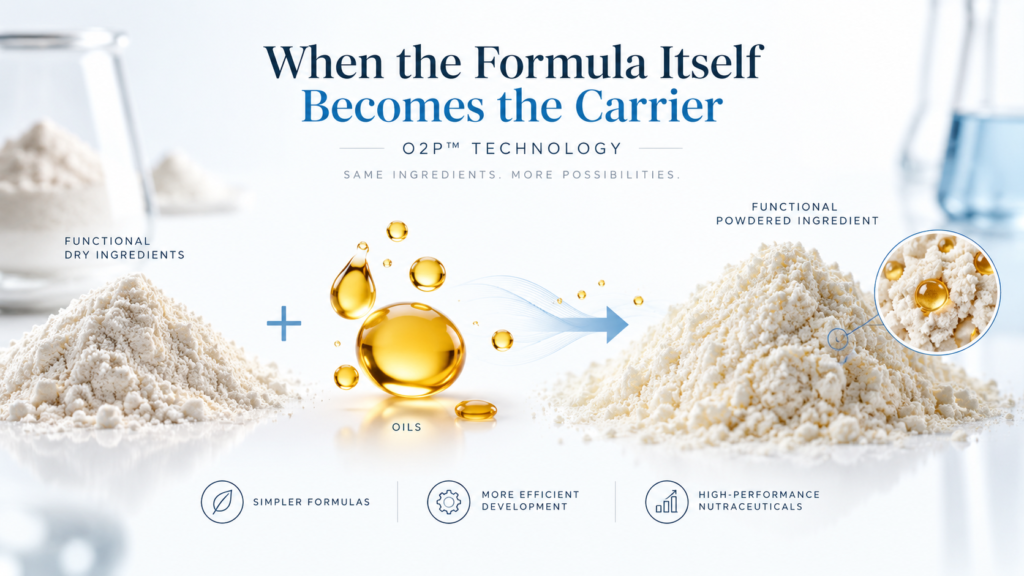
Oil + separate carrier → oil powder → finished formulation
the formulator can potentially think:
Required dry ingredient + required oil → functional powdered ingredient
The oil and an ingredient that was already going into the formulation become one component.
Why This Matters
The objective is not simply to eliminate carriers.
Carriers serve an important technical purpose in many oil powders.
The opportunity is to ask whether an additional carrier is necessary at all when suitable dry ingredients already exist within the formulation.
This can potentially provide several formulation advantages:
More efficient use of formulation space
In capsules, sachets, drink mixes, powdered foods and other dose-limited products, every gram matters.
If an ingredient already required by the formula can also carry the oil, less formulation space may need to be allocated to additional excipients.
Simpler ingredient systems
Reducing unnecessary components may help formulators create cleaner and more efficient formulations.
Multiple oils can potentially be incorporated
A formulation requiring several fatty acids or oils does not necessarily require several individual conventional oil powders.
Depending upon compatibility and formulation requirements, oils may potentially be blended and incorporated through a common O2P™ processing system.
This opens possibilities for formulations containing combinations such as omega-3 fatty acids, MCTs and botanical oils.
The Dry Ingredient May Contribute More Than Just Carrying Capacity
There is another consideration that can be particularly interesting.
Certain ingredients naturally contain compounds with antioxidant characteristics.
Where technically appropriate, incorporating oils with ingredients possessing antioxidant properties may contribute to an environment that helps protect oxidation-sensitive fatty acids.
Likewise, components already present in a formulation may contain preservation systems or other characteristics favorable to ingredient stability.
This does not eliminate the need for proper oxidative-stability testing, packaging or shelf-life validation.
But it illustrates an important principle:
The relationship between the oil and the carrier does not have to be passive.
The surrounding dry matrix can potentially contribute functionality of its own.
Not Every Dry Ingredient Will Behave the Same Way
This approach is highly formulation-dependent.
Particle structure, density, porosity, moisture, oil absorption characteristics, flow behavior and the required oil concentration all influence whether a particular dry ingredient is suitable.
For that reason, the question should not be:
“Can every ingredient carry oil?”
A better question is:
“Which ingredients already in this formulation could participate in carrying the required oil?”
That is a formulation-development question—and often one worth investigating.
Most Dry Formulas Do Not Require Extremely High Oil Levels
Much attention in oil-powder technology is placed on achieving the highest possible oil loading.
But many finished powdered products do not require extremely high concentrations of oil.
A formulation may need only a relatively small addition of a particular fatty acid.
In those applications, the flexibility of the carrier system can sometimes be more valuable than maximizing the oil percentage of an individual ingredient.
The objective should therefore be formulation efficiency, not simply the highest possible oil-loading number.
Think About the Entire Formula
Formulators traditionally evaluate an oil powder as an individual raw material.
O2P™ allows another way of looking at the problem.
Instead of asking:
“Which oil powder should I add to my formulation?”
consider asking:
“Can the formulation itself help us incorporate the oil?”
That change in thinking can create opportunities to reduce unnecessary excipients, simplify formulations and incorporate fatty acids in ways that conventional oil powders may not easily accommodate.
For product developers working with complex dry formulations, sometimes the best carrier is already in the formula.
Need Help With Your Formulation?
Whether you’re developing a new oil powder, improving product stability, or solving formulation challenges, our technical team is ready to help. Contact us for formulation guidance, product recommendations, or sample requests.
Recommended Technical Articles
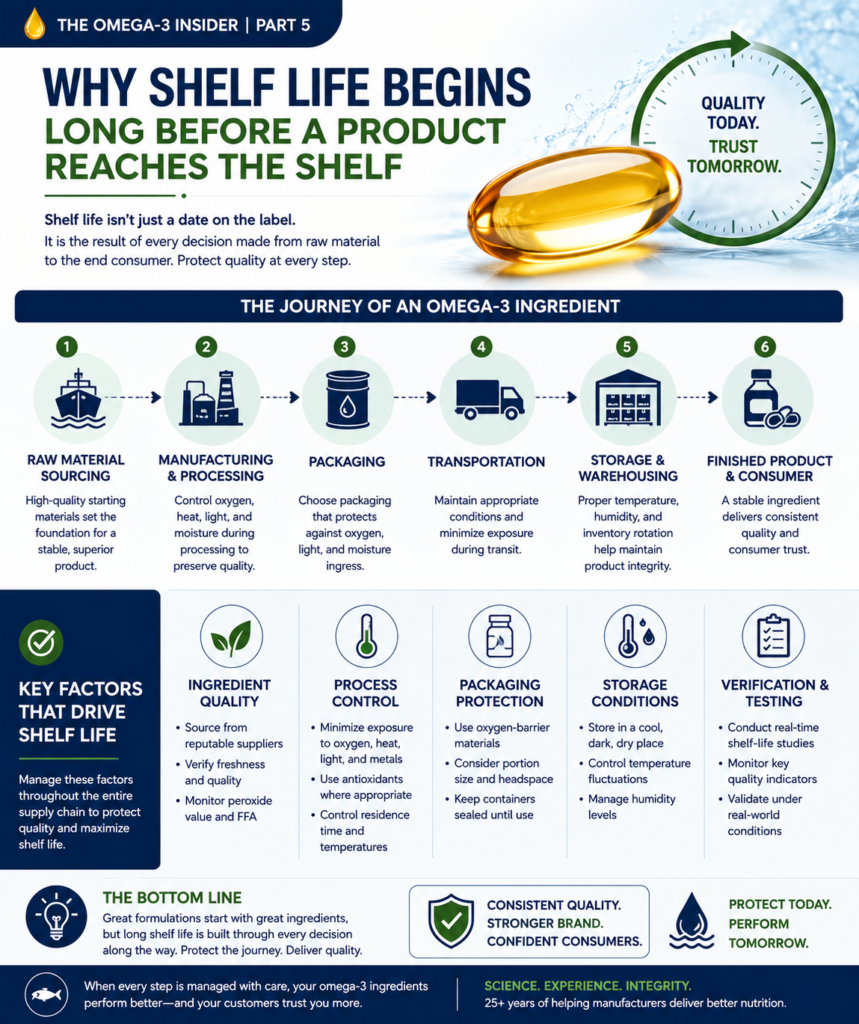
Why Shelf Life Begins Long Before a Product Reaches the Shelf
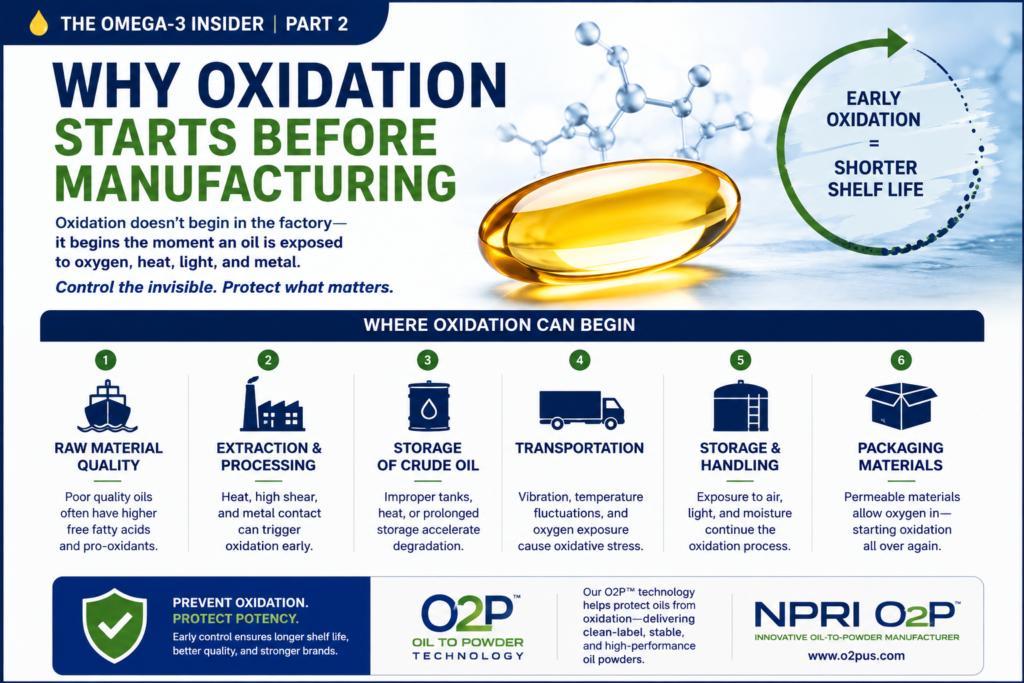
How O2P™ Technology Protects Oils from Oxidation
Shelf life begins long before a finished product reaches the consumer. Learn how raw material quality, manufacturing, packaging, storage, and transportation all contribute to product stability and long-term performance.
Oxidation begins long before oils reach the manufacturing line. Learn how raw material quality, processing, storage, transportation, and oxygen exposure can silently reduce stability, potency, and shelf life.
Discover how O2P™ technology can potentially use dry ingredients already present in a formulation to carry oils and fatty acids—helping reduce unnecessary excipients, simplify formulations, and create more efficient powdered products.
