
Developing an Omega-3 Product? Five Questions to Answer Before Selecting Your Ingredient
Choosing the right Omega-3 ingredient starts with understanding the finished product, not simply selecting the highest concentration of EPA or DHA.
Whether developing a nutritional supplement, functional food, beverage, or pet nutrition product, ingredient selection affects formulation performance, manufacturing compatibility, product positioning, and cost.
Before committing to an Omega-3 ingredient, product development and procurement teams should answer five important questions.
1. What is the target EPA and DHA dosage per serving?
The first consideration is the amount of EPA and DHA required in the finished product.
For example, an ingredient containing 50% combined EPA and DHA will require a different inclusion rate than one containing 30%.
However, total Omega-3 concentration does not tell the complete story.
A formulation targeting a specific EPA-to-DHA ratio must account for the individual fatty acid concentrations, not simply the combined Omega-3 percentage.
This becomes particularly important when working with limited serving sizes or high-potency formulations.
Key question: How many milligrams of EPA and DHA must each serving deliver?
2. What is the preferred Omega-3 source?
Omega-3 ingredients are available from several sources, including fish oil, algae oil, and plant-derived oils.
Fish oils commonly provide both EPA and DHA, although the concentrations and ratios vary.
Algae oils can provide a direct source of DHA, with certain varieties also supplying EPA.
Plant oils such as flaxseed and chia seed primarily provide alpha-linolenic acid (ALA). While the body can convert some ALA into EPA and DHA, conversion is limited and should not be assumed to provide equivalent quantities of these long-chain Omega-3 fatty acids.
The selection of oil source may also depend on dietary positioning, sustainability requirements, availability, sensory characteristics, and ingredient cost.
Key question: Does the product require EPA, DHA, ALA, or a specific combination?
3. What is the intended finished-product format?
An Omega-3 ingredient suitable for a softgel capsule may not be the most practical choice for a powdered supplement, beverage mix, chewable product, or dry food formulation.
Liquid oils can present handling and blending challenges in dry manufacturing systems.
Converting a liquid functional oil into a free-flowing powder can provide an alternative ingredient format for applications where dry blending, portioning, and manufacturing flexibility are important.
At NPRI-O2P, our proprietary O2P™ technology converts functional oils into water-dispersible powders without applying heat or exposing the oils to oxygen during the conversion process.
Importantly, converting an oil into powder does not make the oil itself water-soluble, nor does it eliminate the original oil’s characteristic flavor or odor.
Key question: Will the Omega-3 ingredient be used in a capsule, powder, chew, food, beverage, or another delivery format?
4. How will the ingredient perform during manufacturing?
Ingredient specifications are essential, but they do not always predict manufacturing behavior.
Depending on the application, formulators may need to evaluate:
Powder flowability and blending uniformity
Water dispersibility and physical suspension
Carrier composition and labeling requirements
Oil loading and serving-size limitations
Oxidative stability, packaging, and storage conditions
Compatibility with other formulation ingredients
An Omega-3 powder containing a high percentage of oil is not automatically the best choice for every formulation.
The appropriate oil loading and carrier system depend on the finished product and its manufacturing requirements.
Key question: Has the ingredient been evaluated under conditions representative of the intended manufacturing process?
5. What is the actual cost of delivering the required EPA and DHA?
Comparing ingredient prices solely on a per-kilogram basis can produce misleading conclusions.
For example, a lower-priced Omega-3 powder may contain less EPA and DHA, requiring a higher inclusion rate to deliver the same target dosage.
A more useful comparison considers:
Cost per gram of delivered EPA and DHA, together with manufacturing, packaging, and formulation requirements.
Other commercial considerations include minimum order quantities, supply reliability, documentation, lead times, and consistency between batches.
Key question: What is the effective ingredient cost per finished serving at the required EPA/DHA dosage?
Selecting the Right Omega-3 Ingredient Is a Formulation Decision
Successful Omega-3 product development requires balancing fatty acid composition, ingredient source, physical format, manufacturing requirements, and economics.
At NPRI-O2P, we work with product developers and ingredient decision-makers to evaluate functional oil powder options for nutritional supplements, functional foods, beverages, and pet nutrition products.
Our proprietary O2P™ technology offers a dry-format delivery option for a variety of functional oils, including fish-derived Omega-3, algae DHA, MCT, and other specialty oils.
Developing an Omega-3 Product?
If you are evaluating an Omega-3 ingredient for a new or existing formulation, we welcome the opportunity to discuss your requirements.
Share your target EPA/DHA dosage, oil source preference, finished-product format, and anticipated ingredient volume.
NPRI-O2P, LLC
Website: https://o2pus.com
Email: godfrey@o2pus.com
Proprietary Oil-to-Powder Technology Since 2001.
Need Help With Your Formulation?
Whether you’re developing a new oil powder, improving product stability, or solving formulation challenges, our technical team is ready to help. Contact us for formulation guidance, product recommendations, or sample requests.
Recommended Technical Articles
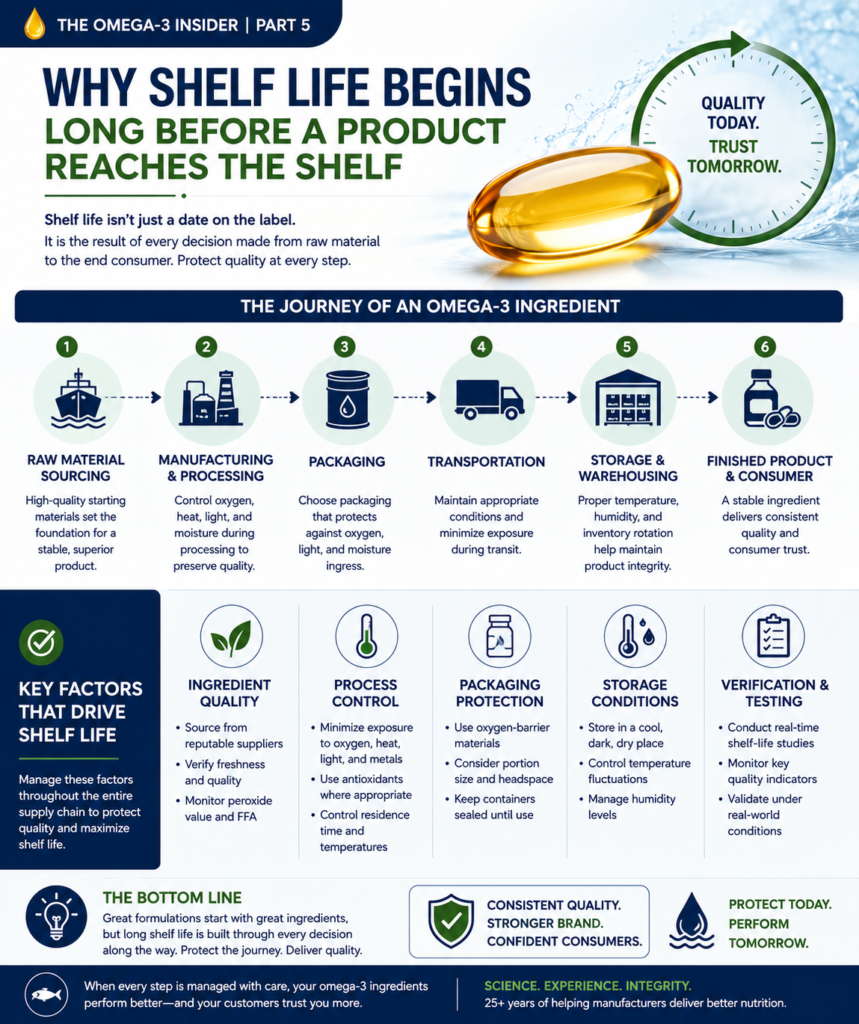
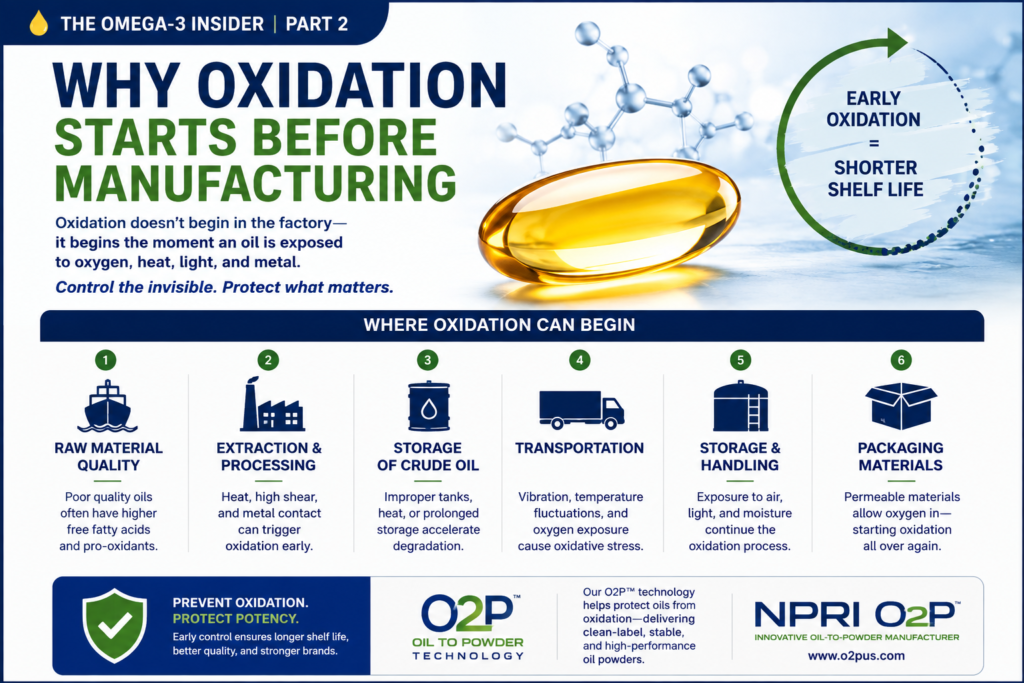
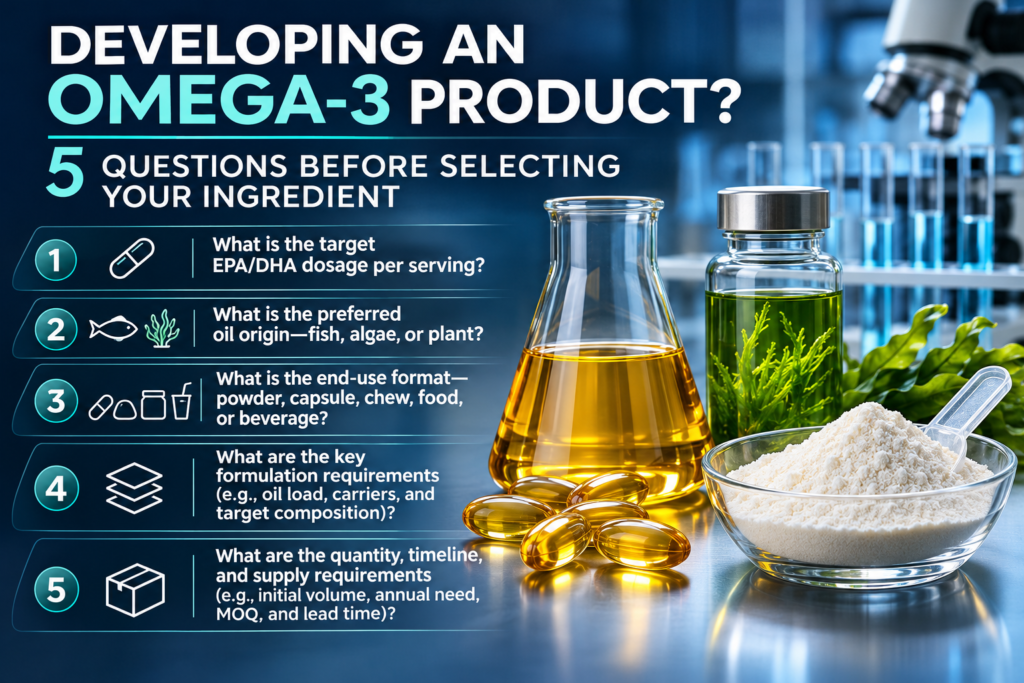
Why Shelf Life Begins Long Before a Product Reaches the Shelf
How O2P™ Technology Protects Oils from Oxidation
Shelf life begins long before a finished product reaches the consumer. Learn how raw material quality, manufacturing, packaging, storage, and transportation all contribute to product stability and long-term performance.
Oxidation begins long before oils reach the manufacturing line. Learn how raw material quality, processing, storage, transportation, and oxygen exposure can silently reduce stability, potency, and shelf life.
Selecting an Omega-3 ingredient requires more than comparing EPA and DHA percentages. Explore five essential questions covering dosage, oil source, formulation, delivery format, and cost.