
Your Omega-3 Supply Shouldn’t Depend on the Next Fishing Season
Same EPA. Same DHA. A Different Source. A New Opportunity.
For decades, the nutritional industry has relied on anchovies, sardines, and other marine fish as important sources of EPA and DHA.
But what happens when fishing seasons are suspended, raw material supplies tighten, and manufacturers can no longer obtain the omega-3 oils they depend on?
For companies manufacturing dietary supplements, functional foods, beverages, and pet nutrition products, this is no longer a hypothetical question.
When an essential ingredient becomes difficult to source, the challenge goes beyond purchasing. It becomes a question of production continuity, customer commitments, and business survival.
Perhaps it’s time to reconsider where our omega-3 fatty acids come from.
The Supply Chain Challenge
The global omega-3 industry has historically relied heavily on marine fisheries, particularly the anchovy fishery off the coast of Peru.
These fisheries are influenced by ocean temperatures, El Niño conditions, changing fish populations, government quotas, and seasonal closures.
In 2026, unfavorable fishing conditions and restrictions in Peru created significant supply disruptions.
According to IFFO, the international marine ingredients organization, fish oil production across its reporting countries was approximately 26% lower through August 2026 compared with the previous year.
For manufacturers, these disruptions create familiar challenges: higher procurement costs, longer lead times, reduced availability, and uncertainty about future production.
A manufacturer may have the customers, the formulation, and the production capacity—but without a dependable raw material supply, none of those advantages guarantees that orders can be fulfilled.
What If We Could Obtain Omega-3s Without Relying on Fish?
Here’s something worth considering.
Marine fish obtain much of their EPA and DHA through aquatic food webs that ultimately depend on omega-3-producing microorganisms, including microalgae.
Fish accumulate these fatty acids as they move through the marine food chain.
So why must manufacturers always depend on catching fish to obtain EPA and DHA?
Advances in algae cultivation and fermentation have created another pathway for producing these important fatty acids.
Rather than relying exclusively on wild fish harvests, manufacturers can explore oils derived from suitable omega-3-producing algae.
This represents more than an alternative ingredient source.
It creates an opportunity to diversify a supply chain that has become increasingly vulnerable to environmental and seasonal disruptions.
Same EPA. Same DHA. A Different Source.
From a molecular perspective, EPA remains EPA and DHA remains DHA, regardless of whether these fatty acids originate from algae or fish.
Their chemical identities do not change simply because their biological sources differ.
This is an important consideration for formulators who have traditionally associated EPA and DHA with fish oil.
However, the complete oil ingredients are not necessarily interchangeable.
Their fatty-acid concentrations, molecular forms, accompanying components, oxidative stability, sensory characteristics, and regulatory suitability must all be evaluated.
The objective is to identify an algae-derived oil that can deliver the intended nutritional specifications while meeting the manufacturer’s processing and finished-product requirements.
What About EPA? Isn’t Algae Oil Primarily DHA?
Historically, many commercial algae oils have been particularly rich in DHA, with relatively little EPA.
This has been one of the biggest obstacles to replacing conventional EPA-rich fish oils.
A DHA-focused algae oil cannot directly replace an EPA/DHA fish oil when a formulation requires specific concentrations of both fatty acids.
But algae oil technology is advancing.
Certain algae-derived oils can now provide substantial concentrations of both EPA and DHA.
Consider an algae oil with the following composition:
EPA: 300 mg/g
DHA: 200 mg/g
Combined EPA+DHA: 500 mg/g
EPA:DHA ratio: 1.5:1
This composition closely matches the fatty-acid ratio of certain conventional EPA-rich fish oils.
For manufacturers using an EPA/DHA profile of approximately 1.5:1, this creates a particularly interesting formulation opportunity.
Could they maintain their intended EPA and DHA concentrations while transitioning to a different raw material source?
In suitable applications, the answer may be yes—provided the replacement ingredient meets the necessary specifications and passes formulation testing.
A Different Source Without Abandoning Your Nutritional Objectives
One of the greatest concerns manufacturers have when considering an ingredient change is whether their established product will need to be reformulated.
This concern is understandable.
Products have undergone development, stability testing, labeling reviews, and commercial validation. A change in raw material source can introduce additional qualification work.
But switching from fish-derived EPA/DHA to appropriately specified algae-derived EPA/DHA does not necessarily require changing the product’s intended fatty-acid targets.
A manufacturer may be able to maintain its EPA and DHA delivery while evaluating another sourcing pathway.
The transition still requires verification of ingredient specifications, sensory performance, shelf-life stability, regulatory documentation, and commercial economics.
The opportunity is not to eliminate formulation work entirely.
It is to determine whether that qualification effort today can protect production continuity tomorrow.
The Importance of Supply Diversification
No raw material source is entirely immune to disruption.
Algae cultivation and fermentation depend on production capacity, raw materials, energy, quality controls, and reliable manufacturing operations.
Algae oil is not automatically less expensive than fish oil, nor is its availability unlimited.
However, it provides manufacturers with an alternative that is not directly tied to the timing and success of wild anchovy fishing seasons.
For businesses that depend heavily on fish-derived omega-3 ingredients, having a technically qualified alternative source could be an important advantage.
It may allow manufacturers to reduce dependence on a single supply chain and evaluate additional options for long-term procurement planning.
The opportunity isn’t necessarily to abandon fish oil. It’s to avoid being dependent on fish oil alone.
Bringing Algae-Derived EPA and DHA Into Powder Form
For many nutritional manufacturers, the physical form of an omega-3 ingredient is just as important as its nutritional composition.
Liquid oils may be difficult to incorporate into dry formulations, tablets, powdered beverages, stick packs, sachets, and certain pet nutrition products.
NPRI-O2P, LLC addresses this challenge through its proprietary O2P™ Oil-to-Powder technology.
As a U.S.-based direct manufacturer and owner of this technology, NPRI-O2P converts compatible liquid functional oils into dry, free-flowing powders using a room-temperature physical process.
Our conversion technology does not alter the original chemical identity of the oil.
By selecting suitable oil loadings and carrier systems, we can evaluate algae-derived EPA/DHA powders for different nutritional manufacturing applications.
For example, an algae oil containing 300 mg/g EPA and 200 mg/g DHA, converted at a theoretical 50% oil loading, would provide approximately:
EPA: 150 mg/g of finished powder
DHA: 100 mg/g of finished powder
Combined EPA+DHA: 250 mg/g of finished powder
These are theoretical formulation values that must be confirmed through finished-powder testing.
The objective is to provide manufacturers with an alternative omega-3 ingredient format while preserving their intended EPA/DHA nutritional targets.
The Time to Evaluate Alternatives Is Before the Next Shortage
For manufacturers that have successfully used fish oil for years, there may seem to be little reason to change.
But recent supply disruptions have demonstrated the risks associated with depending heavily on a raw material whose availability can change with ocean conditions and fishing restrictions.
Waiting until inventories are depleted may leave insufficient time to identify, qualify, and incorporate an alternative ingredient.
Manufacturers considering algae-derived EPA/DHA can begin with a technical evaluation, compare specifications, conduct formulation trials, and assess commercial feasibility.
A second qualified omega-3 source could eventually become an important part of their supply strategy.
Looking Ahead
The future of omega-3 nutrition does not have to depend entirely on the availability of wild-caught fish.
Algae-derived EPA and DHA create new opportunities for manufacturers to diversify raw material sourcing while continuing to pursue their established nutritional objectives.
For some products, fish oil may remain the preferred ingredient.
For others, algae-derived omega-3 may offer a practical alternative.
And for manufacturers concerned about future interruptions, maintaining access to both could provide greater flexibility.
Your next production run should not have to depend entirely on the next successful fishing season.
At NPRI-O2P, we are expanding our algae-derived omega-3 powder capabilities to help manufacturers explore that alternative.
Is Your Company Considering an Alternative to Fish Oil?
If your company is experiencing fish oil supply challenges or evaluating algae-derived EPA/DHA ingredients, we welcome the opportunity to discuss your specific formulation requirements.
NPRI-O2P, LLC
Proprietary O2P™ Oil-to-Powder Technology
Las Vegas, Nevada, USA
https://o2pus.com
godfrey@o2pus.com
References
IFFO — The Marine Ingredients Organisation. Amid Coastal El Niño, Fishmeal and Fish Oil Output Remains Weak. August 20, 2026. https://www.iffo.com/amid-coastal-el-nino-fishmeal-and-fish-oil-output-remains-weak
IFFO — The Marine Ingredients Organisation. El Niño Remains a Concern, with Expectations of a Prolonged Coastal Warming in Peru. October 5, 2026. https://www.iffo.com/el-nino-remains-concern-expectations-prolonged-coastal-warming-peru
Comparative Bioavailability of DHA and EPA from Microalgal and Fish Oil in Adults. Scientific study examining EPA/DHA bioavailability from algae and fish oils. https://pubmed.ncbi.nlm.nih.gov/41096614/
Need Help With Your Formulation?
Whether you’re developing a new oil powder, improving product stability, or solving formulation challenges, our technical team is ready to help. Contact us for formulation guidance, product recommendations, or sample requests.
Recommended Technical Articles
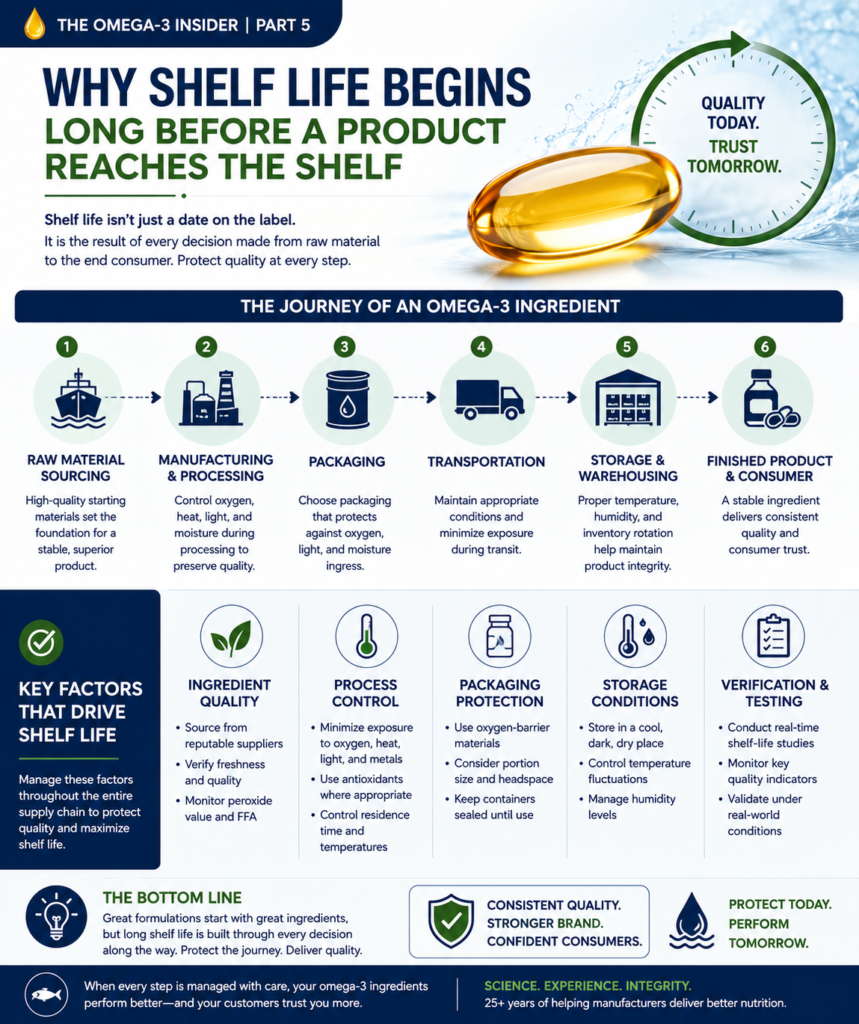
Why Shelf Life Begins Long Before a Product Reaches the Shelf
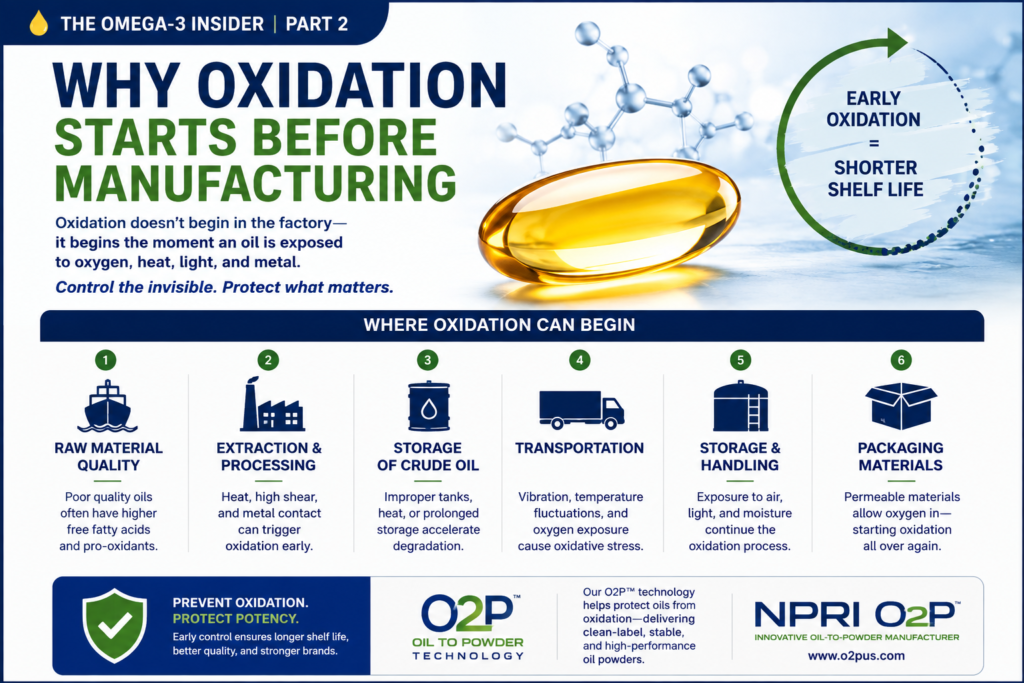
How O2P™ Technology Protects Oils from Oxidation
Shelf life begins long before a finished product reaches the consumer. Learn how raw material quality, manufacturing, packaging, storage, and transportation all contribute to product stability and long-term performance.
Oxidation begins long before oils reach the manufacturing line. Learn how raw material quality, processing, storage, transportation, and oxygen exposure can silently reduce stability, potency, and shelf life.
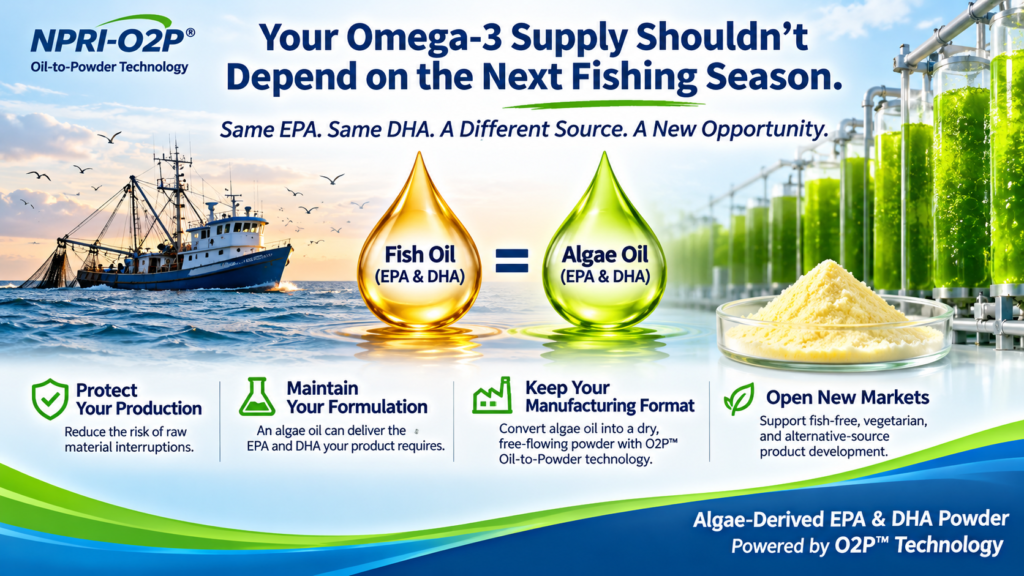
As fish oil supplies face growing uncertainty, could algae-derived EPA and DHA offer manufacturers a more diversified omega-3 sourcing strategy?