
DHA, ARA and EPA in Infant Formula: Are We Asking the Right Questions?
Why did algae-derived DHA and ARA become standard ingredients in infant nutrition, why is conventional fish oil less common, and what remains unanswered about EPA?
November 17, 2026 | NPRI-O2P Technical Insights
For more than two decades, infant formula manufacturers have commonly incorporated two long-chain polyunsaturated fatty acids: docosahexaenoic acid (DHA), an omega-3 fatty acid, and arachidonic acid (ARA), an omega-6 fatty acid.
Yet another familiar omega-3 fatty acid, eicosapentaenoic acid (EPA), has received considerably less attention in infant formula formulation.
This raises several interesting questions.
Why did DHA and ARA become the preferred combination? Why has algae-derived DHA become such a widely used source instead of conventional anchovy or sardine fish oil? And if EPA contributes to cardiovascular function in adults, should its potential role in infant development receive greater attention?
These questions have become particularly timely following the U.S. Food and Drug Administration’s October 29, 2026 announcement of a proposed review of infant formula nutrient requirements, published in the Federal Register on November 2.
How DHA and ARA Became Standard Ingredients
Before the early 2000s, many infant formulas relied primarily on the essential fatty acids linoleic acid (LA) and alpha-linolenic acid (ALA), which the body can convert into longer-chain fatty acids.
However, conversion efficiency varies, and researchers recognized that DHA and ARA accumulate in developing tissues during pregnancy and infancy.
Both fatty acids are naturally present in human breast milk.
DHA is particularly important as a structural component of the developing brain and retina. ARA contributes to cell membrane structure and participates in numerous developmental and physiological signaling processes.
In 2002, infant formulas supplemented with DHA and ARA entered the U.S. market.
Their adoption was rapid.
A 2009 USDA Economic Research Service report documented that DHA/ARA-supplemented formulas accounted for almost two-thirds of supermarket infant formula dollar sales by the second quarter of 2004.
What began as a nutritional innovation quickly evolved into widespread industry practice.
However, an important distinction remains: widespread commercial adoption does not necessarily establish a federal regulatory requirement.
Why Algae-Derived DHA Instead of Anchovy or Sardine Fish Oil?
This is one of the more interesting questions from a formulation perspective.
DHA is chemically the same fatty acid regardless of whether it originates from algae or fish.
The important distinction is often the accompanying fatty-acid composition of the oil.
Conventional anchovy and sardine oils generally contain both EPA and DHA, frequently with more EPA than DHA.
By contrast, selected DHA-rich algal oils contain substantial DHA with relatively low EPA concentrations.
This provides manufacturers with greater flexibility to control DHA incorporation without simultaneously introducing large amounts of EPA.
ARA can then be incorporated separately at the intended concentration.
There are also practical considerations involving raw material specifications, source traceability, environmental contaminants, oxidative stability, and consistency between production lots.
However, algae-derived DHA is not inherently superior simply because it comes from algae. Properly purified and qualified fish-derived DHA oils can also be appropriate for infant formula applications.
The relevant questions are whether the ingredient meets applicable safety requirements and whether its fatty-acid composition is suitable for the intended nutritional formulation.
Why Has EPA Played a Smaller Role?
EPA is widely studied for its involvement in lipid metabolism, inflammatory signaling, and cardiovascular health.
But evidence of cardiovascular benefits in certain adult populations does not automatically establish a nutritional requirement for infants.
DHA has a particularly prominent structural role in the brain and retina. ARA is also an important component of developing tissues.
EPA has important biological functions, but its optimal dietary intake during infancy—and whether direct supplementation produces meaningful developmental benefits—remains less clearly established.
Historical research also contributed to the formulation industry’s caution.
In the early 1990s, Susan Carlson and colleagues investigated marine oil-supplemented formulas in premature infants.
Some early studies raised concerns about changes in ARA status and growth when formulas contained marine oils supplying EPA and DHA without additional ARA.
These findings encouraged further investigation of fatty-acid balance, rather than simply increasing total omega-3 content.
Importantly, they do not demonstrate that all EPA exposure is harmful to infants.
They suggest that the proportions of individual fatty acids may matter considerably during early development.
What About Infants Who Cannot Be Breastfed?
This is perhaps the most important question.
Human breast milk naturally contains DHA, ARA, and smaller amounts of EPA. The concentrations vary with maternal diet and other factors.
For infants who depend entirely on formula, the nutritional composition of that formula becomes especially important.
Modern infant formulas are designed to provide complete nutrition, including essential fatty acids. Many also supply preformed DHA and ARA.
EPA may be present in small amounts through certain ingredients or produced by the infant through metabolism of ALA.
But does this supply enough EPA to support every physiological function in which EPA participates?
At present, the evidence does not establish that routine additional EPA supplementation improves cardiac development or long-term cardiovascular health in healthy infants.
That does not make the research question unimportant.
Rather, it points toward opportunities for carefully controlled studies examining EPA exposure, cardiovascular developmental outcomes, inflammatory signaling, growth, and the relationship between EPA and ARA.
The question should not be whether infant formulas are currently deficient in EPA without evidence demonstrating such a deficiency.
The better question is whether the potential physiological roles of EPA during infancy have been sufficiently investigated.
The Continuing Scientific Debate Around DHA and ARA
There is considerable agreement that DHA and ARA have important biological functions.
However, determining whether specific supplemental concentrations consistently improve measurable developmental outcomes has been more complicated.
Some clinical trials have reported benefits involving visual function and aspects of neurodevelopment.
Other studies have not demonstrated consistent improvements, particularly in longer-term cognitive outcomes among healthy term infants.
A 2017 Cochrane review found that available randomized trials did not establish consistent developmental advantages sufficient to recommend routine long-chain polyunsaturated fatty-acid supplementation for all healthy term infants. The evidence was considered low quality.
Meanwhile, a 2020 position paper led by Berthold Koletzko, published in the American Journal of Clinical Nutrition, recommended that infant formula provide both DHA and ARA.
The authors expressed concern about supplying DHA without accompanying ARA and called for further research into optimal concentrations and ratios.
This reflects an important distinction between recognizing the biological importance of a nutrient and establishing the exact amount that should be required in every commercial formula.
Why Is FDA Reviewing DHA and ARA in 2026?
On October 29, 2026, FDA announced a phased review of infant formula nutrient requirements. The proposed rule was published on November 2.
In that document, FDA specifically invited public comments on whether DHA and ARA should become mandatory ingredients, including appropriate concentrations, ratios, and potential differences among infant populations.
FDA also requested input on ALA, the essential omega-3 fatty acid that serves as a metabolic precursor to EPA and DHA.
The agency has not concluded that DHA and ARA are unnecessary.
Rather, it is evaluating whether available scientific evidence supports establishing formal minimum requirements.
The current phase proposes changes to several vitamins and minerals. DHA and ARA will receive more extensive consideration in a subsequent phase.
The regulatory question is therefore not whether DHA and ARA have biological functions. They clearly do.
It is whether the evidence supports specific, enforceable requirements for all applicable infant formulas.
That decision requires consideration of clinical outcomes, human milk composition, safety, dose-response relationships, and differences among infant populations.
Should EPA Receive Greater Scientific Attention?
Perhaps the most interesting unanswered question is why EPA has remained comparatively peripheral to infant formula development.
EPA is not absent from human biology during infancy, nor is it absent from human breast milk.
Its biological functions differ from those of DHA and ARA.
The early concerns surrounding EPA-rich marine oils should not automatically end further investigation into whether carefully controlled EPA intake could have benefits.
Equally, evidence from adult cardiovascular research should not be used to justify adding EPA to infant formula without infant-specific safety and efficacy studies.
What is needed is more research into appropriate exposure levels, possible developmental effects, and interactions among DHA, ARA, and EPA.
For ingredient developers and infant nutrition researchers, these questions underline why individual fatty-acid profiles matter more than simply describing an ingredient as containing omega-3.
Looking Ahead
The evolution of infant formula since 2002 illustrates how scientific research, ingredient technology, commercial adoption, and regulation can progress at different speeds.
DHA and ARA became established formulation ingredients long before FDA began considering making them universally mandatory.
Algae-derived DHA offered manufacturers an effective way to formulate DHA separately from EPA.
And EPA, despite its recognized physiological roles, remains an area where additional infant-specific research may be valuable.
As FDA continues its review, perhaps the most useful question is not simply which fatty acids should be present in infant formula.
It is whether we fully understand the individual and combined roles of DHA, ARA, and EPA during the earliest stages of human development.
At NPRI-O2P, LLC, our experience manufacturing specialty nutritional powders, including infant and toddler nutrition products, has reinforced the importance of ingredient composition, raw material selection, and formulation requirements.
Our proprietary O2P™ Oil-to-Powder technology converts compatible liquid oils into dry powder ingredients through a room-temperature physical process without changing the chemical identity of the original oil.
As nutritional science advances, we believe ingredient manufacturers have an important role in supporting research-informed formulation decisions.
What are your thoughts? Should the scientific discussion around infant fatty-acid nutrition extend beyond DHA and ARA to examine EPA more closely?
NPRI-O2P, LLC | Proprietary Oil-to-Powder Technology
Scientific and regulatory references
U.S. Food and Drug Administration. Infant Formula Nutrient Requirements, proposed rule, November 2, 2026. https://www.govinfo.gov/content/pkg/FR-2026-11-02/html/2026-22273.htm
FDA. Questions & Answers for Consumers Concerning Infant Formula, including historical DHA/ARA assessments. https://www.fda.gov/food/people-risk-foodborne-illness/questions-answers-consumers-concerning-infant-formula
USDA Economic Research Service. The WIC Program: Background, Trends, and Economic Issues, 2009 Edition. https://ers.usda.gov/sites/default/files/_laserfiche/publications/46165/17230_err73f_1_.pdf
Carlson SE et al. First year growth of preterm infants fed standard compared to marine oil n-3 supplemented formula. Lipids, 1992. https://pubmed.ncbi.nlm.nih.gov/1491608/
Jasani B et al. Long-chain polyunsaturated fatty acid supplementation in infants born at term. Cochrane Database of Systematic Reviews, 2017. https://www.cochrane.org/evidence/CD000376_long-chain-polyunsaturated-fatty-acid-supplementation-infants-born-term
Koletzko B et al. Should formula for infants provide arachidonic acid along with DHA? American Journal of Clinical Nutrition, 2020. https://pubmed.ncbi.nlm.nih.gov/31665201/
European Commission. Commission Delegated Regulation (EU) 2016/127, infant formula lipid requirements. https://eur-lex.europa.eu/legal-content/EN/TXT/?uri=CELEX:32016R0127
This article is intended for scientific and industry discussion. It is not a recommendation to modify infant feeding practices or add EPA supplements to infant formula.
Need Help With Your Formulation?
Whether you’re developing a new oil powder, improving product stability, or solving formulation challenges, our technical team is ready to help. Contact us for formulation guidance, product recommendations, or sample requests.
Recommended Technical Articles
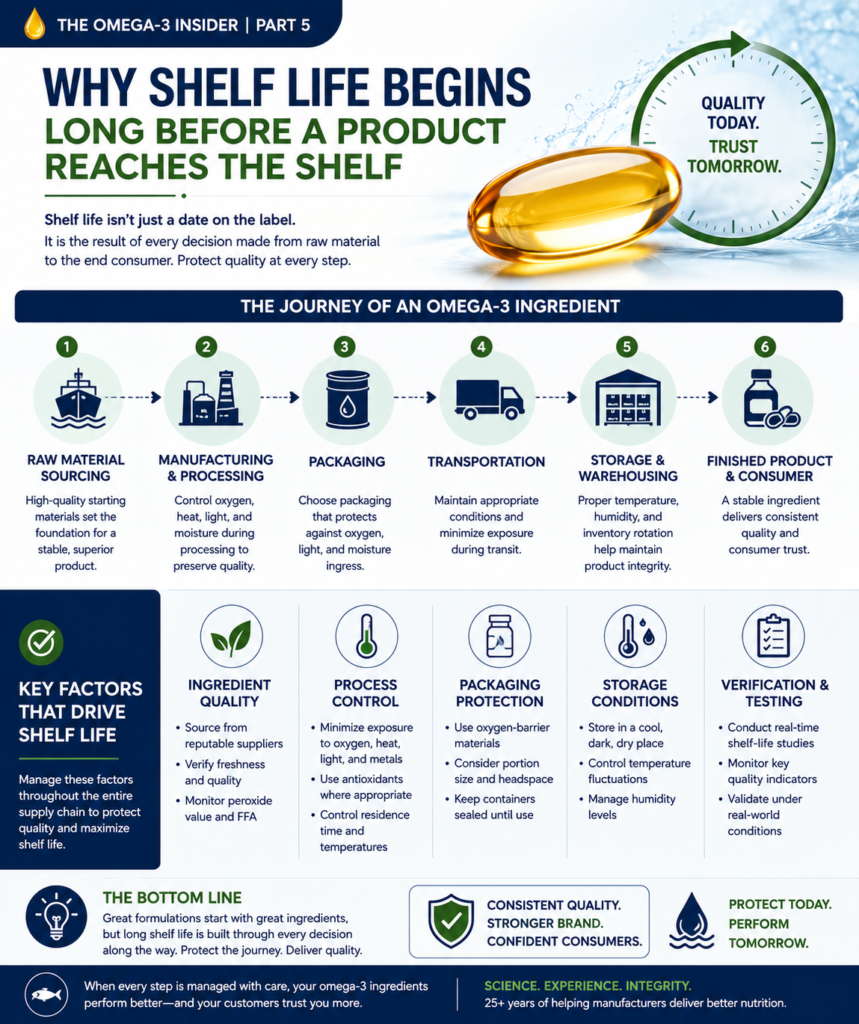
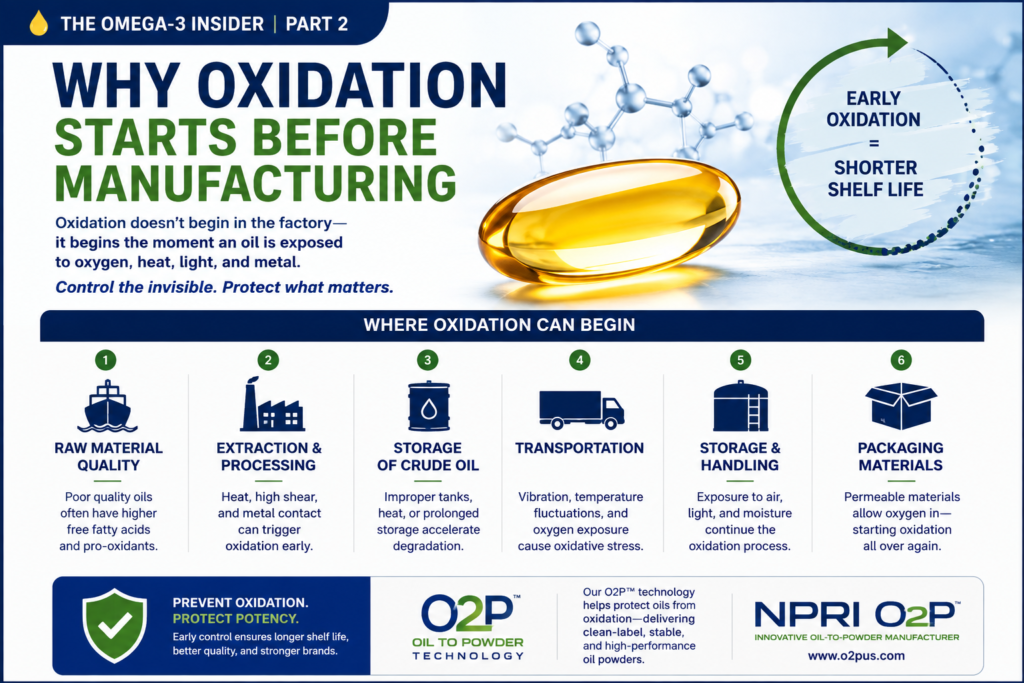

Why Shelf Life Begins Long Before a Product Reaches the Shelf
How O2P™ Technology Protects Oils from Oxidation
Shelf life begins long before a finished product reaches the consumer. Learn how raw material quality, manufacturing, packaging, storage, and transportation all contribute to product stability and long-term performance.
Oxidation begins long before oils reach the manufacturing line. Learn how raw material quality, processing, storage, transportation, and oxygen exposure can silently reduce stability, potency, and shelf life.
Why infant formula favors DHA and ARA, how algae and fish oils differ, and what FDA’s 2026 review means for infant nutrition.