
Anchovies, Sardines, and Omega-3: What’s the Connection to Marine Algae?
The surprising journey of EPA and DHA through the marine food chain—and what it means for the future of Omega-3 ingredients.
When we think about Omega-3 fish oil, two familiar names frequently come to mind: anchovies and sardines.
These small marine fish are among the important commercial sources of Omega-3 oils used in nutritional supplements, functional foods, and animal nutrition.
But have you ever wondered where the Omega-3 in these fish actually comes from?
Do anchovies and sardines manufacture all their own EPA and DHA? Or is there something much smaller, almost invisible to the human eye, responsible for supplying these valuable fatty acids?
The answer takes us to the beginning of the marine food chain.
It Begins With Microscopic Marine Algae
Long before Omega-3 reaches an anchovy or sardine, much of it originates in microscopic marine organisms known as microalgae.
Certain species of microalgae naturally synthesize long-chain Omega-3 fatty acids, including eicosapentaenoic acid (EPA) and docosahexaenoic acid (DHA).
These fatty acids become part of the marine food web.
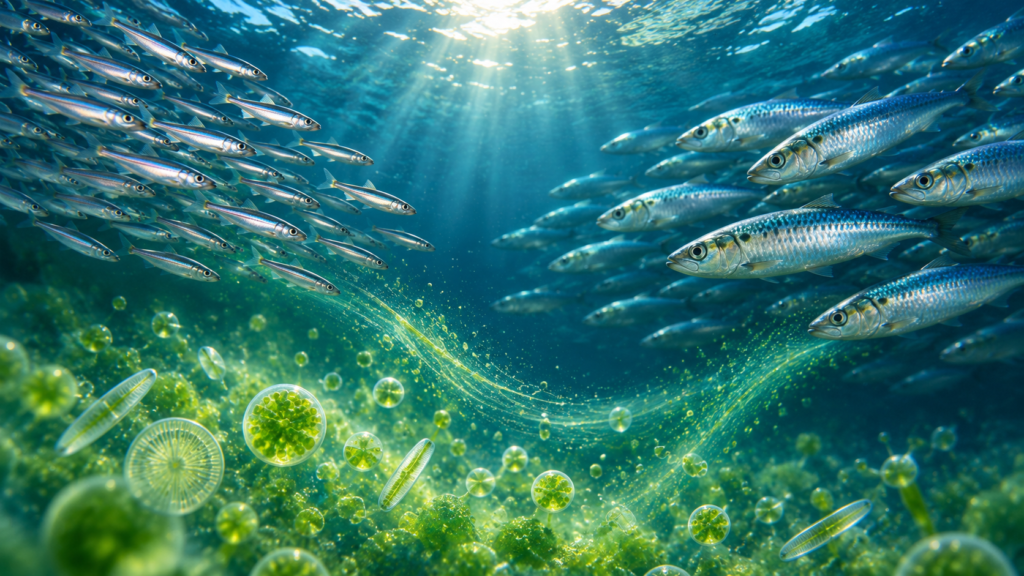
Tiny organisms called zooplankton feed on phytoplankton, including microalgae. Small fish such as anchovies and sardines consume plankton, acquiring and accumulating Omega-3 fatty acids through their diets.
In simplified terms:
Marine Microalgae → Zooplankton → Anchovies and Sardines → Fish Oil
Some fish also consume phytoplankton directly, and fish can metabolize certain fatty acids themselves. Nevertheless, microalgae are a fundamental original source of EPA and DHA in marine food webs.
What we commonly call fish-derived Omega-3 therefore has a fascinating biological history that begins much earlier than the fish itself.
Do Anchovies and Sardines Contain the Same Omega-3?
Not necessarily.
Although both are valued sources of EPA and DHA, their fatty acid concentrations can differ.
Researchers studying European anchovies and sardines have documented variations in lipid content and fatty acid composition associated with season, feeding conditions, and reproductive activity.
This raises an interesting question for manufacturers:
If the Omega-3 content of fish changes with their diet and environment, how should we think about consistency when sourcing Omega-3 ingredients?
Commercial fish oil refining and concentration processes can help manufacturers achieve specified EPA and DHA concentrations. However, the composition of the original biological material remains an important consideration.
It reminds us that Omega-3 ingredients begin as biological materials, subject to natural variation.
Are All Marine Algae Equally Rich in EPA and DHA?
Here is another interesting part of the story.
Just as not all fish contain identical quantities of Omega-3, not all marine algae produce the same fatty acid profiles.
Some microalgae are particularly rich in DHA, while others produce substantial quantities of EPA. Certain species produce both, but their relative concentrations can vary considerably.
This distinction matters.
For example, an algae oil containing 60% DHA may provide a highly concentrated source of DHA, but that does not automatically make it nutritionally equivalent to fish oil containing significant amounts of both EPA and DHA.
The intended nutritional application must determine which fatty acids are required and in what quantities.
For product developers, this means selecting an Omega-3 ingredient involves more than deciding between fish and algae.
It requires understanding the specific fatty acid composition.
Does Understanding the Original Source Change How We Think About Omega-3?
Perhaps it should.
For many years, marine fish have provided an established and valuable source of EPA and DHA.
But understanding the role of microalgae reveals another possible pathway: obtaining specific Omega-3 fatty acids directly from cultivated algae rather than relying exclusively on fish-derived oils.
This approach offers several potential advantages, including reduced dependence on wild-capture fisheries, controlled production environments, and access to concentrated DHA-rich oils.
However, there are also practical considerations.
Algae-derived oils may differ significantly in EPA content, cost, availability, sensory characteristics, and oxidative stability.
Neither source should automatically be considered superior for every application.
The better question may be: Which Omega-3 ingredient provides the right fatty acid composition for the intended product?
From Marine Biology to Modern Ingredient Formulation
Once an appropriate Omega-3 source has been selected, another challenge begins.
How can a liquid oil be incorporated into a powdered nutritional supplement, a dry pet nutrition formulation, or a functional food product?
Both fish-derived and algae-derived Omega-3 oils contain highly unsaturated fatty acids susceptible to oxidation. Their handling, processing conditions, packaging, and storage deserve careful attention.
At NPRI-O2P, LLC, we are the direct manufacturer, not a distributor or trading company.
At our Las Vegas, Nevada manufacturing facility, we use our proprietary O2P™ Oil-to-Powder technology to convert functional liquid oils into dry, free-flowing powders at room temperature without applying heat during conversion.
Our technology changes the physical delivery format without altering the original chemical identity of the oil.
For manufacturers considering algae-derived Omega-3, our capabilities include DHA-rich algae oil powders that can be evaluated for human nutrition, pet nutrition, and specialty feed formulations.
As with all sensitive Omega-3 ingredients, actual oxidative stability and shelf life must be established through appropriate testing.
A Final Thought
Anchovies and sardines have long been recognized as important sources of marine Omega-3.
Yet the EPA and DHA they provide have a story that begins much earlier—in the microscopic organisms supporting marine ecosystems.
Understanding that journey does not diminish the value of fish oil.
Instead, it expands our understanding of where Omega-3 comes from and the different ways these essential fatty acids can be delivered.
For researchers, formulators, and ingredient manufacturers, perhaps the most interesting discovery is not simply where Omega-3 originates.
It is how understanding its origins may open new possibilities for nutritional innovation.
Exploring Algae-Derived Omega-3 Powder for Your Next Formulation?
NPRI-O2P, LLC is a direct U.S. manufacturer of specialty functional oil powders, including algae-derived DHA oil powder.
Our standard minimum order quantity is 25 kg of finished powder, providing flexibility for product development and specialized commercial applications.
Learn more at https://o2pus.com or contact godfrey@o2pus.com.
NPRI-O2P, LLC | Proprietary O2P™ Oil-to-Powder Technology | Las Vegas, Nevada, USA
Scientific references
The article is supported by the following research:
NIH Office of Dietary Supplements — Omega-3 Fatty Acids. Explains the origin of EPA and DHA in marine microalgae and their accumulation through the marine food chain.
Fatty Acid Composition of Sardines and Anchovies. Published in Conservation Physiology (2020). Examines seasonal and ecological influences on fatty acid composition.
Seasonal Changes in Sardine Fatty Acid Composition. Documents variation in sardine lipid and Omega-3 content.
Red Muscle of Small Pelagic Fishes as a Source of Essential Fatty Acids. Published in the Journal of Food Composition and Analysis (2023). Compares EPA and DHA in sardines and anchovies.
Need Help With Your Formulation?
Whether you’re developing a new oil powder, improving product stability, or solving formulation challenges, our technical team is ready to help. Contact us for formulation guidance, product recommendations, or sample requests.
Recommended Technical Articles
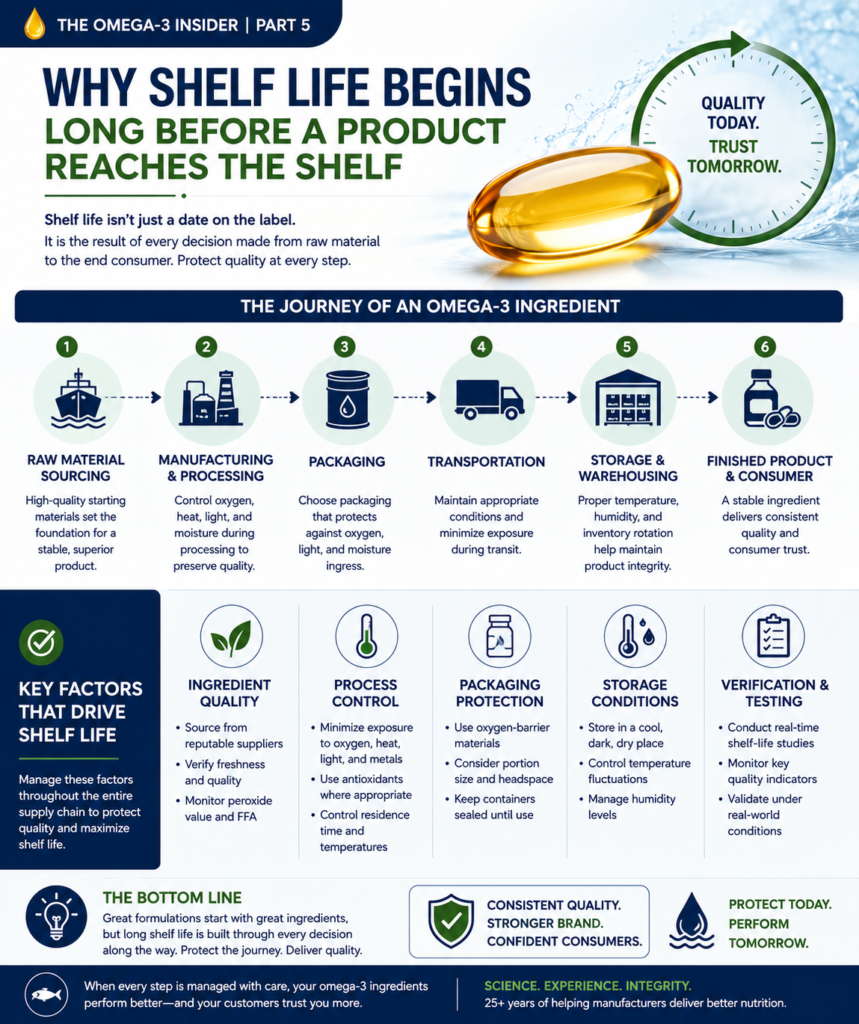
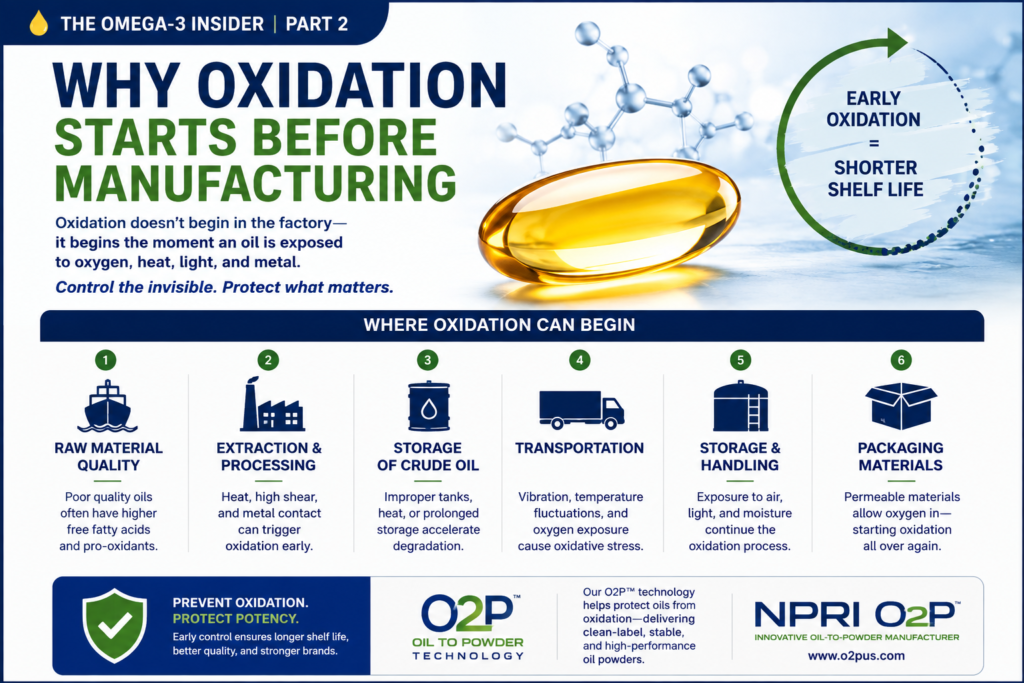
Why Shelf Life Begins Long Before a Product Reaches the Shelf
How O2P™ Technology Protects Oils from Oxidation
Shelf life begins long before a finished product reaches the consumer. Learn how raw material quality, manufacturing, packaging, storage, and transportation all contribute to product stability and long-term performance.
Oxidation begins long before oils reach the manufacturing line. Learn how raw material quality, processing, storage, transportation, and oxygen exposure can silently reduce stability, potency, and shelf life.
Discover how marine algae supply Omega-3 to anchovies and sardines, and what this means for EPA, DHA, and modern nutritional formulations.