
Beyond Joints and Skin: The Broader Benefits of Omega-3 in Pet Nutrition
Why EPA and DHA composition matters when developing nutritional products for dogs and cats.
The Familiar Omega-3 Marketing Message
Visit a pet supplement retailer, and you will encounter familiar claims about omega-3 fatty acids: joint mobility, skin health, coat condition, and inflammation support.
These applications have a legitimate scientific foundation, particularly for dogs experiencing osteoarthritis or certain inflammatory skin conditions.
However, the biological roles of omega-3 fatty acids extend beyond these familiar applications.
Research has also examined the roles of omega-3 fatty acids in neurological development, visual function, cognitive performance, and selected cardiovascular conditions.
This raises a question for pet food manufacturers and nutritional product developers:
Are we designing omega-3 formulations around the full range of their scientifically supported functions, or primarily around the benefits that are easiest to market?
1. Understanding the Differences Between EPA and DHA
The term omega-3 describes a family of fatty acids rather than a single nutritional compound.
Three important members are:
ALA (alpha-linolenic acid): A plant-derived omega-3 found in flaxseed, chia, and certain specialty seed oils.
EPA (eicosapentaenoic acid): A long-chain omega-3 involved in inflammatory signaling and the production of specialized lipid mediators.
DHA (docosahexaenoic acid): A long-chain omega-3 that is particularly abundant in neural and retinal membranes.
Although EPA and DHA share important metabolic pathways, they are not functionally identical.
Their relative contributions to different physiological processes mean that the appropriate fatty acid composition should be considered when developing application-specific nutritional products.
2. Joint Mobility: One of the Better-Studied Applications
Omega-3 supplementation has been studied extensively in dogs with osteoarthritis.
In a randomized, double-blinded clinical trial involving 127 dogs, researchers evaluated diets enriched with fish-oil omega-3 fatty acids.
Dogs receiving the omega-3-enriched diet demonstrated improvements in certain owner-assessed measures of mobility and activity compared with controls.
Other controlled studies have reported improvements in weight bearing and selected clinical signs of osteoarthritis.
These findings support the use of EPA- and DHA-containing diets as part of nutritional management for dogs with osteoarthritis.
However, omega-3 supplementation should not be represented as a cure for degenerative joint disease or a substitute for appropriate veterinary treatment.
3. Skin and Coat: More Than Cosmetic Benefits
Omega-3 fatty acids also participate in processes relevant to skin health.
Their influence on inflammatory signaling has prompted research into supplementation for dogs with atopic dermatitis and other inflammatory skin conditions.
In one randomized clinical study, dogs receiving certain fatty acid supplements experienced improvements in clinical skin scores compared with a placebo group.
Nevertheless, study results vary, and the relationship between fatty acid intake and skin outcomes is complex.
The nutritional benefits should therefore be distinguished from unsupported claims that omega-3 supplementation can universally eliminate itching, allergies, or other skin disorders.
4. Brain Development: An Important Role for DHA
DHA is a significant structural component of neuronal and retinal cell membranes.
Its biological importance is particularly relevant during periods of neurological development.
A 2012 study evaluated 48 Beagle puppies fed diets containing different levels of DHA-rich fish oil.
The puppies receiving the higher-DHA diet performed better in certain learning, visual discrimination, and psychomotor assessments.
Importantly, the diets also differed in some other nutrients, so these findings should not be interpreted as proving that DHA alone caused every observed improvement.
Nevertheless, the findings provide an important foundation for considering DHA composition in nutritional products intended for growing puppies.
Research into cognitive aging in companion animals offers further areas for investigation, although clinical benefits should not be assumed from DHA’s structural role alone.
5. Cardiovascular Nutrition: A More Specialized Application
Omega-3 fatty acids have also been investigated in veterinary cardiovascular nutrition.
The potential benefits differ significantly from the familiar human marketing claims about cardiovascular wellness.
In dogs with congestive heart failure, fish-oil omega-3 supplementation has been used as part of nutritional management, particularly when muscle loss, appetite changes, or certain arrhythmias are present.
However, omega-3 supplementation has not been established as a method of preventing heart disease in healthy dogs or cats.
Its use in animals with diagnosed cardiac disease requires appropriate veterinary oversight.
This distinction demonstrates why physiological relevance, clinical evidence, and approved product claims must be considered separately.
6. Should Every Pet Omega-3 Product Have the Same EPA-to-DHA Ratio?
Given the different biological roles of EPA and DHA, it is reasonable to question whether a single fatty acid composition is appropriate for every pet nutritional application.
For example:
A joint-support formulation may place particular emphasis on studied EPA/DHA combinations associated with inflammatory and mobility outcomes.
A puppy-development product may prioritize sufficient DHA exposure as part of a complete nutritional formulation.
A skin-health product may require consideration of the broader fatty acid composition, total diet, and underlying condition.
A cardiovascular-support product may require specialized veterinary nutritional guidance rather than a general wellness formulation.
These examples do not establish universal EPA-to-DHA ratios for each application.
Instead, they illustrate why product developers should begin with the intended nutritional outcome and then determine whether the ingredient’s fatty acid profile is supported by relevant evidence.
The total amount of omega-3 in a product is not necessarily the most useful measure of its nutritional suitability.
The actual quantities of EPA and DHA, their bioavailability, the complete diet, and the relevant species and life stage are all important considerations.
7. What About Fish-Oil Alternatives?
Growing interest in alternative omega-3 sources creates additional formulation questions.
Fish oil supplies preformed EPA and DHA, while many conventional plant oils primarily supply ALA.
Some algae-derived oils provide substantial DHA, while others may provide EPA or combinations of both.
These ingredients should not automatically be regarded as nutritionally interchangeable.
For example, combining plant-derived ALA with algae DHA might provide an interesting alternative fatty acid profile. However, its ability to deliver EPA exposure and the intended physiological outcomes requires evaluation.
This is particularly important when the product’s intended application relies on evidence obtained using preformed EPA and DHA.
Future research could help establish which alternative omega-3 combinations provide comparable nutritional outcomes in particular animal species and applications.
8. The Role of Ingredient Delivery Format
Beyond fatty acid composition, manufacturers must also consider how the selected oil is incorporated into the finished product.
Liquid functional oils can present practical challenges in dry formulations, including ingredient handling, distribution, packaging, and processing compatibility.
NPRI-O2P, LLC has specialized in functional oil powder manufacturing since 2001.
Our proprietary O2P™ (Oil-to-Powder) technology converts liquid functional oils into free-flowing, water-dispersible powders at room temperature without chemically modifying the original oils.
Our portfolio includes fish-derived EPA/DHA, algae-derived DHA, MCT, and other specialty functional oil powders.
These powder formats can provide additional formulation flexibility for manufacturers developing pet supplements, nutritional powders, treats, and other functional products.
The technology changes the physical delivery format—not the chemical identity or inherent nutritional characteristics of the starting oil.
Finished-product performance and stability must still be assessed under the intended manufacturing and storage conditions.
Conclusion: Formulate for the Nutritional Objective
Omega-3 nutrition in companion animals extends beyond the familiar messages surrounding joints, skin, and coat health.
Research into DHA and neurological development, as well as specialized cardiovascular nutritional applications, illustrates the breadth of scientific interest in these fatty acids.
However, the strength of clinical evidence differs by application, animal species, and population.
For manufacturers, the opportunity is to move beyond generic omega-3 positioning and develop formulations based on specific nutritional objectives.
The future of pet omega-3 nutrition may depend less on how much total omega-3 a product contains and more on whether its EPA and DHA composition is appropriate for its intended use.
At NPRI-O2P, we welcome discussions with product developers and manufacturers exploring innovative functional oil powder applications for companion-animal nutrition.
Contact NPRI-O2P
Website: https://o2pus.com
Email: godfrey@o2pus.com
Scientific references
Roush JK et al. (2010). Multicenter veterinary practice assessment of the effects of omega-3 fatty acids on osteoarthritis in dogs. Journal of the American Veterinary Medical Association, 236(1), 59–66. https://pubmed.ncbi.nlm.nih.gov/20043800/
Fritsch DA et al. (2010). Dose-titration effects of fish oil in osteoarthritic dogs. Journal of Veterinary Internal Medicine. https://pubmed.ncbi.nlm.nih.gov/20707845/
Mueller RS et al. (2004). Effect of omega-3 fatty acids on canine atopic dermatitis. Journal of Small Animal Practice, 45(6), 293–297. https://pubmed.ncbi.nlm.nih.gov/15206474/
Zicker SC et al. (2012). Evaluation of cognitive learning, memory, psychomotor, immunologic, and retinal functions in healthy puppies fed foods fortified with docosahexaenoic acid-rich fish oil from 8 to 52 weeks of age.JAVMA, 241(5), 583–594. https://pubmed.ncbi.nlm.nih.gov/22916855/
Tufts University, Cummings School of Veterinary Medicine. Heart Disease – Nutrition.https://vet.tufts.edu/foster-hospital-small-animals/specialty-services/cardiology/heartsmart/heart-disease-nutrition
Scientific and educational information for ingredient developers and manufacturers. Clinical applications and product claims require species-specific assessment and appropriate regulatory review.
Need Help With Your Formulation?
Whether you’re developing a new oil powder, improving product stability, or solving formulation challenges, our technical team is ready to help. Contact us for formulation guidance, product recommendations, or sample requests.
Recommended Technical Articles
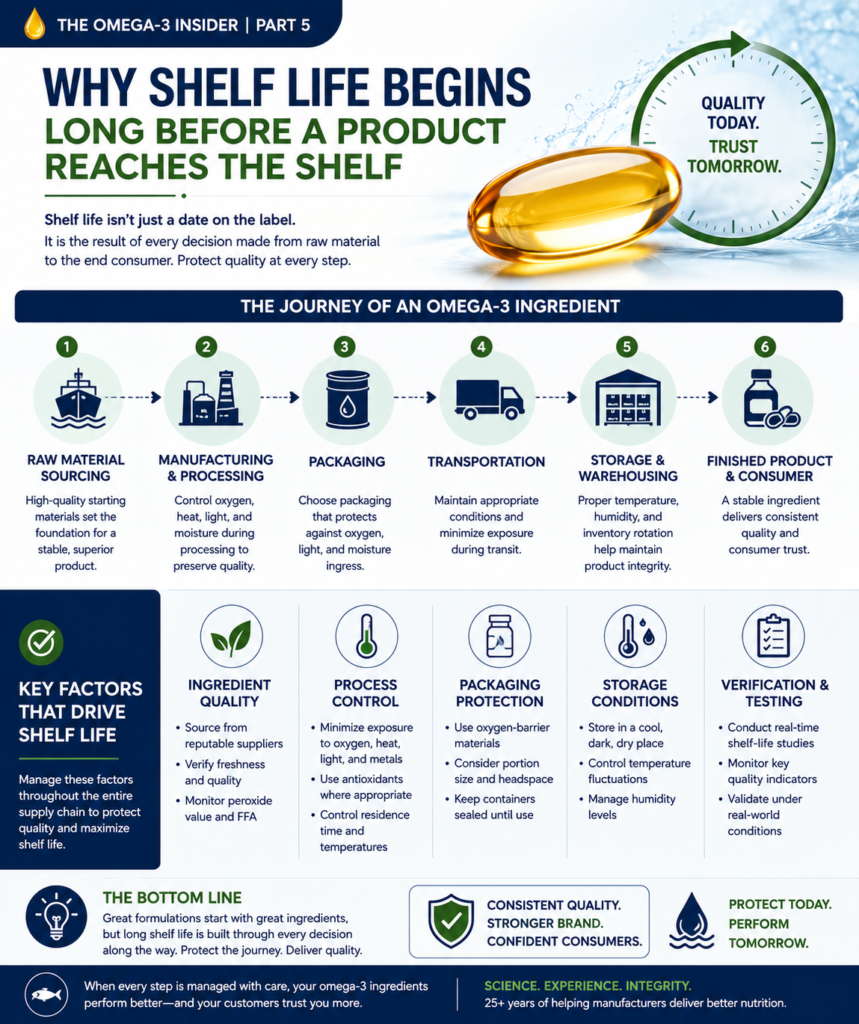
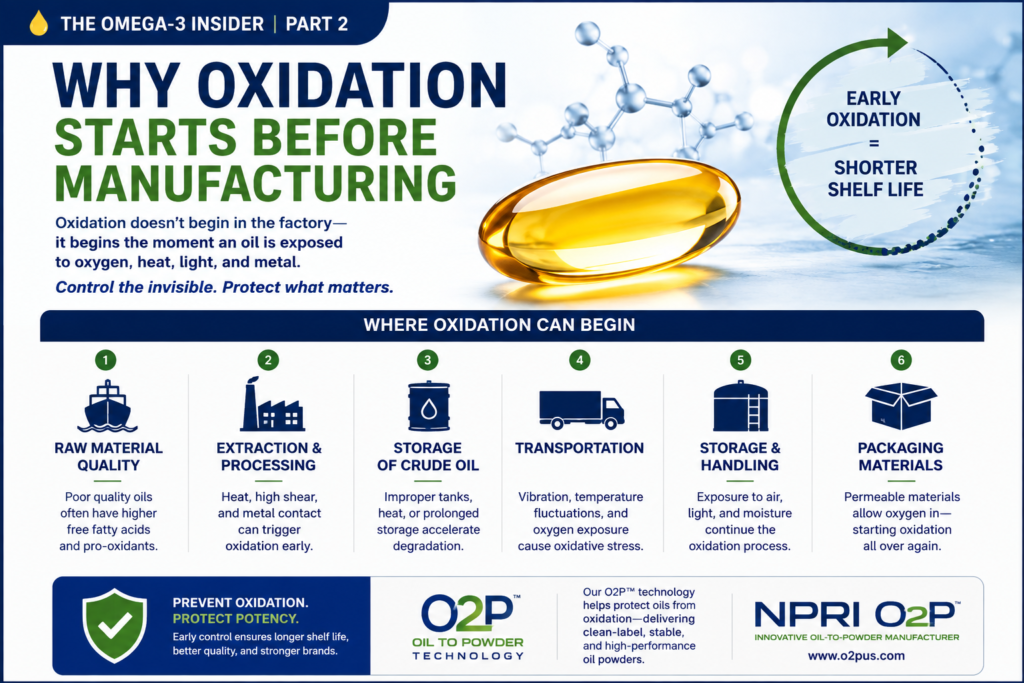

Why Shelf Life Begins Long Before a Product Reaches the Shelf
How O2P™ Technology Protects Oils from Oxidation
Shelf life begins long before a finished product reaches the consumer. Learn how raw material quality, manufacturing, packaging, storage, and transportation all contribute to product stability and long-term performance.
Oxidation begins long before oils reach the manufacturing line. Learn how raw material quality, processing, storage, transportation, and oxygen exposure can silently reduce stability, potency, and shelf life.
Omega-3 offers more than joint and skin support. Explore the science behind EPA, DHA, brain development, cardiovascular nutrition, and smarter pet formulations.