
High DHA Is Only Half the Story: What Happens When Algae Oil Enters a Dry Formulation?
A technical perspective from NPRI-O2P, LLC
DHA-rich algae oil has become an increasingly important ingredient for human nutrition, pet nutrition, and functional food development. Its appeal extends beyond being an alternative source of omega-3 fatty acids: algae oil offers manufacturers opportunities to develop products with targeted DHA concentrations and greater flexibility in raw material sourcing.
However, selecting the right DHA oil is only the beginning.
The real formulation challenge often starts when a liquid oil must become part of a dry product.
The Challenge of Incorporating Liquid Oil
Many nutritional products are manufactured as dry blends, including powdered beverages, nutritional supplements, pet food premixes, and functional food formulations.
Introducing liquid oil directly into these systems can create processing difficulties.
Depending on the formulation, manufacturers may encounter:
Poor powder flow and mixing characteristics
Uneven oil distribution
Agglomeration and caking
Increased exposure of sensitive fatty acids to oxygen
Incompatibility with downstream processing or packaging requirements
These challenges are not unique to algae oil, but they become particularly important when working with oxidation-sensitive DHA.
Oil Loading Is Only One Part of Powder Design
A high oil-loading percentage may appear attractive because it reduces the proportion of non-oil material in the finished ingredient.
However, maximum oil loading is not necessarily the optimum formulation.
A useful oil powder must balance oil concentration with powder flow, uniformity, handling properties, and stability.
At NPRI-O2P, our proprietary room-temperature oil-to-powder technology offers flexibility in oil loading and carrier selection. Depending on the oil and carrier system, formulations can be developed across a broad range of oil concentrations.
The appropriate loading level should be determined by the intended application rather than by oil percentage alone.
Can Existing Formula Ingredients Serve as Carriers?
This is an important question for product developers.
Conventional approaches often introduce additional carrier ingredients specifically to accommodate liquid oils.
However, some dry formulations already contain suitable ingredients that may be used as part of the oil-carrying system.
NPRI-O2P technology allows us to evaluate the feasibility of incorporating oil directly into selected dry formulation ingredients.
This can potentially reduce the need for additional carriers while supporting a more streamlined ingredient declaration.
Carrier selection also influences the physical properties of the finished powder. In certain formulations, naturally occurring antioxidant constituents of suitable ingredients may provide additional benefits, although oxidative protection must be demonstrated through testing.
Water-Dispersible Does Not Mean Water-Soluble
For powdered beverages and other products intended to be mixed with water, dispersibility is another important consideration.
Algae oil remains an oil regardless of its physical presentation.
Converting it into powder does not make the triglycerides water-soluble.
However, an appropriately designed powder system can facilitate the distribution of oil particles throughout an aqueous formulation.
The resulting performance depends on carrier composition, oil loading, particle characteristics, mixing conditions, and the overall product formulation.
Protecting DHA After Conversion
Oxidation remains a critical consideration.
Converting algae oil into powder does not automatically extend its shelf life. The increased surface area of powdered systems can create additional opportunities for oxygen exposure.
For this reason, finished-product stability must be evaluated under appropriate storage and packaging conditions.
At NPRI-O2P, we use controlled packaging approaches, including nitrogen purging and protective packaging materials, to help manage oxygen exposure.
Final shelf life depends on the specific formulation, processing, packaging, and storage environment.
Formulation Flexibility Creates New Opportunities
The real value of algae oil powder is not simply that a liquid ingredient has been converted into a solid.
It is the opportunity to incorporate an important nutritional lipid into products where liquid oil would otherwise create formulation or manufacturing challenges.
For human nutrition, pet nutrition, and food manufacturers, that flexibility can expand the practical applications of DHA-rich algae oil.
The most effective omega-3 ingredient is not necessarily the one with the highest DHA concentration. It is the one that delivers the required DHA in a form compatible with the finished product.
At NPRI-O2P, we work with manufacturers to evaluate algae oil and specialty oil-powder formulations for their specific product-development requirements.
NPRI-O2P, LLC
Proprietary Room-Temperature Oil-to-Powder Technology
https://o2pus.com
Need Help With Your Formulation?
Whether you’re developing a new oil powder, improving product stability, or solving formulation challenges, our technical team is ready to help. Contact us for formulation guidance, product recommendations, or sample requests.
Recommended Technical Articles
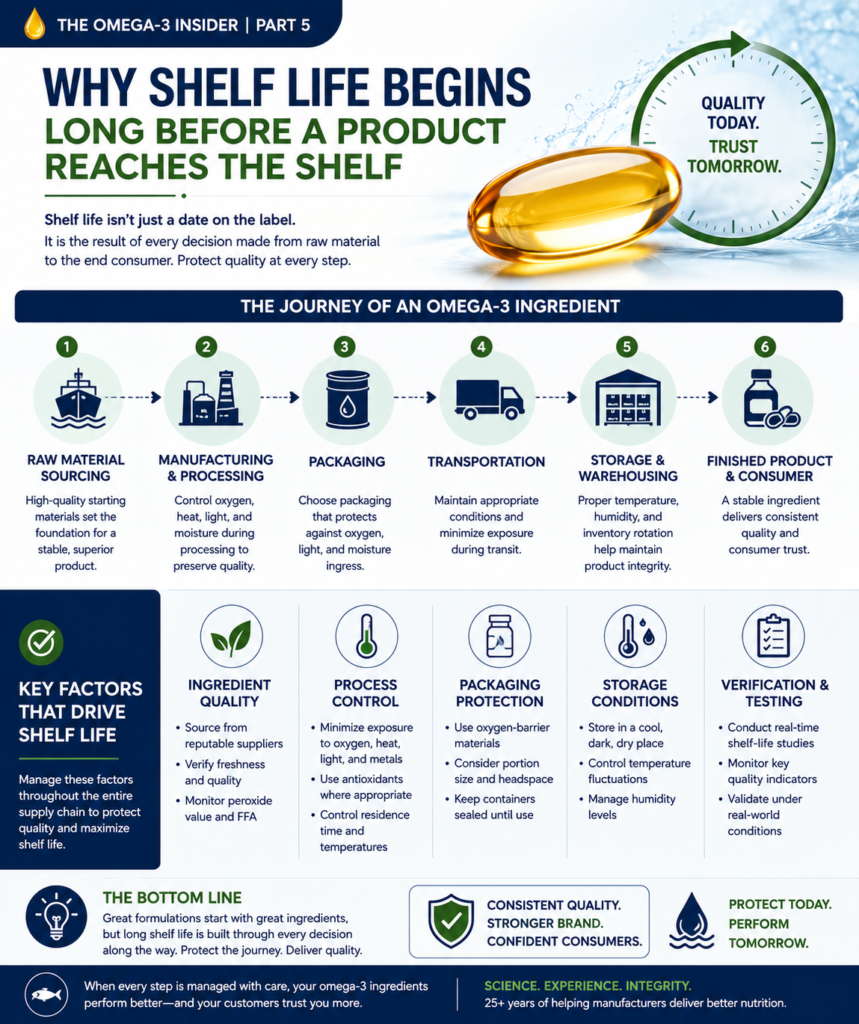
Why Shelf Life Begins Long Before a Product Reaches the Shelf
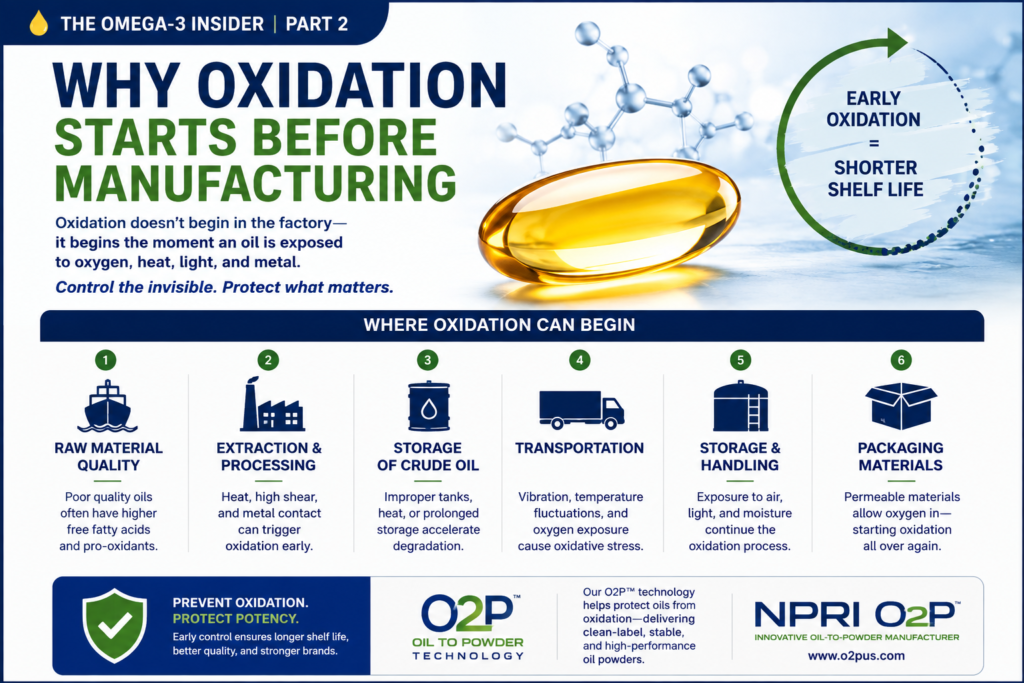
How O2P™ Technology Protects Oils from Oxidation
Shelf life begins long before a finished product reaches the consumer. Learn how raw material quality, manufacturing, packaging, storage, and transportation all contribute to product stability and long-term performance.
Oxidation begins long before oils reach the manufacturing line. Learn how raw material quality, processing, storage, transportation, and oxygen exposure can silently reduce stability, potency, and shelf life.
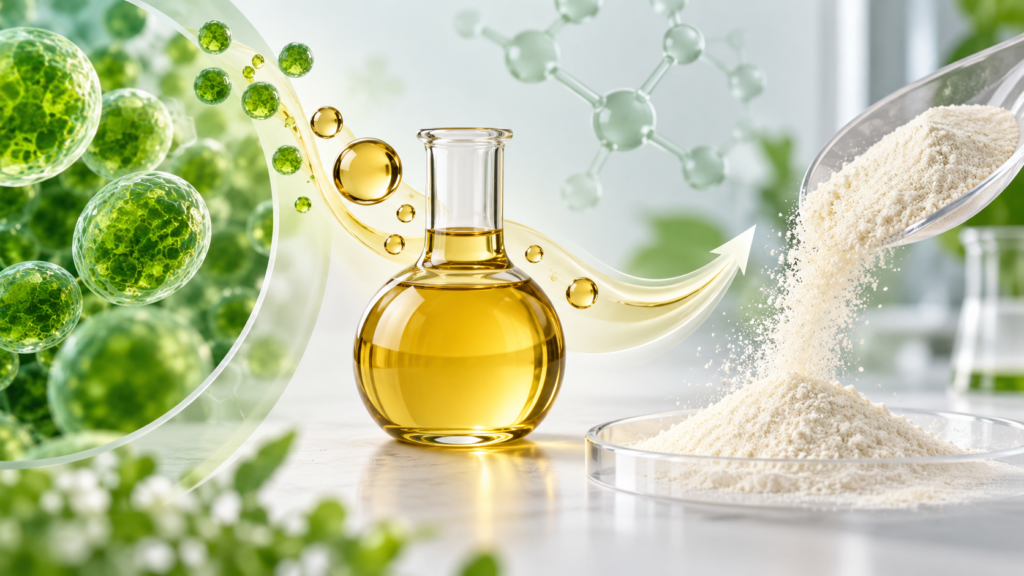
Discover how DHA algae oil is converted into free-flowing powder, including oil loading, carrier selection, oxidative stability, and formulation challenges.