
Fish Oil and Algae Oil Blends: EPA & DHA Formulation
Why Choose Between Fish Oil and Algae Oil? Combining EPA and DHA for Smarter Omega-3 Formulations
Exploring how blended marine and algae-derived omega-3 oils can improve formulation flexibility, diversify raw material sourcing, and support customized oil-powder applications.
Rethinking Traditional Omega-3 Formulation
For decades, fish oil has been the dominant commercial source of the long-chain omega-3 fatty acids eicosapentaenoic acid (EPA) and docosahexaenoic acid (DHA).
Both fatty acids are nutritionally important, but they serve different physiological functions.
EPA participates in biological pathways associated with inflammatory regulation and cardiovascular physiology. DHA is a major structural component of the brain, retina, and cell membranes.
Their distinct roles make fatty acid composition an important consideration when developing omega-3 nutritional products.
However, recent fish oil supply challenges have raised an increasingly important question for ingredient manufacturers and formulators:
Is exclusive dependence on fish-derived omega-3 still the most practical formulation strategy?
At NPRI-O2P, we believe there is another approach worth considering.
Rather than treating fish oil and algae oil as competing ingredients, we can utilize their complementary characteristics to develop more flexible omega-3 formulations.
1. Combining Two Sources of Omega-3
Algae are the original biological producers of many marine omega-3 fatty acids. Fish accumulate EPA and DHA through the marine food chain.
Today, commercially available algae oils can provide concentrated sources of DHA, while certain algae strains and production systems can also supply EPA.
However, high-EPA algae oils or those containing substantial concentrations of both EPA and DHA can be considerably more expensive than DHA-rich algae oils.
This creates an interesting formulation opportunity.
By combining DHA-rich algae oil with EPA-containing fish oil, manufacturers may be able to develop an omega-3 profile that takes advantage of both sources.
Fish oil contributes EPA and DHA, while the algae component provides additional DHA.
The resulting fatty acid composition depends on the selected oils and their blending proportions.
Importantly, adding DHA-rich algae oil does not necessarily maintain the original EPA concentration per kilogram of oil. Rather, the objective is to achieve the desired EPA and DHA content in the final formulation.
This distinction is particularly important when developing products with specific omega-3 label claims.
2. Increasing DHA Without Eliminating EPA
Many applications emphasize DHA because of its importance in neurological development, retinal structure, and other biological functions.
At the same time, EPA remains important in products designed to deliver both long-chain omega-3 fatty acids.
A DHA-rich algae oil can increase the DHA proportion of an appropriately designed fish oil blend without entirely eliminating the EPA contribution.
For example, a product developer may wish to increase DHA while maintaining a specified minimum quantity of EPA per serving.
Rather than relying exclusively on a single fish oil concentrate, the formulator can explore blending different omega-3 sources.
The final composition must be calculated from the fatty acid profiles of the individual oils and confirmed through appropriate analytical testing.
The objective is not simply to add more DHA. It is to achieve a useful EPA balance for the intended product.
3. Reducing Dependence on Fish Oil Supply
The global fish oil market is subject to variations in fishing conditions, harvest volumes, raw material availability, and supply chain disruptions.
For manufacturers relying exclusively on fish-derived omega-3, these uncertainties can affect ingredient procurement, pricing, and production planning.
Incorporating algae-derived DHA into suitable formulations provides an additional sourcing option.
Although blending does not eliminate dependence on fish oil, it can reduce the quantity required for a given formulation.
This may provide manufacturers with greater sourcing flexibility and help mitigate exposure to fluctuations in fish oil availability.
However, supply security depends on the availability, cost, quality, and consistency of both raw materials.
4. The Economics of EPA and DHA
One of the most common mistakes in omega-3 ingredient evaluation is comparing oils solely on their purchase price per kilogram.
A more informative approach is to evaluate the cost of the actual omega-3 fatty acids delivered.
For example, two oils with significantly different prices per kilogram may have very different DHA concentrations.
A more concentrated DHA source may provide better value on a cost-per-gram-of-DHA basis, even when its price per kilogram is higher.
The same principle applies to EPA.
When blending algae oil and fish oil, manufacturers should consider:
DHA and EPA concentration in each oil
Required EPA and DHA per finished serving
Cost per gram of each target fatty acid
Availability and procurement lead times
Oxidative stability and shelf-life requirements
Processing, packaging, and delivery costs
NPRI-O2P is currently seeing competitive opportunities for DHA-rich algae oil when evaluated against conventional fish oil on a DHA-per-gram basis.
The most economical formulation will depend on the required final fatty acid profile, ingredient pricing, and finished-product specifications.
5. Converting Blended Omega-3 Oils into O2P™ Oil Powders
Developing an effective omega-3 oil blend is only part of the formulation challenge.
Many food, nutritional supplement, and pet nutrition products require omega-3 fatty acids in dry powder form.
This creates additional considerations involving powder flow, oil concentration, dispersibility, ingredient compatibility, and oxidative stability.
NPRI-O2P’s proprietary O2P™ technology provides an alternative approach to conventional thermal oil-powder manufacturing methods.
Our process converts liquid oils and compatible oil blends into free-flowing, water-dispersible powders at room temperature, without intentional exposure to heat or oxygen during conversion.
The technology can accommodate different oil-loading levels depending on the oil characteristics, carrier selection, and required powder properties.
It also offers opportunities to incorporate oils into compatible dry ingredients already present in the customer’s formulation, potentially reducing the need for additional carrier materials.
For blended fish and algae oils, this means that a customized liquid omega-3 profile can also be developed into a powder format suitable for further formulation.
As with all sensitive polyunsaturated oils, appropriate oxidative stability testing, packaging, and storage conditions remain essential.
6. Applications Across Multiple Industries
Human Nutrition
Customized EPA/DHA powder formulations may be incorporated into dietary supplements, powdered nutritional products, and selected functional food systems.
Pet Nutrition
EPA and DHA are important nutritional ingredients in companion animal formulations. Blended omega-3 powders may offer flexibility for dry pet foods, supplements, treats, and other suitable applications.
Food and Beverage Manufacturing
Water-dispersible omega-3 powders can provide an alternative delivery format for nutritional dry mixes, powdered beverages, and compatible food formulations.
In each application, the appropriate fatty acid profile, ingredient composition, regulatory requirements, and stability must be evaluated.
7. Formulation Flexibility Is the Real Opportunity
The future of omega-3 ingredient development should not be limited to selecting one source over another.
Fish oil offers valuable EPA and DHA.
Algae oil provides an alternative source of DHA and, depending on the type, EPA.
Blending the two offers opportunities to customize fatty acid profiles, diversify sourcing, and evaluate more competitive formulation economics.
When combined with oil-to-powder technology, these possibilities extend to dry nutritional systems that would otherwise be difficult to formulate with conventional liquid oils.
At NPRI-O2P, our approach is to work with manufacturers and product developers to identify the oil composition and powder characteristics appropriate for their applications.
The question is no longer simply whether to use fish oil or algae oil.
The more interesting question is how to combine their strengths to develop better-targeted omega-3 ingredients.
Discuss Your Omega-3 Formulation Requirements
NPRI-O2P, LLC specializes in liquid nutritional oils, customized oil blends, proprietary O2P™ oil powders, and contract oil-to-powder manufacturing.
We welcome discussions with formulation scientists, R&D professionals, and ingredient manufacturers seeking customized EPA/DHA solutions.
NPRI-O2P, LLC
https://o2pus.com
Technical note: Fatty acid composition, processing compatibility, oxidation stability, and finished-product suitability must be confirmed for each formulation. Nutritional applications and claims are subject to applicable regulatory requirements.
Need Help With Your Formulation?
Whether you’re developing a new oil powder, improving product stability, or solving formulation challenges, our technical team is ready to help. Contact us for formulation guidance, product recommendations, or sample requests.
Recommended Technical Articles
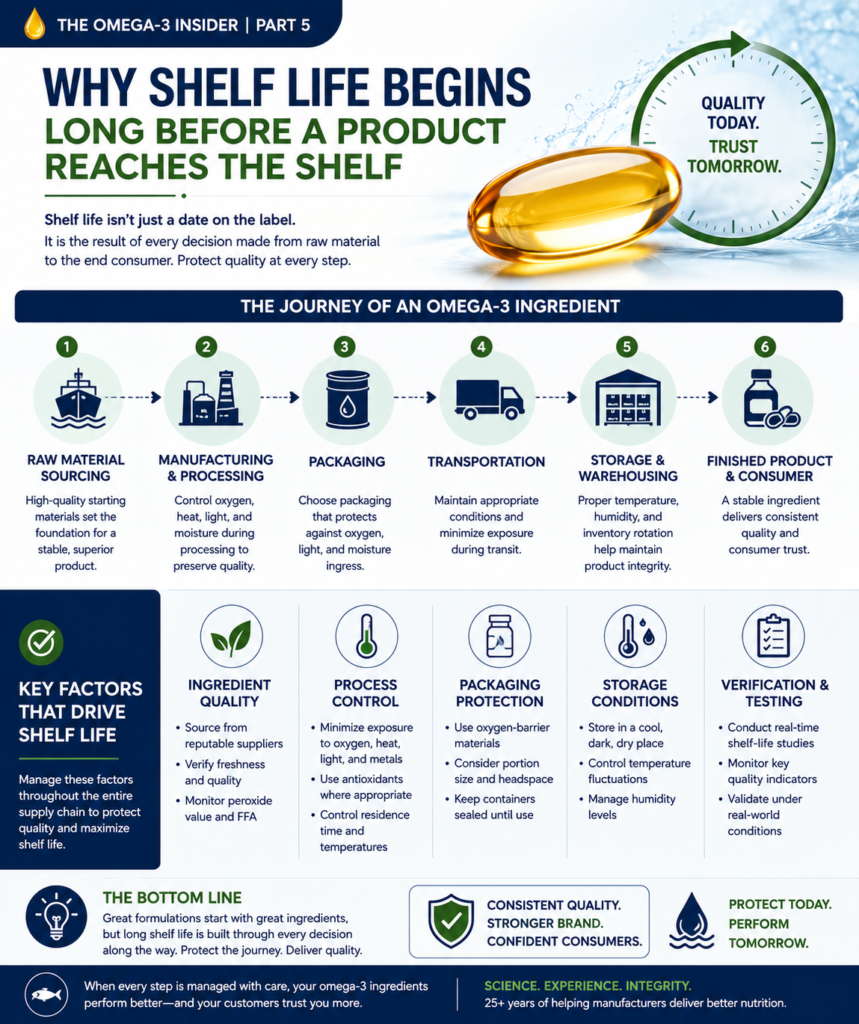
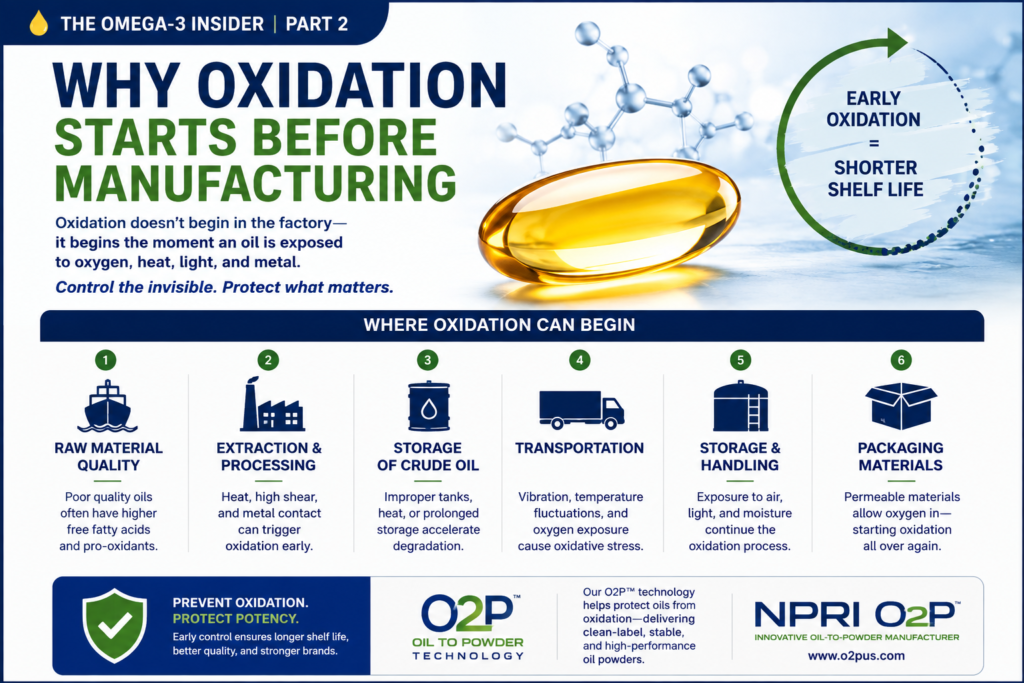

Why Shelf Life Begins Long Before a Product Reaches the Shelf
How O2P™ Technology Protects Oils from Oxidation
Shelf life begins long before a finished product reaches the consumer. Learn how raw material quality, manufacturing, packaging, storage, and transportation all contribute to product stability and long-term performance.
Oxidation begins long before oils reach the manufacturing line. Learn how raw material quality, processing, storage, transportation, and oxygen exposure can silently reduce stability, potency, and shelf life.
Discover how combining fish oil and DHA-rich algae oil can diversify omega-3 sourcing, customize EPA/DHA ratios, and create functional oil powders.