
Higher Oil Loading Isn’t Always Better: What Really Makes an Oil Powder Perform
When manufacturers evaluate an oil powder, one specification often receives immediate attention: oil content.
On the surface, the reasoning appears straightforward. If one powder contains a higher percentage of oil than another, the higher-loaded product may seem more concentrated, more efficient and potentially more economical.
However, oil concentration alone does not determine whether an oil powder will perform successfully in a commercial application.
For nutraceutical, food, beverage and pet-nutrition manufacturers, the more important question is whether the powder can deliver the required amount of oil while maintaining the physical and functional properties necessary for manufacturing and storage.
Oil Loading Is Only One Part of the Formulation
Converting a liquid oil into a functional powder requires a balance between several characteristics.
A commercially useful oil powder may need to provide:
- Adequate oil concentration
- Consistent flow characteristics
- Good ingredient uniformity
- Appropriate dispersibility
- Resistance to caking or agglomeration
- Stability during transportation and storage
- Accurate dosing during manufacturing
- Protection of oxidation-sensitive oils
Increasing oil concentration can affect several of these characteristics simultaneously.
This is particularly relevant when dealing with highly unsaturated oils such as omega-3 fish oil and algal oil, where maintaining the integrity of the lipid is just as important as achieving a particular oil percentage.
The Flowability Challenge
A powder used in commercial manufacturing must move reliably through equipment.
It may need to pass through hoppers, feeders, blenders, filling machines or packaging systems. If an oil powder becomes excessively cohesive, sticky or prone to agglomeration, production efficiency can decline even though the laboratory specification shows an impressive oil content.
Poor powder flow can contribute to problems including inconsistent feeding, material buildup, inaccurate dosing and longer manufacturing times.
Consequently, the highest theoretically achievable oil loading may not always represent the most practical commercial formulation.
Dispersibility Also Matters
Many powdered oils are ultimately used in applications where interaction with water is important.
These may include powdered beverages, nutritional drink mixes, supplements, functional foods or other formulations in which the oil needs to distribute effectively throughout the finished product.
An oil powder therefore cannot be evaluated exclusively by how much oil it contains.
Its behavior when incorporated into the customer’s formulation is equally important.
Stability Must Remain a Priority
Sensitive nutritional oils present another challenge: oxidation.
Polyunsaturated fatty acids are particularly susceptible to degradation when exposed to oxygen, heat, light and other environmental conditions.
A successful powder system should therefore consider not only concentration but also the environment surrounding the oil during processing, storage and subsequent manufacturing.
Increasing oil loading at the expense of physical stability or protection may ultimately work against the original purpose of converting the oil into powder.
Manufacturing Performance Is Part of Ingredient Quality
Ingredient specifications are frequently evaluated before the ingredient ever reaches the production floor.
But commercial manufacturers eventually have to answer a different set of questions.
Does the powder move through the equipment properly?
Does it blend uniformly?
Does it remain consistent during storage?
Does it disperse appropriately?
Can the manufacturer reproduce the same finished product from lot to lot?
These characteristics may have a greater impact on manufacturing economics than a small difference in oil concentration.
The Right Oil Loading Depends on the Application
There is therefore no universal answer to the question:
“What is the best oil percentage for an oil powder?”
The answer depends on the intended application.
A powder intended for a capsule or tablet formulation may have different physical requirements from one intended for a beverage.
A pet-nutrition product may require different carriers, flow characteristics or dispersibility than a human dietary supplement.
A manufacturer producing large-volume powdered blends may place particular emphasis on flowability and uniformity.
The appropriate formulation therefore represents a balance between concentration and performance.
Performance Rather Than a Single Number
Oil loading remains an important specification, but it should not become the sole measurement of product quality.
A better approach is to evaluate the entire ingredient system:
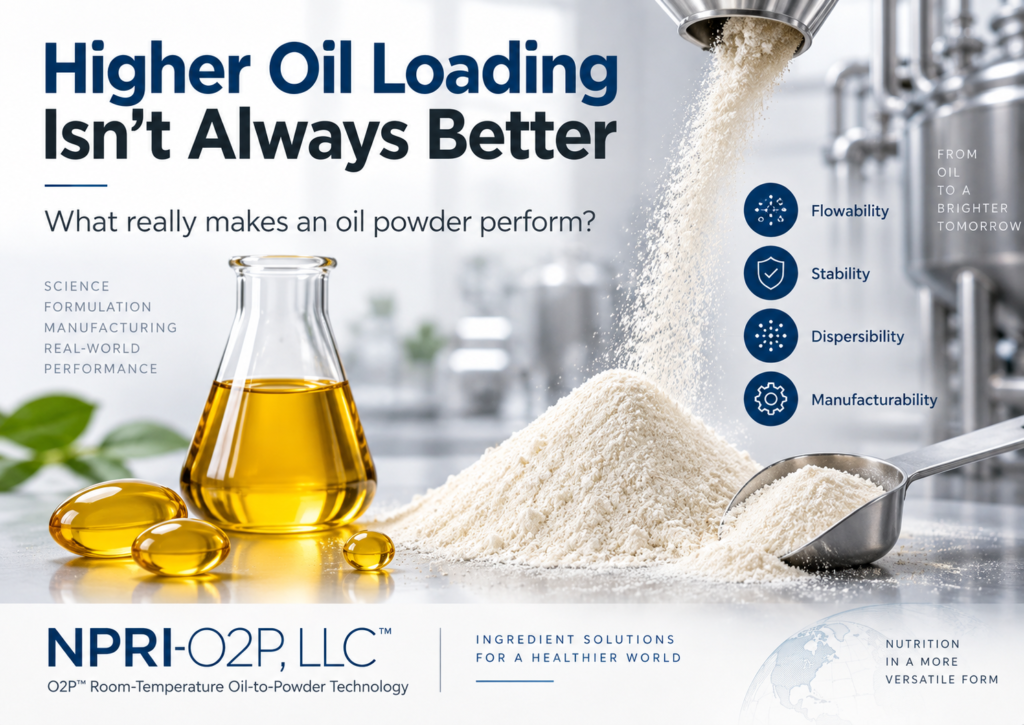
Oil concentration + stability + flowability + dispersibility + manufacturability + finished-product performance.
At NPRI-O2P, LLC, our approach to oil-to-powder manufacturing focuses on developing powders around the requirements of the application rather than pursuing a single specification in isolation.
Using our O2P™ room-temperature oil-to-powder process, we manufacture specialty oil powders for nutraceutical, food, beverage and pet-nutrition applications.
The goal is not simply to put oil into a powder.
The goal is to produce an oil powder that works.
Need Help With Your Formulation?
Whether you’re developing a new oil powder, improving product stability, or solving formulation challenges, our technical team is ready to help. Contact us for formulation guidance, product recommendations, or sample requests.
Recommended Technical Articles
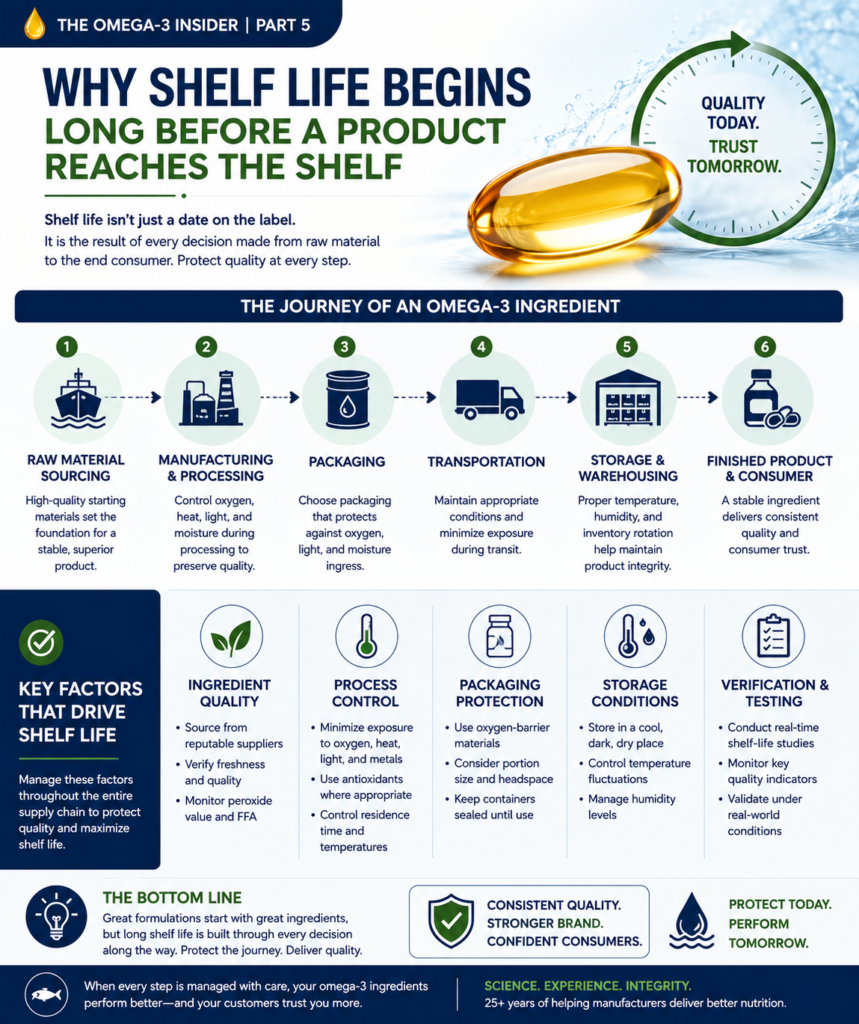
Why Shelf Life Begins Long Before a Product Reaches the Shelf
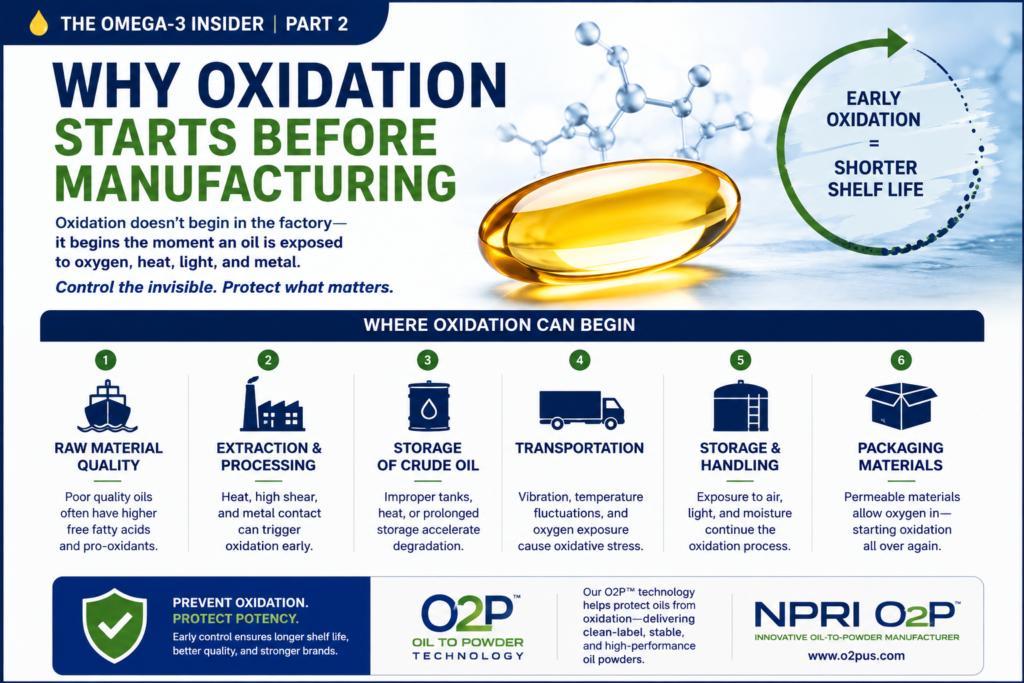
How O2P™ Technology Protects Oils from Oxidation
Shelf life begins long before a finished product reaches the consumer. Learn how raw material quality, manufacturing, packaging, storage, and transportation all contribute to product stability and long-term performance.
Oxidation begins long before oils reach the manufacturing line. Learn how raw material quality, processing, storage, transportation, and oxygen exposure can silently reduce stability, potency, and shelf life.
Why the highest oil percentage isn’t necessarily the best specification—and what formulators should evaluate instead.
