
A COA Is Only as Good as the Test Method Behind It
In the specialty oils and nutraceutical ingredient industries, a Certificate of Analysis is often treated as the final word on whether a material meets specification.
But a number on a COA does not exist in isolation.
Behind every reported result is an analytical method, sample-preparation procedure, extraction technique, instrument, calibration process, and laboratory protocol.
That matters.
Two laboratories can test the same material and obtain different results
When a manufacturer and a customer receive different analytical results from the same production lot, the immediate reaction is often to assume that one laboratory must be wrong.
Sometimes that may be the case.
But sometimes both laboratories performed their respective procedures correctly.
The difference may come from how the material was prepared, extracted, analyzed, or calculated.
For oils, fats, lipid powders, and encapsulated ingredients, analytical methodology becomes especially important because the material being tested may not be a simple homogeneous liquid oil.
A finished oil powder may contain oil, carrier material, flow aids, antioxidants, or other components. Recovering the oil fraction before analysis can therefore become an important part of obtaining a representative result.
The test method should be part of the specification
When companies establish an ingredient specification, they frequently concentrate on the numerical requirement:
- Minimum active level
- Maximum moisture
- Fat content
- EPA and DHA concentration
- Peroxide value
- Anisidine value
- Acid value
But the analytical method used to determine that number can be equally important.
A specification stating simply:
EPA + DHA: NLT X mg/g
may not tell the complete story.
A more useful specification identifies the agreed analytical method, including any applicable extraction or sample-preparation requirements.
That gives the manufacturer, customer, and third-party laboratory the same analytical starting point.
Standardized methods help reduce disputes
Organizations such as the American Oil Chemists’ Society have developed validated analytical methods specifically for fats, oils, lipids, and related materials.
These standardized methods help laboratories work from established procedures rather than independently developed approaches.
They do not eliminate every source of analytical variation, but they provide a common technical foundation.
For manufacturers and customers, that can make a major difference when evaluating whether a product actually meets specification.
Sample preparation matters
This becomes particularly important with powdered oils and encapsulated lipids.
A test method originally designed for a liquid oil may not automatically produce the same result when applied directly to a powder matrix.
The laboratory may first need to recover or extract the lipid fraction.
Variables such as solvent selection, extraction efficiency, sample size, mixing, temperature, and calculation basis can influence the reported result.
A laboratory result therefore should not always be evaluated solely by looking at the final number.
The first questions should include:
What method was used?
How was the sample prepared?
Was the method appropriate for this particular matrix?
Was the result reported on the same basis as the product specification?
A COA should begin a technical conversation—not end one
At NPRI-O2P, we believe analytical specifications should be tied as closely as practical to defined, repeatable testing procedures.
When results differ, the objective should not immediately be to determine who is right and who is wrong.
The better approach is to compare the methods.
That means reviewing sample preparation, extraction, analytical procedure, calculation basis, laboratory controls, and the specification itself.
Only then can two results be meaningfully compared.
Consistency requires alignment
Raw-material consistency, manufacturing consistency, and analytical consistency are closely connected.
Manufacturers can invest heavily in process control, quality systems, and ingredient qualification, but disagreements can still arise if the manufacturer and customer are evaluating the finished product using fundamentally different analytical approaches.
A strong supplier-customer relationship therefore includes agreement not only on what specification must be achieved, but also on how that specification will be measured.
Because ultimately, a COA is only as reliable—and as meaningful—as the analytical method behind it.
NPRI-O2P, LLC
Oil-to-Powder Technology
www.o2pus.com
Need Help With Your Formulation?
Whether you’re developing a new oil powder, improving product stability, or solving formulation challenges, our technical team is ready to help. Contact us for formulation guidance, product recommendations, or sample requests.
Recommended Technical Articles
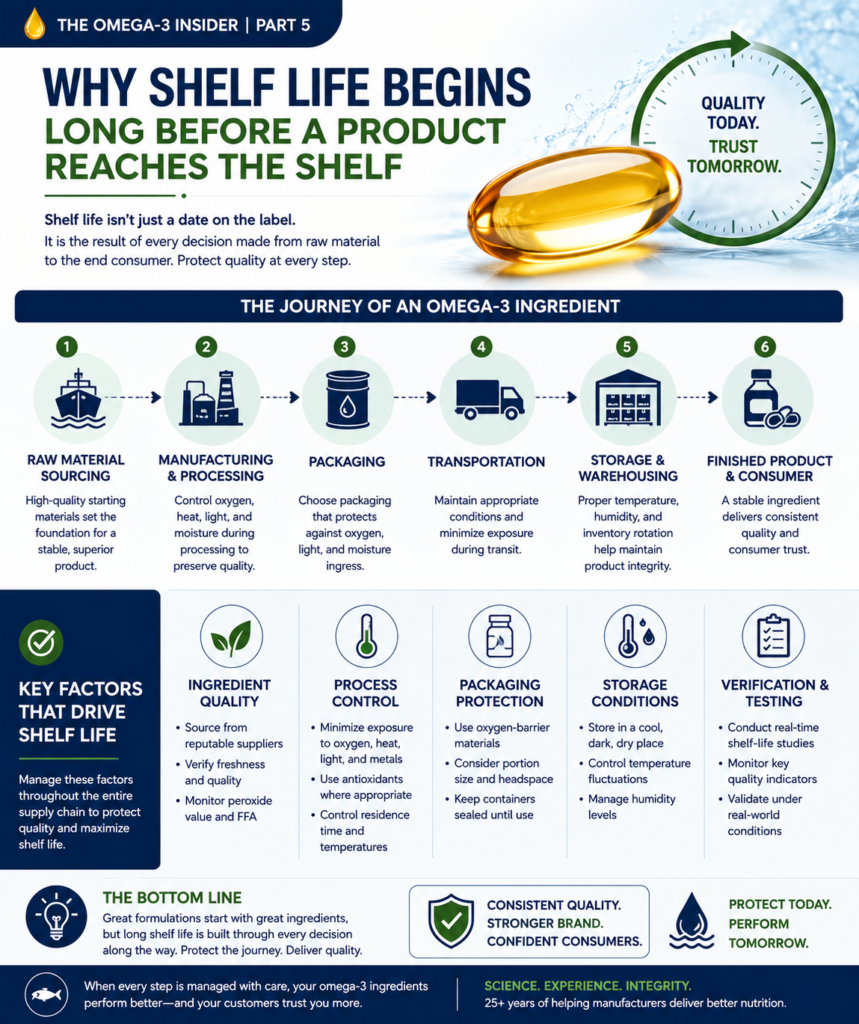
Why Shelf Life Begins Long Before a Product Reaches the Shelf
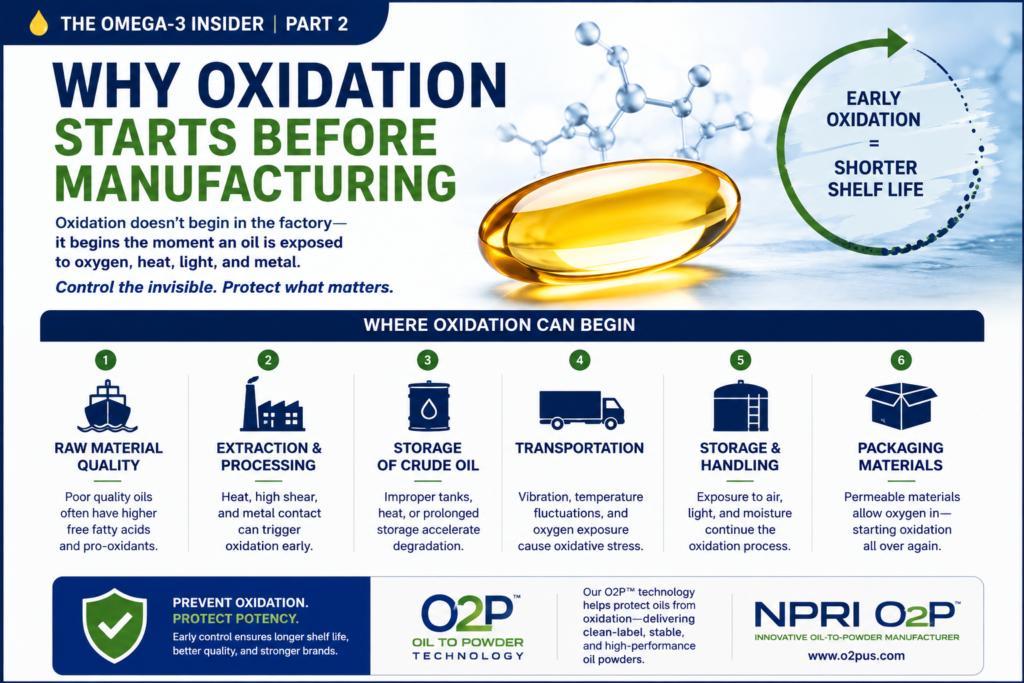
How O2P™ Technology Protects Oils from Oxidation
Shelf life begins long before a finished product reaches the consumer. Learn how raw material quality, manufacturing, packaging, storage, and transportation all contribute to product stability and long-term performance.
Oxidation begins long before oils reach the manufacturing line. Learn how raw material quality, processing, storage, transportation, and oxygen exposure can silently reduce stability, potency, and shelf life.
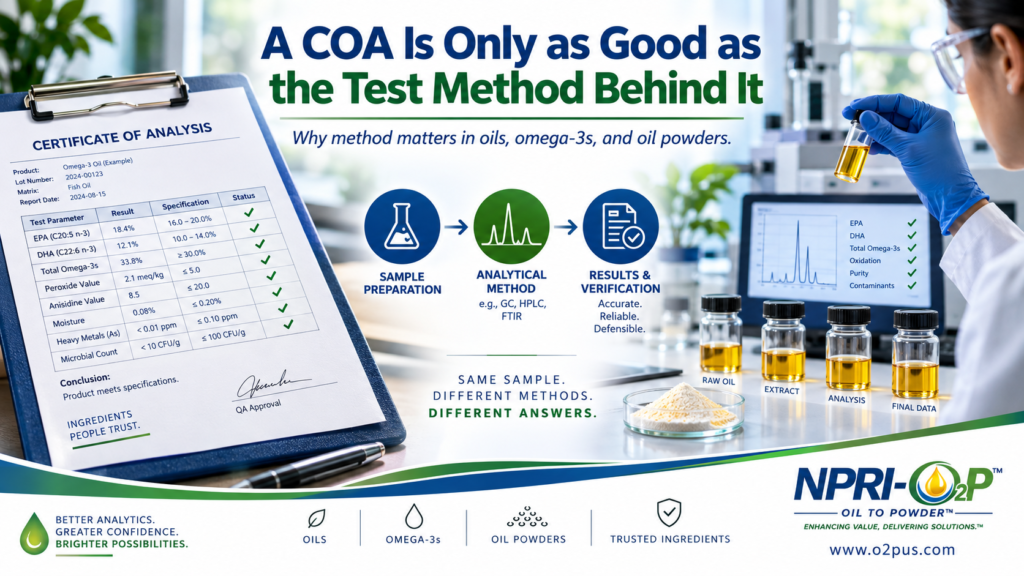
Why analytical methods, extraction procedures and sample preparation matter when interpreting COA results for oils, omega-3 ingredients and oil powders.
