
The Hidden Cost of Buying Nutraceutical Ingredients on Price Alone
Price matters in nutraceutical manufacturing. Raw-material costs can significantly affect margins, especially in competitive categories where manufacturers are under constant pressure to control costs.
But the lowest-priced ingredient is not always the lowest-cost ingredient.
When purchasing decisions are driven primarily by price, manufacturers can unintentionally introduce variability into production, finished-product quality, and long-term consistency.
Two ingredients may have the same general name and appear to meet similar specifications, yet perform very differently once they enter a manufacturing process.
A Specification Does Not Always Mean Equivalency
A certificate of analysis can confirm that a raw material meets the parameters that were tested.
That is important.
But it does not necessarily mean that one supplier’s material will behave exactly the same way as another supplier’s material.
Differences can exist in:
- active concentration
- purity
- oxidation level
- moisture
- carrier systems
- particle characteristics
- processing methods
- raw-material source
- storage conditions
- testing methodology
- lot-to-lot consistency
These differences may not always be obvious when comparing supplier quotations.
They often become visible later, during production.
Supplier Switching Can Affect More Than Purchasing Cost
Manufacturers frequently change suppliers in response to pricing pressure.
On paper, the savings may look attractive.
A lower raw-material price can reduce immediate purchasing cost, but if the replacement ingredient behaves differently in production, that savings can disappear quickly.
Potential consequences include:
- formulation adjustments
- additional testing
- production delays
- lower manufacturing yield
- blending inconsistencies
- changes in taste or odor
- flowability problems
- active-content variation
- rework
- rejected lots
- increased customer complaints
A raw material that costs slightly more but performs consistently may ultimately be less expensive to manufacture with.
Consistency Has Economic Value
Consistency is often treated as a quality issue.
It is also a financial issue.
When a manufacturer knows how a material behaves from lot to lot, production becomes more predictable.
Formulations remain more stable.
Operators make fewer adjustments.
Quality-control results become easier to interpret.
Finished products become more consistent.
That predictability has value.
A purchasing decision should therefore consider not only the cost per kilogram, but the total impact of that ingredient on the manufacturing process.
The Importance of Supplier Qualification
A reliable supplier relationship can be worth more than a temporary price advantage.
Supplier qualification should consider more than whether a company can provide a competitive quotation.
Manufacturers may also want to evaluate:
- historical lot consistency
- quality systems
- analytical methods
- traceability
- raw-material sourcing
- storage and handling practices
- responsiveness to quality issues
- documentation
- technical support
A qualified supplier should be able to provide confidence not only that the material meets specification, but that it can continue to meet expectations consistently over time.
Raw-Material Variability Can Affect Finished Products
This issue becomes especially important when working with sensitive ingredients.
Oils, fatty acids, botanical extracts, and other nutraceutical raw materials can be affected by processing history, storage, oxidation, temperature, and handling.
Small differences upstream can create larger differences downstream.
At NPRI-O2P, consistency of incoming materials is important because variations in the starting oil or ingredient can influence the properties of the finished powder.
Supplier selection, specifications, analytical testing, and lot-to-lot consistency therefore matter alongside price.
The Lowest Purchase Price Is Not Always the Lowest Manufacturing Cost
Purchasing departments understandably look for opportunities to reduce costs.
But ingredient sourcing should also consider the cost of inconsistency.
A lower-priced ingredient that creates production problems may ultimately cost more than a dependable ingredient that performs predictably.
In nutraceutical manufacturing, consistency has value.
The real question is not simply:
“What is the lowest price?”
A better question may be:
“Which raw material gives us the most consistent performance at the lowest total manufacturing cost?”
Need Help With Your Formulation?
Whether you’re developing a new oil powder, improving product stability, or solving formulation challenges, our technical team is ready to help. Contact us for formulation guidance, product recommendations, or sample requests.
Recommended Technical Articles
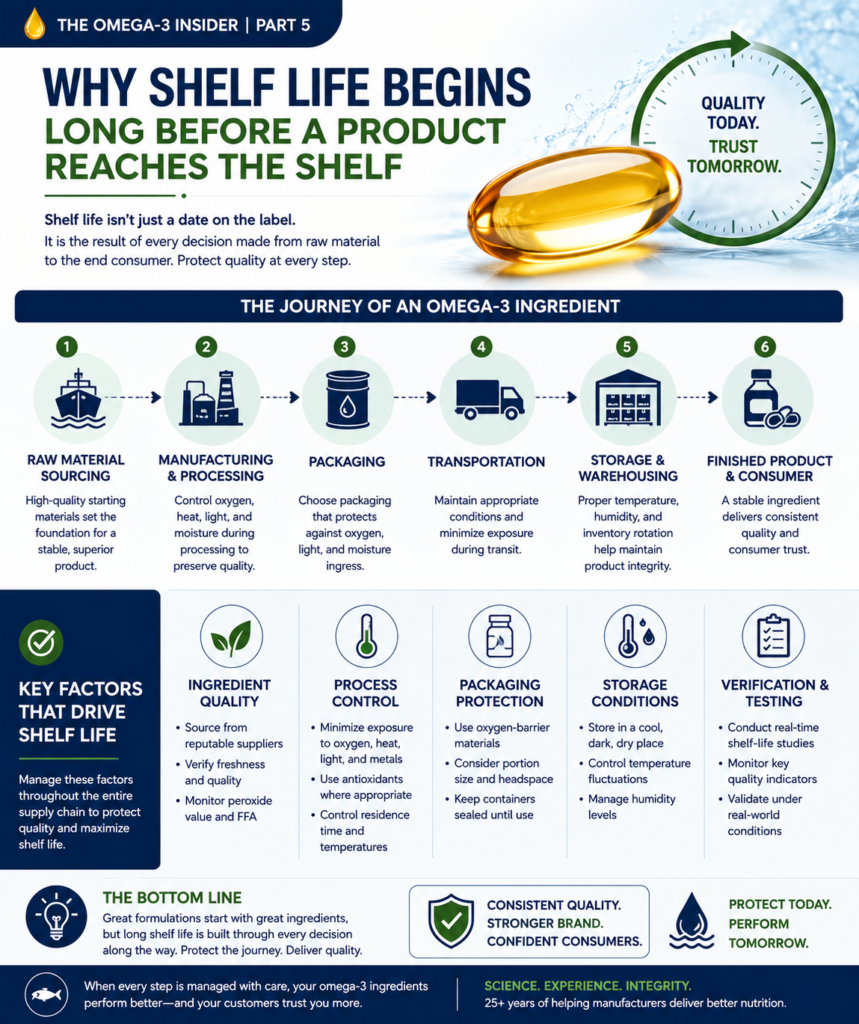

Why Shelf Life Begins Long Before a Product Reaches the Shelf
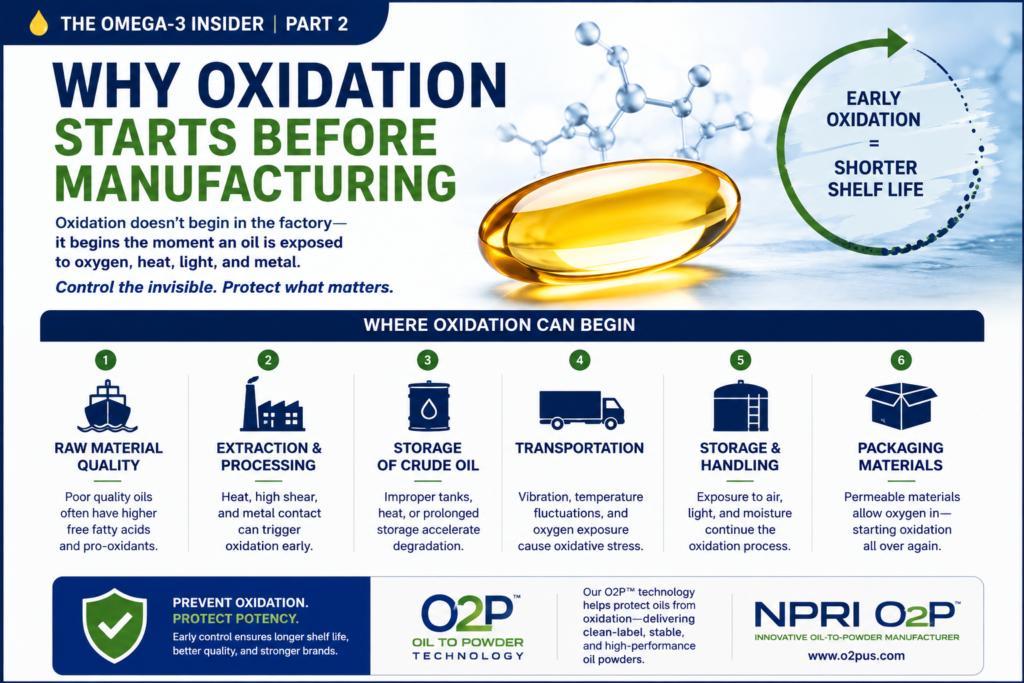
How O2P™ Technology Protects Oils from Oxidation
Shelf life begins long before a finished product reaches the consumer. Learn how raw material quality, manufacturing, packaging, storage, and transportation all contribute to product stability and long-term performance.
Oxidation begins long before oils reach the manufacturing line. Learn how raw material quality, processing, storage, transportation, and oxygen exposure can silently reduce stability, potency, and shelf life.
Lower raw-material prices can look attractive, but inconsistency can create added costs through rework, testing, production delays, quality variation, and rejected product.
