
Do Supplements Really Work? What the Science Actually Tells Us About Vitamins, Minerals and Nutritional Supplements
Every morning, millions of people swallow capsules, tablets, softgels and powders with breakfast.
A multivitamin. Vitamin D. Magnesium. Calcium. Omega-3. Perhaps probiotics, botanical extracts or several other nutritional products.
We spend billions of dollars on these products largely because of one fundamental expectation:
We believe they are helping us stay healthy.
But are they?
It sounds like a straightforward question. Scientifically, however, it is anything but straightforward.
The evidence does not support the sweeping conclusion that dietary supplements either “work” or “do not work.”
A much better question is:
Which ingredient, at what dose, in what form, for which individual or population, and for what intended nutritional or physiological purpose?
Once we ask the question that way, the science becomes considerably more interesting.
Essential Nutrients and Supplementation Are Not the Same Thing
There is an important distinction that is sometimes lost in discussions about dietary supplements.
Vitamins and minerals perform essential functions in human physiology. Deficiencies of particular nutrients can have well-established consequences, and correcting inadequate nutritional intake can be important.
But demonstrating that a nutrient is essential does not automatically demonstrate that consuming additional quantities beyond nutritional requirements will make an adequately nourished individual healthier.
Those are two very different scientific propositions.
Consider a simple analogy.
Water is essential for life.
That does not mean that if an adequate amount of water is beneficial, continually increasing the amount consumed must provide continually increasing benefits.
Nutrients should not automatically be viewed differently.
The biological importance of a nutrient establishes why we need it. It does not, by itself, establish that more is always better.
What Do Clinical Studies Tell Us?
There is substantial clinical research on vitamins, minerals and other nutritional ingredients.
But the results depend heavily upon what researchers are studying.
Studies may examine people with inadequate nutrient status, generally healthy populations, older adults, pregnant individuals or people with particular nutritional requirements. They may use different doses, formulations, durations and endpoints.
Consequently, apparently contradictory findings do not necessarily mean that nutritional science is unreliable.
They may simply be answering different questions.
For example, the U.S. Preventive Services Task Force has evaluated vitamin and mineral supplementation for prevention of cardiovascular disease and cancer in community-dwelling, nonpregnant adults without known nutritional deficiencies.
Its conclusions do not establish that vitamins are unimportant.
Rather, they demonstrate something much narrower and more useful: evidence supporting broad supplementation for preventing those particular diseases in that particular population is not as conclusive as consumers might assume.
That distinction matters enormously.
Correcting a Deficiency Is Different From Optimizing an Adequate Diet
One of the strongest reasons for nutritional supplementation is straightforward: supplying a nutrient when dietary intake or nutritional status is inadequate.
But that scenario should not automatically be extrapolated to everyone.
If an individual is deficient in a nutrient, providing that nutrient may produce an important physiological response.
If another individual already has adequate nutritional status, providing substantially more of the same nutrient may produce a very different result.
This is one reason headlines declaring that a particular vitamin either “works” or “doesn’t work” can be misleading.
The population being studied matters.
So does baseline nutritional status.
What About Herbal Supplements?
Botanical and herbal supplements introduce another level of complexity.
The phrase “herbal supplements” describes an enormous collection of chemically different materials.
Two products carrying the name of the same plant may even differ according to plant variety, growing conditions, harvested portion, extraction technique, solvent, concentration, standardization and storage conditions.
Therefore, asking whether herbal supplements work as a category has little scientific meaning.
The evidence must be evaluated ingredient by ingredient, preparation by preparation and application by application.
Traditional use can provide an interesting basis for scientific investigation, but traditional use alone should not be confused with clinical proof.
The Question We Often Forget: What Actually Reaches the Body?
Suppose an ingredient does have credible evidence behind it.
There is still another important question:
Does consuming the finished product deliver the ingredient in the amount and condition expected?
This brings us into areas such as bioavailability, formulation and ingredient stability.
Swallowing 500 milligrams of something does not necessarily mean that 500 milligrams becomes biologically available.
The chemical form of a nutrient can matter.
The surrounding formulation can matter.
Digestion and absorption can matter.
And before the product is ever consumed, manufacturing and storage can matter.
An ingredient may travel through raw-material processing, manufacturing, transportation, warehousing and months of shelf life before reaching the consumer.
The condition of the ingredient at the time of consumption therefore deserves consideration alongside the quantity printed on the label.
Stability Is Part of the Nutritional Equation
Some nutritional compounds are considerably more susceptible to environmental conditions than others.
Heat, oxygen, moisture and light can alter sensitive ingredients.
This becomes particularly relevant for oils containing polyunsaturated fatty acids.
The presence of an ingredient at the beginning of manufacturing does not by itself tell us everything about its condition at the end of processing or after extended storage.
For sensitive nutritional ingredients, preservation and stability therefore become part of the broader discussion about product quality.
This is an area in which ingredient science and processing science intersect.
Omega-3: A Useful Case Study
Omega-3 fatty acids illustrate why the question “Does it work?” can be too simplistic.
EPA and DHA have been extensively investigated scientifically.
But an Omega-3 product is not defined solely by the words “Omega-3” on its label.
Several variables can distinguish one ingredient or finished product from another:
Source. Different marine and algal sources provide different fatty-acid profiles.
Concentration. Products can contain substantially different quantities of EPA and DHA.
Molecular form. Omega-3 fatty acids may be present in different chemical forms depending upon source and processing.
Dose. Results from a study using a particular intake should not automatically be attributed to every product containing some amount of Omega-3.
Oxidative condition. Polyunsaturated fatty acids are susceptible to oxidation, making processing and storage important quality considerations.
Delivery system. The way an oil is incorporated into a finished nutritional product can influence formulation, handling, dispersibility and protection during its journey to the consumer.
Consequently, evidence concerning EPA and DHA should not be interpreted as proof that every Omega-3 product is functionally identical.
The Same Principle Extends to Animal Nutrition
Nutritional supplementation is not limited to humans.
Vitamins, minerals, fatty acids and other nutritional ingredients are widely incorporated into companion-animal diets and nutritional products.
Veterinary researchers have conducted controlled studies examining particular nutritional interventions, including Omega-3 fatty acids.
As with human research, however, results must be interpreted according to the species, population, formulation, dosage and outcome being studied.
Evidence involving a specific formulation and controlled dose should not automatically be generalized to every product containing the same ingredient.
This is an important distinction for both manufacturers and consumers.
More Is Not Necessarily Better
The supplement marketplace can sometimes encourage a psychological assumption that higher numbers represent greater value.
More milligrams.
Higher potency.
More ingredients.
More capsules.
But nutrition does not necessarily operate according to that principle.
Depending upon the nutrient and circumstances, additional intake beyond what the body requires may provide no additional advantage, and excessive intake of some nutrients can present risks.
Therefore, responsible nutritional formulation should not simply ask:
“How much can we put into the product?”
It should ask:
“What amount is scientifically appropriate for the intended nutritional purpose?”
That is a fundamentally different approach.
Five Questions Worth Asking About Any Supplement
Rather than trying to classify the entire supplement industry as effective or ineffective, consumers, formulators and manufacturers may benefit from asking five more precise questions.
1. Is there credible evidence for the ingredient?
Not merely testimonials, popularity or traditional reputation, but relevant scientific evidence.
2. Is the dose meaningful?
An ingredient may have been clinically investigated, but that does not establish that every quantity of that ingredient produces the same effect.
3. Is the ingredient in an appropriate form?
Chemical form, formulation and delivery can influence how an ingredient behaves.
4. Has the ingredient maintained its integrity?
Sensitive ingredients can be affected by processing, oxygen, heat, moisture, light and storage.
5. Does the finished product deliver what is expected?
Ultimately, consumers do not consume scientific papers or raw-material specifications.
They consume finished products.
That makes the quality and integrity of the finished formulation critically important.
So, Do Supplements Really Work?
The most scientifically responsible answer may be:
Sometimes, for particular purposes, in particular populations, at appropriate doses and when the product actually delivers the ingredient being studied.
That answer is less dramatic than either “supplements work” or “supplements are a waste of money.”
But science is rarely improved by forcing complicated questions into simple answers.
Vitamins and minerals remain essential components of nutrition. Certain nutritional interventions have well-established applications. Other proposed benefits remain uncertain or are supported by varying levels of evidence.
Botanical ingredients must be considered individually rather than collectively.
And an ingredient with promising science still has to survive formulation, manufacturing, transportation and storage before it reaches the person—or animal—expected to benefit from it.
Perhaps, therefore, the supplement industry’s next great challenge is not simply discovering more ingredients.
It is ensuring that the science behind an ingredient, the formulation of the product and the integrity of what ultimately reaches the consumer are aligned.
At NPRI-O2P, this question is particularly relevant to our work with oil-based nutritional ingredients. Our focus on converting oils into functional powder systems has continually reinforced an important principle:
The value of a nutritional ingredient is determined not only by what it is, but also by how it is processed, protected and ultimately delivered.
That may be one of the most important questions the nutritional-products industry can ask.
This article is intended for general educational and industry discussion purposes and does not provide medical or veterinary advice. References to scientific research should not be interpreted as claims that any particular dietary supplement or nutritional product diagnoses, treats, cures or prevents disease.
Need Help With Your Formulation?
Whether you’re developing a new oil powder, improving product stability, or solving formulation challenges, our technical team is ready to help. Contact us for formulation guidance, product recommendations, or sample requests.
Recommended Technical Articles
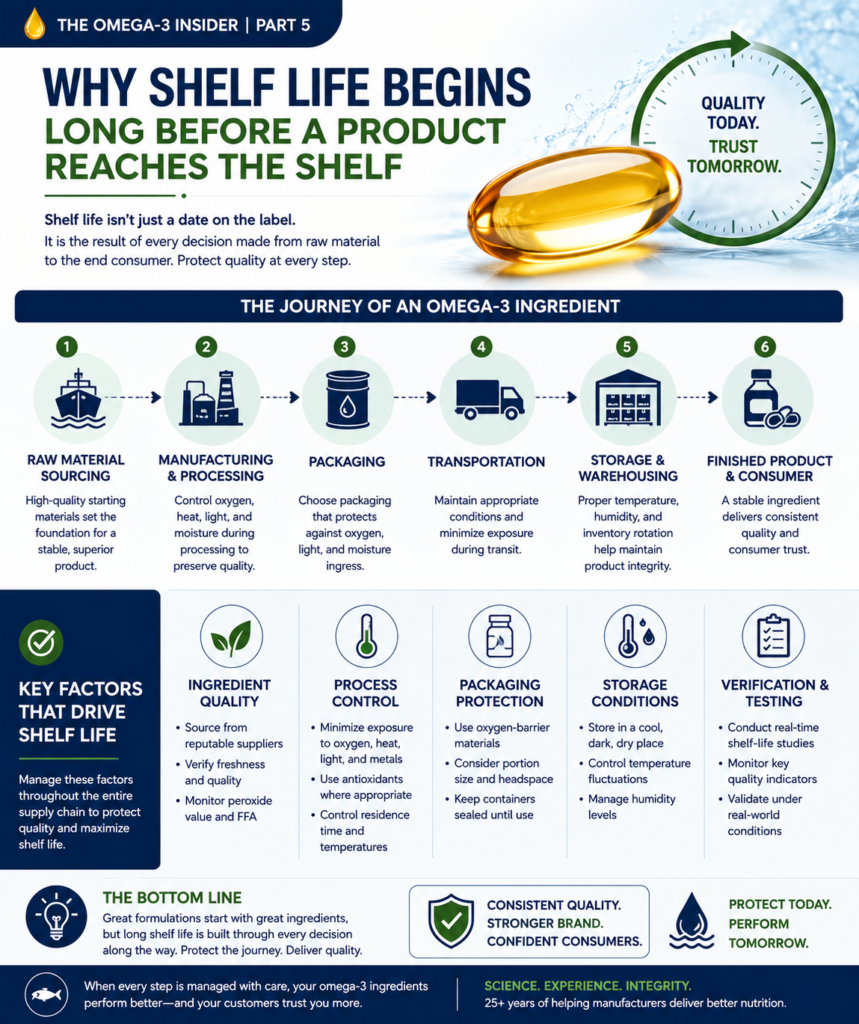
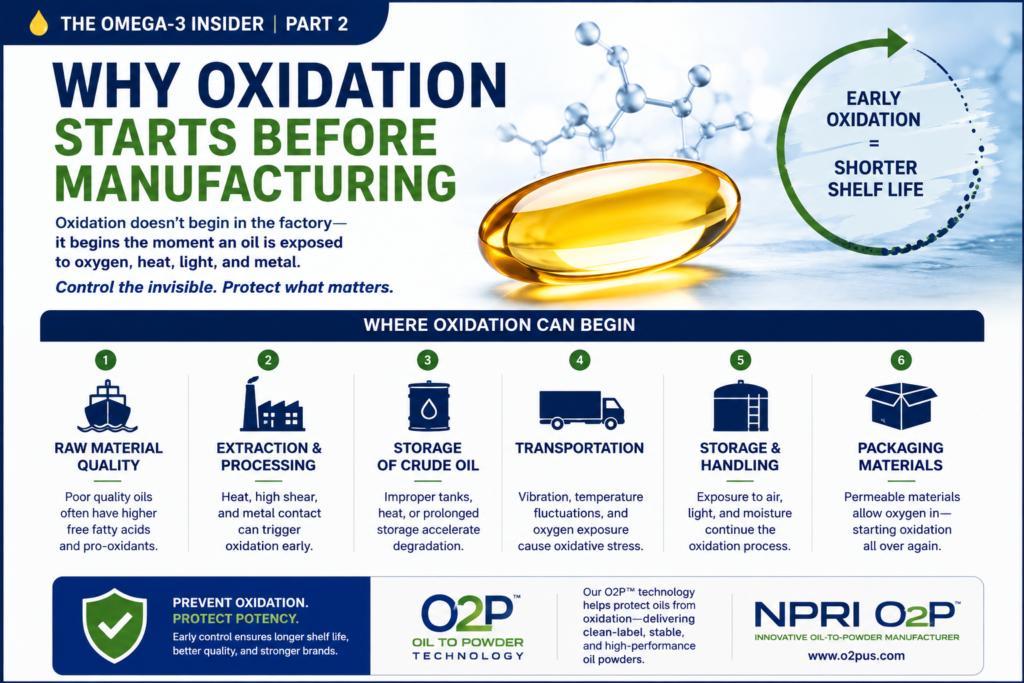
Why Shelf Life Begins Long Before a Product Reaches the Shelf
How O2P™ Technology Protects Oils from Oxidation
Shelf life begins long before a finished product reaches the consumer. Learn how raw material quality, manufacturing, packaging, storage, and transportation all contribute to product stability and long-term performance.
Oxidation begins long before oils reach the manufacturing line. Learn how raw material quality, processing, storage, transportation, and oxygen exposure can silently reduce stability, potency, and shelf life.
What does the science really say about vitamins, minerals, herbal supplements and Omega-3s? We examine the evidence—and why dosage, bioavailability, stability and ingredient quality matter.
