
The Science of Fatty Acids – Part 8: What Happens After Processing? Understanding Oxidative Stability Over Time
In Part 7 of The Science of Fatty Acids, we examined how lipid oxidation can be evaluated using Peroxide Value (PV), p-Anisidine Value (p-AV), and TOTOX Value.
These analytical measurements provide important information about the oxidative condition of an oil.
But they also raise an important practical question:
Does a good analytical result today guarantee that an oil will remain stable tomorrow?
The answer is no.
Oxidative stability is not simply a characteristic measured at one moment in time. It is the ability of an oil or oil-containing product to resist oxidative deterioration throughout processing, storage, distribution, and ultimately its intended shelf life.
For manufacturers working with highly unsaturated functional oils, understanding this distinction is extremely important.
Initial Quality and Long-Term Stability Are Not the Same Thing
An oil may begin with excellent analytical values.
Its Peroxide Value may be low. Its p-Anisidine Value may be well within specification. Its TOTOX Value may indicate very little accumulated oxidation.
Those results tell us something important about the condition of the oil at the time it was tested.
They do not necessarily tell us how that oil will behave six months, twelve months, or two years later.
Once an oil is manufactured, processed, packaged, transported, stored, opened, or incorporated into another formulation, its environment changes.
Oxidation can continue.
The rate at which it continues depends on numerous factors, including the fatty-acid composition of the oil and the conditions to which it is subsequently exposed.
Unsaturation Creates Vulnerability
As discussed earlier in this series, fatty acids containing multiple double bonds are particularly susceptible to oxidation.
This is especially important for oils containing substantial concentrations of long-chain polyunsaturated fatty acids such as EPA and DHA.
The same molecular structure that makes these fatty acids nutritionally valuable also makes them more vulnerable to oxidative reactions.
Consequently, protecting a sensitive oil is not simply a matter of starting with good-quality raw material.
The oil must also be protected from conditions that can accelerate oxidation throughout its useful life.
Oxygen Remains One of the Primary Concerns
Oxidation requires an oxidizing environment, and oxygen exposure is therefore one of the most important factors affecting lipid stability.
Exposure can occur at numerous stages:
during handling,
during processing,
inside packaging headspace,
through oxygen-permeable packaging materials,
or repeatedly after a package has been opened.
The amount and duration of exposure can influence the rate at which oxidative reactions proceed.
This is one reason why packaging and product format can have a meaningful effect on the oxidative stability of sensitive oils.
Temperature Matters
Temperature is another major consideration.
In general, increasing temperature accelerates many chemical reactions, including reactions associated with lipid oxidation.
Heat exposure may occur during manufacturing, subsequent processing, transportation, warehousing, or storage.
For sensitive polyunsaturated oils, therefore, temperature history can become part of the product’s overall stability story.
This does not mean that every exposure to heat automatically causes unacceptable oxidation.
Rather, it means that manufacturers should consider the cumulative conditions experienced by an oil from raw material through finished product.
Light Can Accelerate Oxidative Deterioration
Light exposure can also promote oxidation, particularly when photosensitizing compounds are present.
For this reason, packaging selection is more than an aesthetic decision.
Opaque or light-protective packaging can play an important role in protecting certain sensitive oils during storage and distribution.
The relationship between packaging and oxidative stability illustrates an important principle:
Protection does not end when manufacturing ends.
Oxidation Is a Progression, Not a Single Event
Part 7 explained why Peroxide Value alone cannot provide the complete oxidation history of an oil.
During early oxidation, hydroperoxides are formed.
Peroxide Value measures these primary oxidation products.
But hydroperoxides are themselves unstable.
As oxidation progresses, they can decompose into secondary compounds, including aldehydes and other volatile substances.
Therefore, a Peroxide Value can rise during early oxidation and subsequently decline as those primary oxidation products break down.
A low PV at a particular point in time does not necessarily mean that significant oxidation has never occurred.
That is why measurements such as p-Anisidine Value and TOTOX can provide additional information when evaluating an oil’s oxidative condition.
Stability Must Be Considered Over Time
This brings us to an important concept in product development:
Oxidative stability is a timeline, not a snapshot.
Testing at manufacture establishes an important baseline.
Shelf-life and stability evaluations examine what happens afterward.
A well-designed stability program may evaluate products at predetermined intervals and under defined storage conditions.
By comparing analytical results over time, manufacturers can better understand whether oxidative deterioration is occurring and how quickly it is progressing.
This information can assist in decisions involving formulation, processing, packaging, storage conditions, and shelf-life expectations.
Converting an Oil Into a Powder Changes the System
When a liquid functional oil is converted into a powder, the physical environment surrounding the oil changes considerably.
The oil is no longer simply a bulk liquid.
It becomes part of a multi-component system involving the oil, carrier or encapsulating materials, and the physical structure of the finished powder.
This can offer significant practical advantages, including easier handling, improved incorporation into dry formulations, and broader application possibilities.
But the oxidative stability of the finished powder still deserves careful consideration.
Factors such as the effectiveness of the protective matrix, exposure of oil at or near particle surfaces, moisture, oxygen availability, packaging, storage conditions, and the inherent stability of the original oil can all influence performance over time.
Encapsulation Can Help — But the Entire System Matters
Encapsulation and oil-to-powder technologies are frequently used to help protect sensitive oils from environmental exposure.
The objective is straightforward:
create a physical environment around the oil that reduces its exposure to factors capable of promoting deterioration.
However, no single factor determines oxidative stability.
The carrier system matters.
The original quality of the oil matters.
Processing conditions matter.
Packaging matters.
Storage conditions matter.
And the degree of unsaturation of the fatty acids matters.
The finished product therefore needs to be considered as a complete system rather than simply as an oil that has been converted into a powder.
Processing History Matters Too
An important but sometimes overlooked consideration is what happens to an oil before the finished product reaches the shelf.
Every processing step becomes part of the oil’s history.
For highly unsaturated functional oils, minimizing unnecessary exposure to conditions that can encourage oxidation is therefore a logical part of product design.
At NPRI-O2P, this principle is fundamental to our approach.
Our proprietary O2P™ technology converts liquid oils into free-flowing powders at room temperature, without subjecting the oil to the high-temperature drying conditions associated with conventional spray-drying processes.
The purpose is not to claim that processing alone determines oxidative stability.
It does not.
Rather, the objective is to avoid introducing unnecessary thermal stress while converting sensitive oils into functional powder forms.
Once manufactured, proper packaging, handling, storage, and formulation remain important.
From Analytical Number to Product Strategy
PV, p-AV, and TOTOX are much more useful when viewed as part of a broader understanding of lipid stability.
A laboratory result tells us about the condition of a product at a particular point in time.
Stability tells us how that condition changes.
For manufacturers developing products containing omega-3 oils, essential fatty acids, botanical oils, or other oxidation-sensitive lipids, the important question is therefore not simply:
“What is the Peroxide Value today?”
A more complete question is:
“What are we doing throughout processing, formulation, packaging, and storage to help maintain the integrity of this oil over time?”
That is where analytical science becomes practical product development.
Coming in Part 9
In Part 9 of The Science of Fatty Acids, we will look more closely at how packaging, oxygen exposure, moisture, light, and storage conditions influence the shelf life of functional oils and oil powders.
NPRI-O2P, LLC
Oil-to-Powder Technology for Sensitive Functional Oils
Need Help With Your Formulation?
Whether you’re developing a new oil powder, improving product stability, or solving formulation challenges, our technical team is ready to help. Contact us for formulation guidance, product recommendations, or sample requests.
Recommended Technical Articles
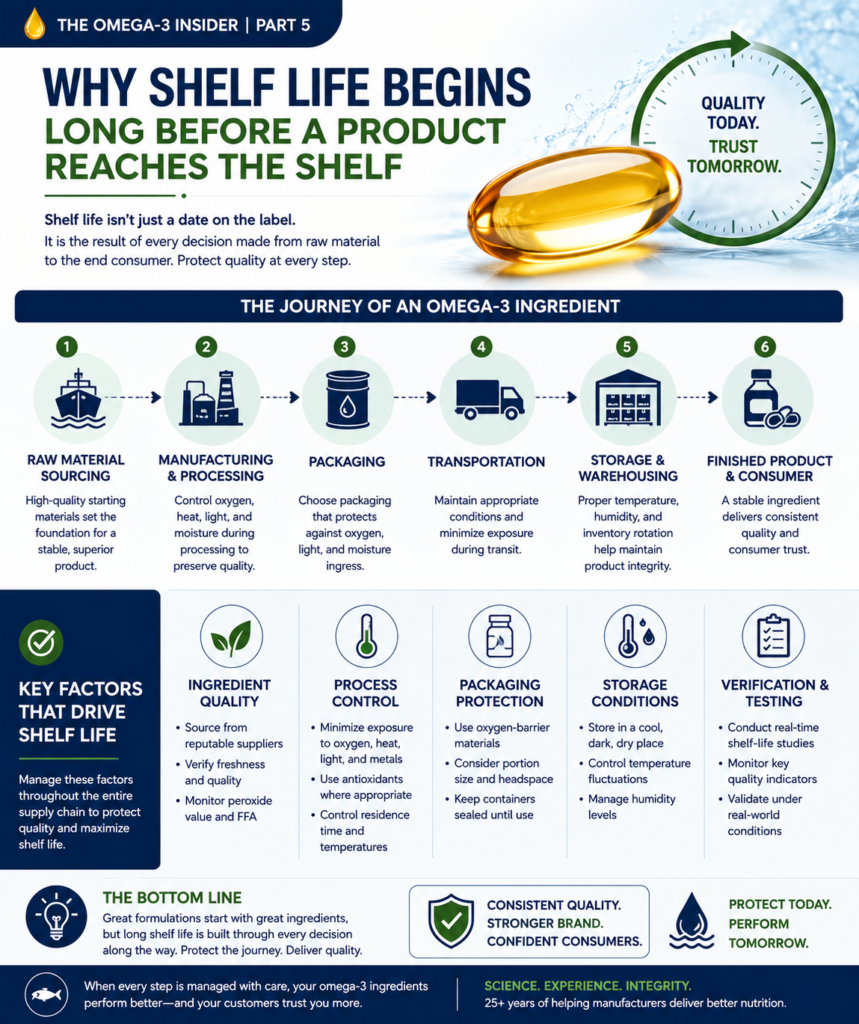
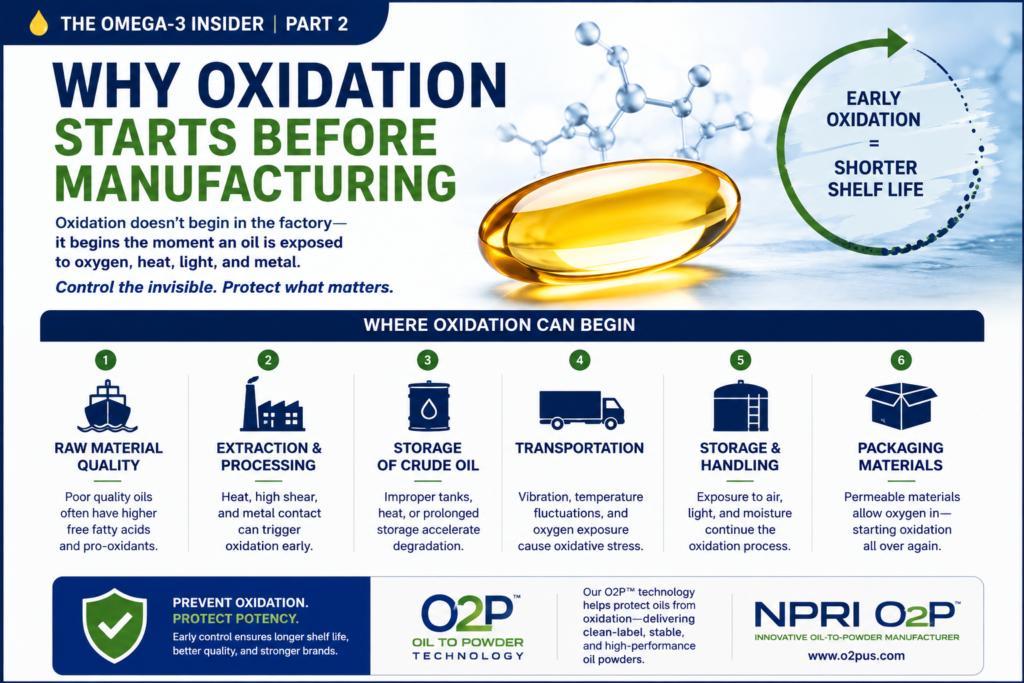
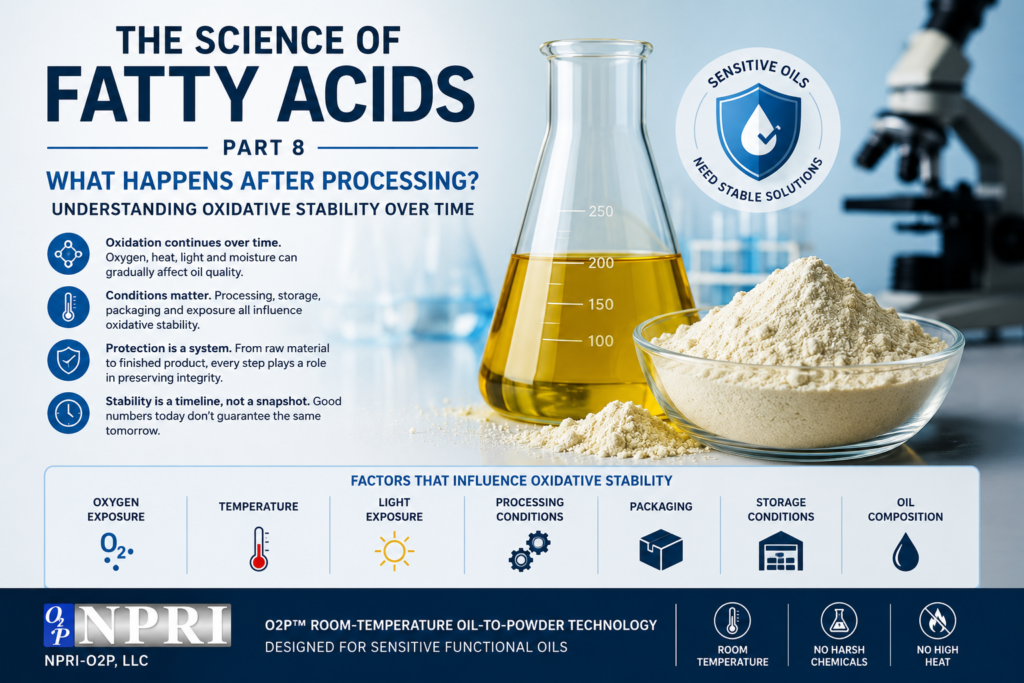
Why Shelf Life Begins Long Before a Product Reaches the Shelf
How O2P™ Technology Protects Oils from Oxidation
Shelf life begins long before a finished product reaches the consumer. Learn how raw material quality, manufacturing, packaging, storage, and transportation all contribute to product stability and long-term performance.
Oxidation begins long before oils reach the manufacturing line. Learn how raw material quality, processing, storage, transportation, and oxygen exposure can silently reduce stability, potency, and shelf life.
Explore why oxidative stability is a timeline—not a snapshot—and how oxygen, temperature, light, processing, packaging, and storage can influence the long-term integrity of sensitive functional oils.
