
The Science of Fatty Acids – Part 7: How Do We Measure Lipid Oxidation?
In Parts 1–6 of this series, we explored fatty-acid structure, the importance of double bonds, the lipid oxidation chain reaction, and how processing conditions can influence the stability of functional oils and oil powders.
Understanding oxidation, however, raises another important question:
How do we actually measure it?
Oxidation is not a single event. It is a progression involving the formation and eventual breakdown of several different chemical compounds. Consequently, no single analytical measurement necessarily tells the entire story.
Three measurements are particularly useful when evaluating many functional oils: Peroxide Value (PV), p-Anisidine Value (p-AV), and TOTOX Value.
Peroxide Value: Measuring Primary Oxidation
During the early stages of lipid oxidation, reactions involving unsaturated fatty acids and oxygen produce compounds known as hydroperoxides.
Peroxide Value measures these primary oxidation products and is therefore commonly used as an indicator of early-stage oxidative deterioration.
Generally, a low PV indicates relatively low concentrations of hydroperoxides.
But there is an important limitation.
Hydroperoxides are themselves unstable. As oxidation progresses, they can decompose into secondary oxidation products. Consequently, PV may initially rise and later decline even though the oil has continued to deteriorate.
This means that a low Peroxide Value does not automatically prove that an oil has never undergone significant oxidation.
The analytical result must be interpreted in context.
p-Anisidine Value: Looking at Secondary Oxidation
As hydroperoxides decompose, they form secondary oxidation products, including aldehydes.
These compounds are particularly important because many contribute to the undesirable odors and flavors associated with oxidized or rancid oils.
The p-Anisidine Value (p-AV) provides an indication of certain secondary oxidation products, particularly aldehydic compounds.
PV and p-AV therefore examine different stages of the oxidative process:
PV primarily reflects earlier oxidation, while p-AV provides information about later-stage decomposition products.
Using the two measurements together can provide a more informative picture than relying on either measurement alone.
TOTOX: Combining the Two Perspectives
Because primary and secondary oxidation occur as part of the same continuing process, the Total Oxidation Value, or TOTOX, combines PV and p-AV into a single calculated indicator.
The commonly used calculation is:
TOTOX = (2 × PV) + p-AV
Why multiply PV by two?
The calculation gives additional weighting to primary oxidation while incorporating secondary oxidation into the overall assessment.
TOTOX can therefore provide a broader indication of an oil’s oxidative condition than either PV or p-AV considered independently.
However, TOTOX should still be interpreted alongside the nature of the oil, its processing history, specifications and intended application.
Why One Test Is Rarely Enough
Consider two hypothetical oils.
Oil A may have a relatively elevated PV but a low p-AV, suggesting that primary oxidation has begun but relatively few secondary products have accumulated.
Oil B could have a comparatively low PV but a high p-AV. That situation could indicate that hydroperoxides have already decomposed into secondary oxidation products.
Looking only at PV might make Oil B appear to be in better condition.
Looking at the broader analytical picture tells a different story.
This illustrates an important principle in lipid chemistry:
Oxidative stability cannot always be represented adequately by a single number.
Other Analytical Tools
Depending on the oil and application, laboratories may use additional analytical techniques to evaluate oxidative condition and stability.
These can include measurements such as UV absorbance, specific aldehyde analysis, accelerated oxidation testing and other methods appropriate to the particular lipid system.
Sensory evaluation can also provide useful information because oxidative deterioration may eventually produce recognizable changes in aroma and flavor.
The appropriate testing program depends on the oil, its fatty-acid composition, processing history, intended application and applicable quality specifications.
Measurement and Prevention Work Together
Analytical testing tells us about the condition of an oil.
Processing strategy helps determine how that oil reaches that condition.
For oxidation-sensitive functional oils—particularly oils rich in EPA, DHA and other polyunsaturated fatty acids—attention should be given throughout the ingredient’s lifecycle to oxygen exposure, temperature, light, storage, packaging and processing conditions.
At NPRI-O2P, this philosophy is incorporated into our proprietary O2P™ room-temperature oil-to-powder process, designed to transform functional oils into stable, free-flowing powders without introducing unnecessary high-temperature processing.
Testing and processing therefore serve complementary purposes:
Processing seeks to protect quality. Analytical testing helps us understand and verify it.
The Takeaway
Peroxide Value, p-Anisidine Value and TOTOX each provide a different perspective on lipid oxidation.
PV helps evaluate primary oxidation.
p-AV helps evaluate certain secondary oxidation products.
TOTOX combines both measurements to provide a broader indication of overall oxidative condition.
Understanding what these measurements mean—and equally important, what they do not mean—allows formulators and manufacturers to make better decisions when evaluating functional oils and oil-based ingredients.
Because when dealing with oxidation-sensitive lipids, quality should not simply be assumed. It should be understood, controlled and measured.
Next in the series — Part 8: Antioxidants and Oxidative Protection: How Tocopherols Help Protect Sensitive Oils
NPRI-O2P, LLC | O2P™ Oil Powder Technology | Las Vegas, Nevada
Need Help With Your Formulation?
Whether you’re developing a new oil powder, improving product stability, or solving formulation challenges, our technical team is ready to help. Contact us for formulation guidance, product recommendations, or sample requests.
Recommended Technical Articles
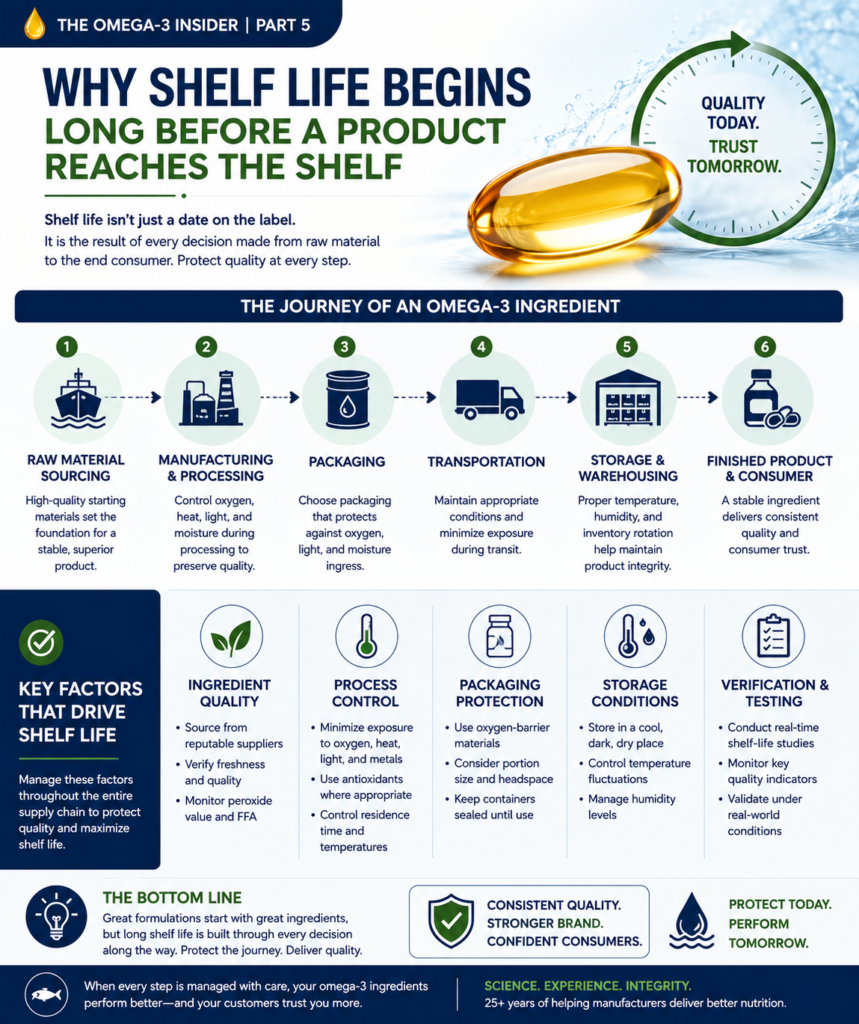
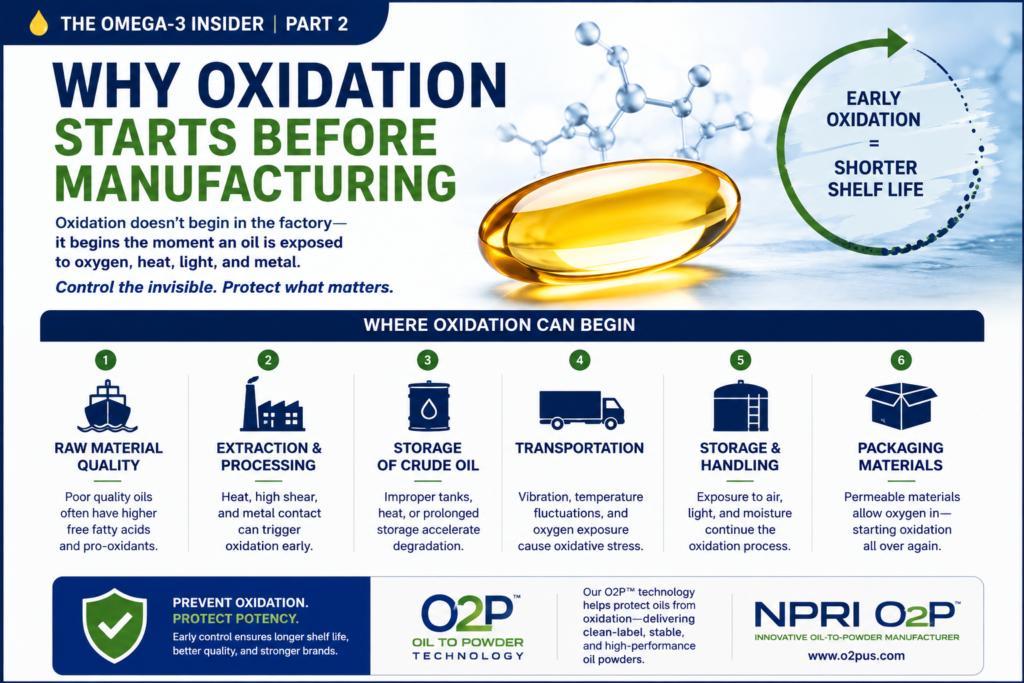
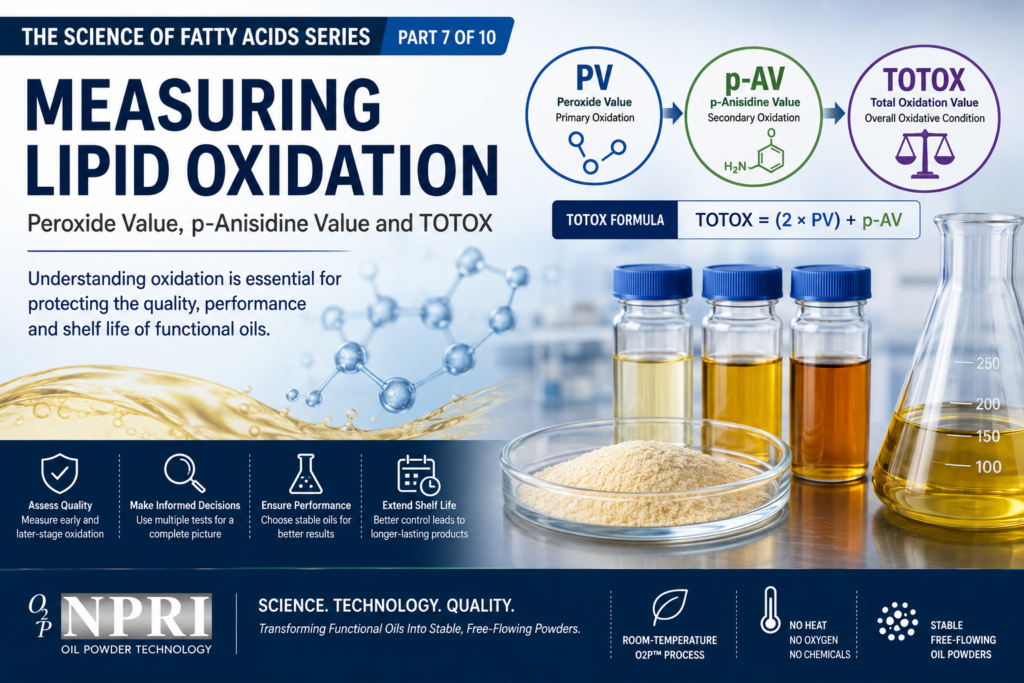
Why Shelf Life Begins Long Before a Product Reaches the Shelf
How O2P™ Technology Protects Oils from Oxidation
Shelf life begins long before a finished product reaches the consumer. Learn how raw material quality, manufacturing, packaging, storage, and transportation all contribute to product stability and long-term performance.
Oxidation begins long before oils reach the manufacturing line. Learn how raw material quality, processing, storage, transportation, and oxygen exposure can silently reduce stability, potency, and shelf life.
Learn how Peroxide Value (PV), p-Anisidine Value (p-AV), and TOTOX are used to evaluate primary and secondary lipid oxidation—and why multiple measurements provide a more complete picture of functional oil quality and stability.
