
The Science of Fatty Acids – Part 3: What Happens When Oils Oxidize?
In Part 2 of our Science of Fatty Acids series, we examined why double bonds make unsaturated fatty acids increasingly susceptible to oxidation.
That explains why certain oils are vulnerable.
The next question is:
What actually happens when oxidation begins?
Lipid oxidation is more complex than oil simply coming into contact with oxygen. Once initiated, oxidation can develop into a self-propagating series of chemical reactions known as a free-radical chain reaction.
Understanding this process is particularly important when working with highly unsaturated nutritional oils such as EPA and DHA.
Oxidation Is a Chain Reaction
Lipid oxidation is commonly described through three fundamental stages:
Initiation → Propagation → Termination
During this process, primary oxidation products are formed and can subsequently decompose into secondary oxidation products.
These reactions can ultimately affect an oil’s sensory characteristics, nutritional quality, stability and shelf life.
Let’s examine the process step by step.
Stage 1: Initiation — Where Oxidation Begins
Oxidation begins when a hydrogen atom is removed from a fatty-acid molecule.
This creates a highly reactive molecule known as a lipid radical.
In simplified form:
LH → L•
where LH represents the fatty acid and L• represents the resulting lipid radical.
Conditions that can contribute to the initiation of oxidation include:
- Heat
- Light, particularly ultraviolet light
- Exposure to oxygen
- Certain metal ions such as iron and copper
- Existing reactive compounds within the oil
Highly unsaturated fatty acids are particularly vulnerable because their molecular structures provide sites where hydrogen removal can occur more readily.
This is one reason EPA, with five double bonds, and DHA, with six, require careful protection during processing and storage.
Stage 2: Propagation — The Chain Reaction Begins
Once the lipid radical has formed, it can react rapidly with molecular oxygen.
This produces a lipid peroxyl radical:
L• + O₂ → LOO•
The peroxyl radical can then remove hydrogen from another fatty-acid molecule.
This produces a lipid hydroperoxide and, importantly, another lipid radical:
LOO• + LH → LOOH + L•
That newly created radical can react with oxygen again.
The process repeats.
This is why lipid oxidation is described as a chain reaction.
Once initiated, the reaction can propagate from one fatty-acid molecule to another.
Primary Oxidation Products: Hydroperoxides
Lipid hydroperoxides are among the principal primary products formed during oxidation.
At this stage, an important phenomenon may occur.
The oil can already be undergoing significant chemical oxidation without necessarily producing an obvious rancid odor.
In other words:
Oxidation can begin before deterioration becomes obvious to the senses.
This is one reason sensory evaluation alone may not provide a complete picture of oxidative stability.
Hydroperoxides are also relatively unstable compounds.
Eventually, they begin to decompose.
And that leads to another important stage in oxidative deterioration.
Hydroperoxide Decomposition
As lipid hydroperoxides break down, they can generate additional radicals and a variety of secondary oxidation compounds.
The rate and pathways of decomposition can be influenced by factors such as:
- Temperature
- Light
- Metal ions
- Fatty-acid composition
- Antioxidant systems
- Oxygen availability
- Storage conditions
The decomposition of hydroperoxides is particularly important because it leads to many of the compounds commonly associated with deteriorated oils.
Secondary Oxidation Products
Secondary oxidation can produce numerous compounds, including:
- Aldehydes
- Ketones
- Alcohols
- Hydrocarbons
- Organic acids
- Other volatile and nonvolatile compounds
Some of these compounds can have very strong sensory characteristics even at relatively low concentrations.
This is where manufacturers may begin to notice familiar signs of lipid deterioration:
Off-odors.
Off-flavors.
Changes in sensory quality.
But by the time these characteristics become obvious, oxidation may already have progressed considerably.
Stage 3: Termination — Ending the Radical Chain
The chain reaction does not continue indefinitely.
Eventually, two radicals can react with one another and form a more stable, non-radical product.
For example:
L• + L• → L–L
or
LOO• + L• → non-radical products
This is known as termination.
However, termination of individual radical reactions does not necessarily mean that the oil returns to its original condition.
Oxidation products that have already formed remain present, and new radical reactions may begin if conditions continue to promote oxidation.
Why Oxidation Matters Beyond Rancidity
Oxidation is sometimes viewed primarily as a flavor or odor problem.
For manufacturers of nutritional products, however, the implications are broader.
Oxidative deterioration may affect:
Sensory quality
Unpleasant odors and flavors can reduce consumer acceptance.
Nutritional quality
Sensitive fatty acids can deteriorate as oxidation progresses.
Ingredient consistency
Oxidative changes may contribute to variability during storage.
Finished-product stability
Oxidation can continue after an ingredient has been incorporated into the final formulation.
Shelf life
Increasing oxidation can ultimately shorten the period during which a product maintains its intended quality.
This is why oxidation control should be considered throughout the entire product lifecycle—from raw material handling through processing, packaging, storage and final consumption.
Why EPA and DHA Require Particular Attention
As discussed in Part 2, the susceptibility of fatty acids to oxidation generally increases with increasing unsaturation.
EPA contains five double bonds.
DHA contains six.
These highly unsaturated structures contribute to their nutritional and biological importance, but they also make EPA and DHA particularly susceptible to oxidative deterioration.
Protecting Omega-3 oils therefore requires more than beginning with high-quality oil.
Manufacturers must also consider what happens to that oil after it enters the manufacturing process.
Processing Is Part of the Oxidation Equation
Every processing step creates an environment in which an oil must maintain its integrity.
Depending upon the process, an oil may encounter:
- Oxygen
- Elevated temperature
- Light
- Moisture
- Mechanical processing
- Extended holding times
- Contact with other ingredients
For sensitive oils, these conditions deserve careful consideration.
The question is not simply:
Can this oil be converted into a powder?
A more important question is:
What happens to the oil while it is being converted into that powder?
The O2P™ Approach
NPRI-O2P developed its proprietary O2P™ Oil-to-Powder technology around the principle that sensitive oils should be handled as gently as practical during conversion.
Unlike conventional spray drying, O2P™ does not rely on high-temperature drying to convert the oil into powder.
The proprietary process operates at room temperature and is designed to minimize exposure of sensitive oils to conditions that can promote oxidation during processing.
The resulting powders provide manufacturers with a practical way to incorporate functional oils into applications where handling, stability and water dispersibility are important.
For highly unsaturated oils such as Omega-3s, this approach becomes especially relevant.
The more oxidation-sensitive the starting oil, the more important the processing environment becomes.
Protecting What Makes the Oil Valuable
EPA, DHA and other polyunsaturated fatty acids are selected because of their nutritional value.
Their molecular structures provide important functionality—but those same structures also make them susceptible to oxidative deterioration.
Understanding the oxidation chain reaction therefore leads to an important principle:
Protecting an oil is not simply about preventing rancidity.
It is about helping preserve the quality and nutritional characteristics that made the oil valuable in the first place.
From ingredient selection to processing, packaging and storage, managing oxidation should be considered an essential part of developing products containing sensitive nutritional oils.
At NPRI-O2P, that philosophy can be summarized simply:
Protect the oil. Protect the nutrition. Protect the value.
Coming Next — Part 4
Primary vs. Secondary Oxidation: What Peroxide Value, Anisidine Value and TOTOX Can Tell Us
In Part 4 of The Science of Fatty Acids, we will examine how oxidation is measured and why relying on a single analytical measurement may not tell the complete story of an oil’s oxidative condition.
NPRI-O2P, LLC | O2P™ Oil-to-Powder Technology
Stabilizing Nature. Delivering Nutrition.
Need Help With Your Formulation?
Whether you’re developing a new oil powder, improving product stability, or solving formulation challenges, our technical team is ready to help. Contact us for formulation guidance, product recommendations, or sample requests.
Recommended Technical Articles
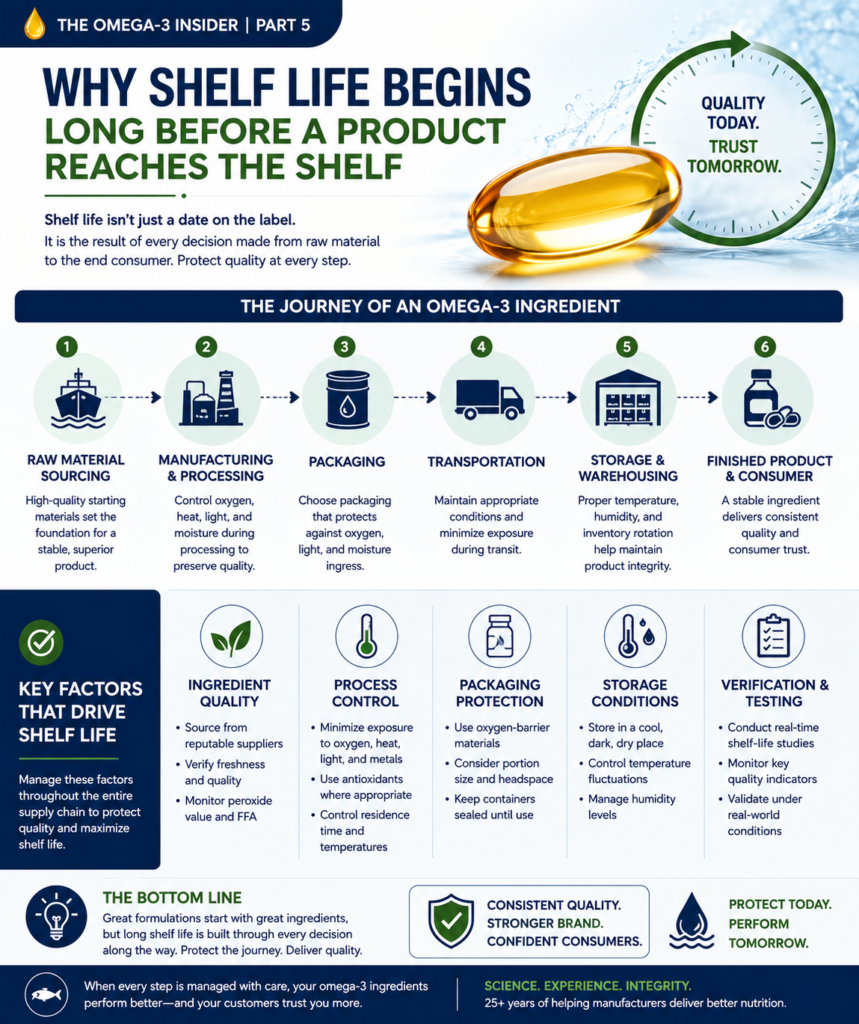
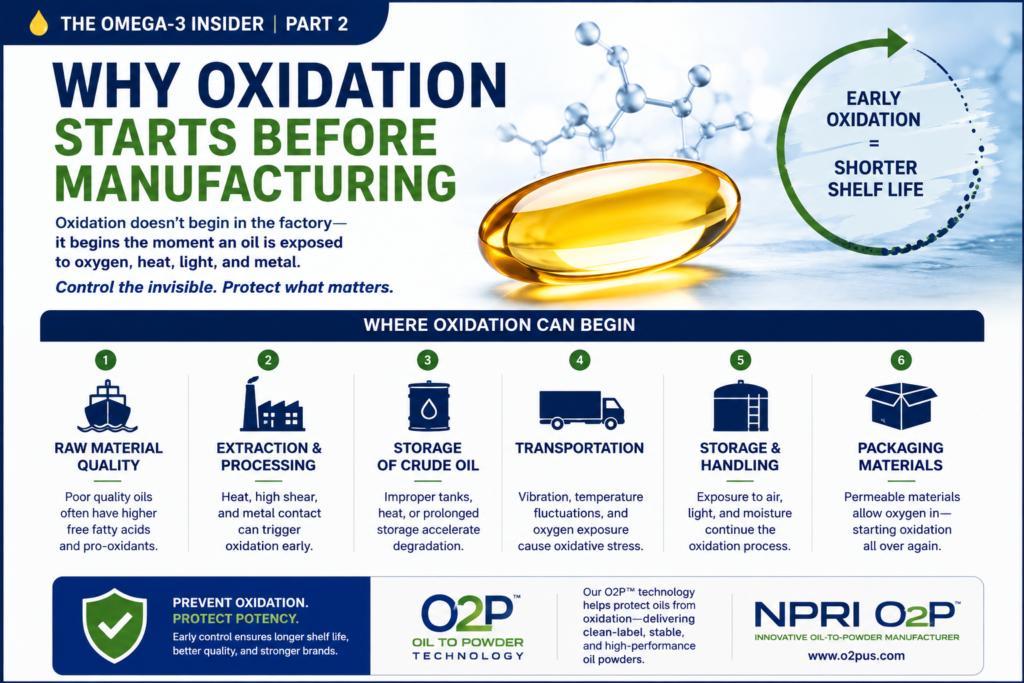
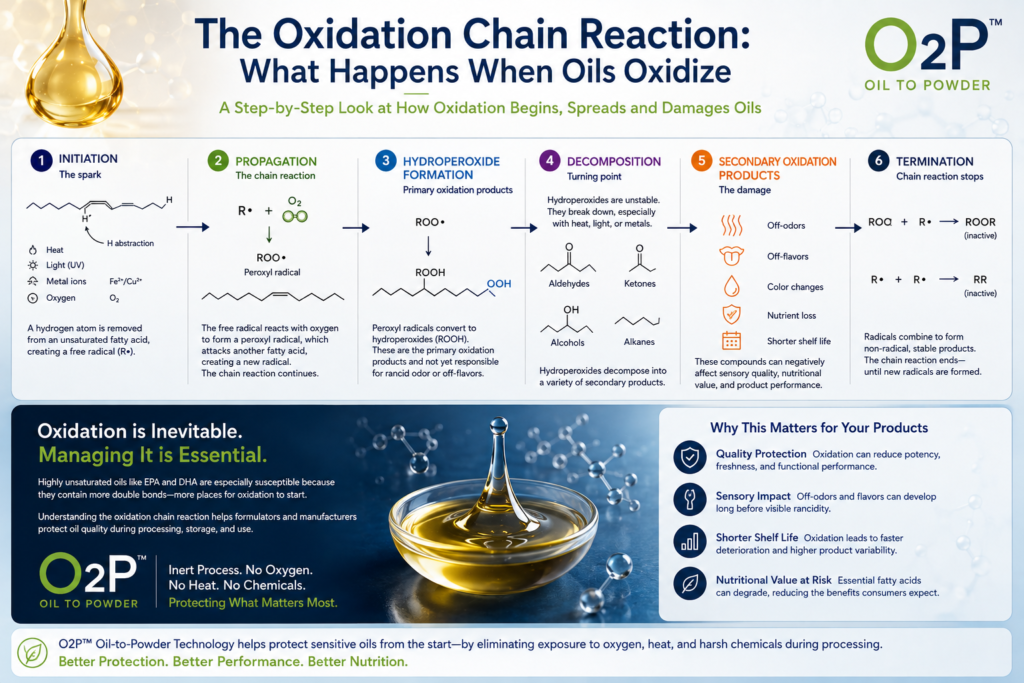
Why Shelf Life Begins Long Before a Product Reaches the Shelf
How O2P™ Technology Protects Oils from Oxidation
Shelf life begins long before a finished product reaches the consumer. Learn how raw material quality, manufacturing, packaging, storage, and transportation all contribute to product stability and long-term performance.
Oxidation begins long before oils reach the manufacturing line. Learn how raw material quality, processing, storage, transportation, and oxygen exposure can silently reduce stability, potency, and shelf life.
Learn how lipid oxidation begins, propagates, and produces compounds that can affect oil quality, nutritional value, sensory characteristics, and shelf life.
