
The Science of Fatty Acids – Part 2: Why Double Bonds Make Oils More Vulnerable to Oxidation
In Part 1 of our Science of Fatty Acids series, we examined the fundamental structural differences between saturated, monounsaturated, and polyunsaturated fatty acids.
Those structural differences influence many of the physical, nutritional, and functional characteristics of fats and oils.
They also influence something particularly important to ingredient manufacturers and formulators:
oxidative stability.
Understanding why certain oils oxidize more readily than others begins at the molecular level—with the presence and number of carbon-carbon double bonds.
Saturation and Oxidative Stability
Fatty acids consist primarily of chains of carbon and hydrogen atoms.
In a saturated fatty acid, the carbon chain contains no carbon-carbon double bonds.
A monounsaturated fatty acid (MUFA) contains one carbon-carbon double bond.
A polyunsaturated fatty acid (PUFA) contains two or more.
This distinction may appear relatively small on paper, but it has major consequences for the chemical stability of an oil.
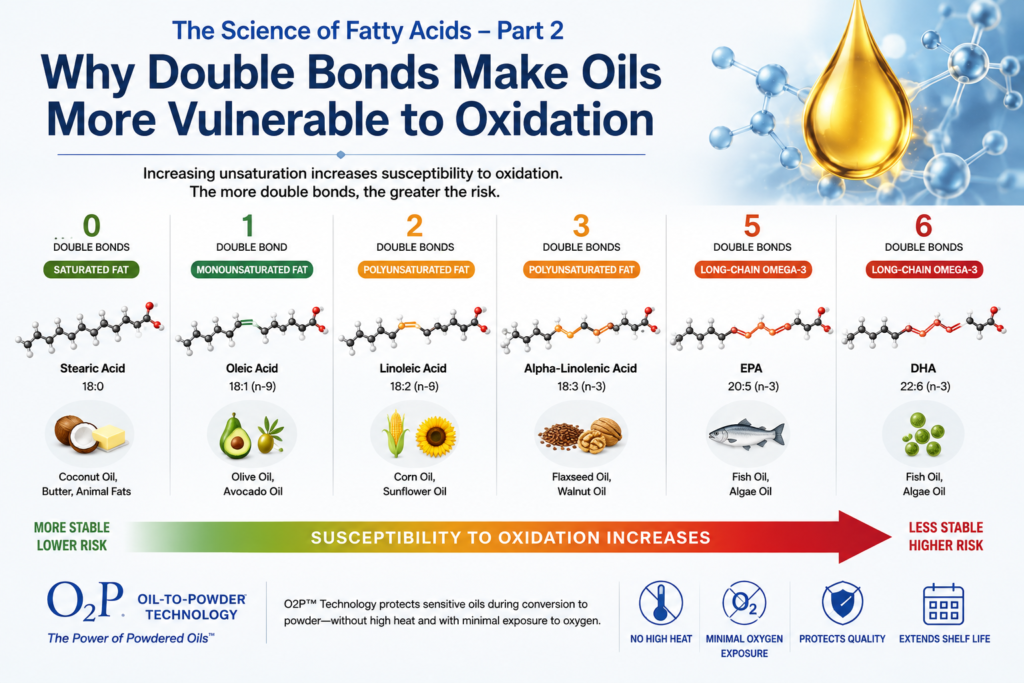
In general, increasing unsaturation increases susceptibility to lipid oxidation.
Consequently, oils containing large amounts of polyunsaturated fatty acids require greater attention to processing, handling, packaging, and storage conditions than fats dominated by saturated fatty acids.
Why Do Double Bonds Matter?
The presence of double bonds changes the electronic and structural characteristics of the fatty-acid molecule.
Particularly important are hydrogen atoms located at positions adjacent to double bonds. In polyunsaturated fatty acids, certain hydrogen atoms—especially those associated with bis-allylic positions between double bonds—can be relatively susceptible to abstraction.
This can initiate a sequence of reactions known as lipid autoxidation.
In simplified terms:
Unsaturated lipid → lipid radical → reaction with oxygen → peroxide radical → lipid hydroperoxide
The process does not necessarily stop there.
Once initiated, oxidation can propagate as a chain reaction, creating additional reactive species and oxidation products.
This is why controlling the conditions that promote oxidation is so important when handling highly unsaturated oils.
Not All Fatty Acids Have the Same Vulnerability
Consider several familiar fatty acids:
Stearic acid (18:0)
No double bonds.
Oleic acid (18:1)
One double bond.
Linoleic acid (18:2)
Two double bonds.
Alpha-linolenic acid (18:3)
Three double bonds.
EPA (20:5)
Five double bonds.
DHA (22:6)
Six double bonds.
As we move toward highly polyunsaturated fatty acids such as EPA and DHA, the molecular structure becomes increasingly susceptible to oxidative reactions.
This presents an interesting paradox.
EPA and DHA are valued precisely because of their unique structures and nutritional functions. Yet those same highly unsaturated structures make them challenging ingredients to protect.
DHA: Nutritionally Valuable—and Chemically Sensitive
DHA, or docosahexaenoic acid, is a long-chain omega-3 fatty acid containing 22 carbon atoms and six double bonds.
Its high degree of unsaturation contributes to DHA’s biological functionality.
But from an ingredient-stability perspective, those six double bonds also mean that DHA-rich oils require careful handling.
Exposure to factors that promote oxidation can compromise oil quality.
These factors can include:
- Oxygen
- Elevated temperature
- Light
- Certain metal ions and other pro-oxidants
- Large exposed surface area
- Extended storage under unfavorable conditions
For manufacturers, therefore, preserving a sensitive oil isn’t simply a matter of selecting a high-quality raw material.
What happens to that oil during processing matters as well.
What Happens When Lipid Oxidation Begins?
Lipid oxidation is not a single event.
It is a sequence of chemical reactions generally described in three broad stages:
1. Initiation
A reactive lipid species is formed, creating the conditions for oxidation to begin.
2. Propagation
The lipid radical reacts with oxygen, producing reactive intermediates capable of attacking additional lipid molecules. The reaction can therefore propagate through the material.
3. Termination
Reactive radicals eventually combine or are otherwise quenched, interrupting the chain reaction.
During this process, primary oxidation products—particularly lipid hydroperoxides—can form.
These compounds can subsequently decompose into secondary oxidation products, including various aldehydes, ketones, and other volatile compounds.
These secondary products are often associated with the characteristic undesirable odors and flavors of oxidized oils.
We will examine this process more closely in Part 3 of this series.
Processing Conditions Matter
The oxidative stability of an oil is influenced by much more than its fatty-acid composition.
Temperature, oxygen availability, light exposure, antioxidant systems, trace metals, moisture conditions, packaging, and storage all can influence oxidation.
Processing technology therefore becomes part of the stability equation.
For oxidation-sensitive oils, manufacturers should consider not only:
“What is the fatty-acid profile of this oil?”
but also:
“What conditions will this oil experience while being transformed into the finished ingredient?”
That distinction is particularly relevant when converting liquid oils into powdered ingredients.
The O2P™ Approach
At NPRI-O2P, our work with omega-3 and other specialty oils has been built around a simple principle:
Protect the oil while transforming its physical form.
O2P™ Oil-to-Powder Technology converts liquid oils into free-flowing powders using a process designed to avoid high-temperature treatment during the conversion step and minimize exposure to oxygen.
This is particularly relevant for highly unsaturated oils such as those containing EPA and DHA.
Rather than viewing oxidation protection only as a storage issue, we believe protection should be considered throughout the ingredient’s journey—from the original oil through processing and into the final powdered form.
Understanding Structure Helps Us Protect Function
The chemistry of fatty acids helps explain why some oils are inherently more difficult to stabilize than others.
Saturated fatty acids contain no double bonds.
Monounsaturated fatty acids contain one.
Polyunsaturated fatty acids contain multiple double bonds—and highly unsaturated omega-3 fatty acids such as EPA and DHA contain many.
Those differences influence oxidative susceptibility and help explain why processing conditions are so important when working with sensitive oils.
The lesson is straightforward:
The greater the degree of unsaturation, the greater the need to consider oxidation protection.
Understanding that relationship allows formulators and manufacturers to make better decisions about ingredient selection, processing, storage, and finished-product design.
Coming Next — Part 3
The Science of Fatty Acids – Part 3: What Happens When Oils Oxidize?
We’ll examine lipid hydroperoxides, primary and secondary oxidation, rancidity, sensory deterioration, and why oxidation can affect the useful life and quality of an oil-based ingredient.
Need Help With Your Formulation?
Whether you’re developing a new oil powder, improving product stability, or solving formulation challenges, our technical team is ready to help. Contact us for formulation guidance, product recommendations, or sample requests.
Recommended Technical Articles
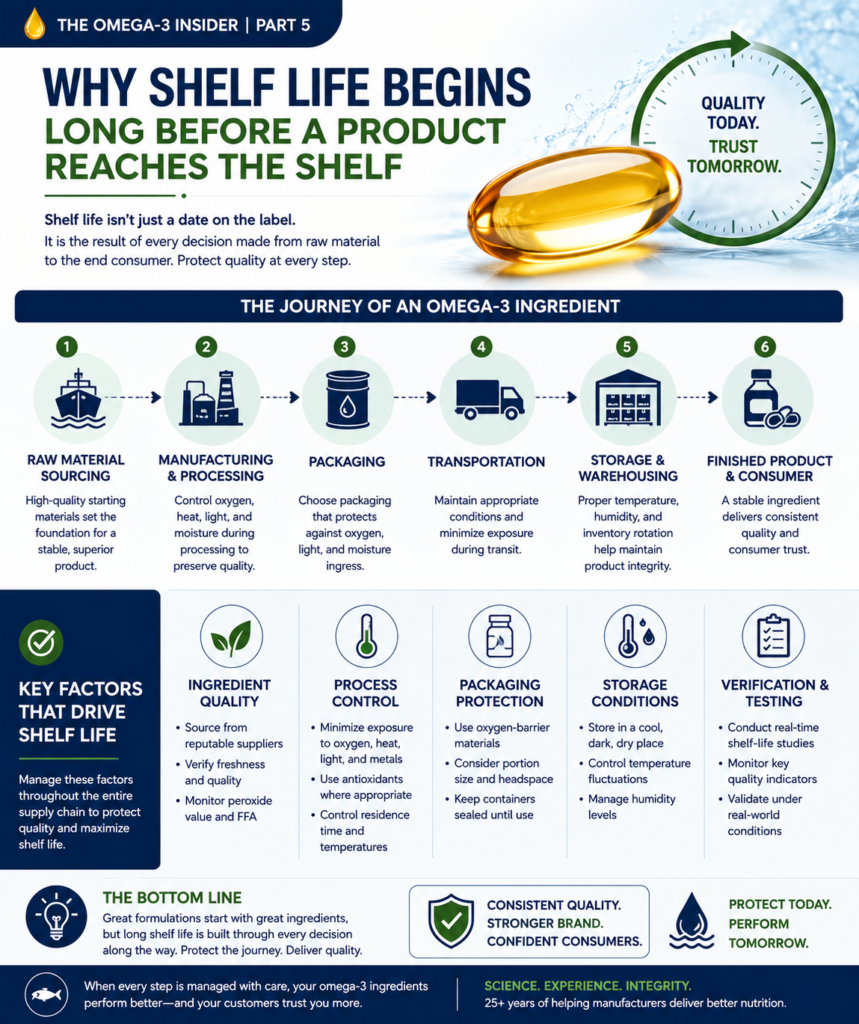
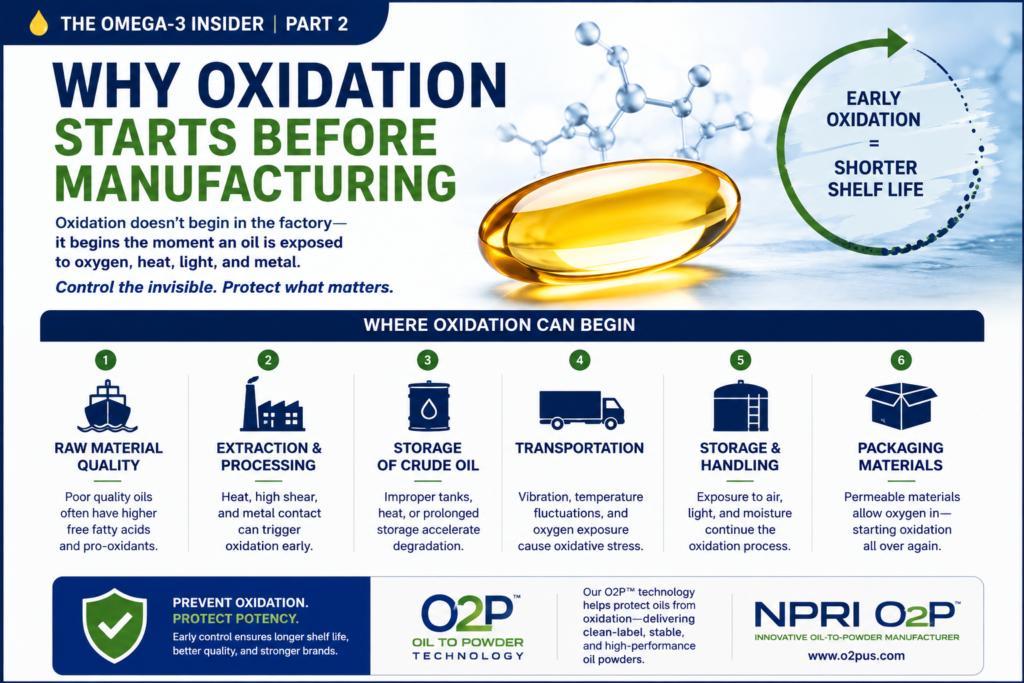
Why Shelf Life Begins Long Before a Product Reaches the Shelf
How O2P™ Technology Protects Oils from Oxidation
Shelf life begins long before a finished product reaches the consumer. Learn how raw material quality, manufacturing, packaging, storage, and transportation all contribute to product stability and long-term performance.
Oxidation begins long before oils reach the manufacturing line. Learn how raw material quality, processing, storage, transportation, and oxygen exposure can silently reduce stability, potency, and shelf life.
Discover how the three major types of fatty acids differ and why their chemical structure affects stability, nutrition, and product performance.
